

Welcome to Finnbrit 100! In each pop-up box you will find an item such as a unique memory, photograph, article, event, or fact about our journey since 1926. New content will be released in batches—so come back regularly and enjoy stories that have helped build a century of friendship between Finland and Britain.
Welcome to Finnbrit 100

Celebrating the 100th anniversary of the Finnish-British Society Helsinki, we honour a century of friendship, cultural exchange, and lasting connections. This history is built on the dedication of countless volunteers and employees whose commitment and enthusiasm have kept the Society vibrant and relevant through changing times.
Through the years, language learning and shared experiences have gone hand in hand at Finnbrit. The Finnbrit Language Centre’s courses and examinations provide practical skills and certifications, while the Society’s cultural and social activities create a space where these skills can be used, friendships can form, and perspectives can widen. Together, they support personal and professional growth and reflect our commitment to inclusivity.
As the Chair of the Council, I extend my heartfelt thanks to all who have contributed to our journey so far and invite you to join us in looking forward to the next hundred years.
To all our members, clients, learners and the wider public, we welcome you all to an exciting range of events and activities that are being planned for 2026, our anniversary year.
Niina Lemettilä, Chair of the Council
Finnbrit 1/100

The Finnbrit 100 logo

The Finnbrit 100 logo is designed by Sam Schumacher (pictured below on the left). You will have seen more of his work on the wall of the Club Room (see Finnbrit 4/100). There is another piece by Sam permanently on display in the Fredrikinkatu premises. If you have not found it yet, ask a member the next time you visit.
Thank you, Sam, for creating this fantastic and memorable image that will be featured throughout the year.

Finnbrit 2/100
“Hidden agendas of Finnish-British parliamentary relations in the 20th century” – a talk by Gunilla Carlander

Friday, 16 January 2026
18:00-20:00
Venue: Finnbrit
During the 20th century, meetings between parliamentarians from different countries developed into a new way for politicians to gather information, observe developments and get to know political realities in other countries. Finland was the first country in the world to give women full political rights. This happened in 1906, the same year that the Finnish “parliament” (Diet of Four Estates) received its first invitation to an international congress from the British Parliament in London. The British Parliament was also the only Western parliament that was interested in regular parliamentary contacts with Finland after the Second World War. Why was the UK Parliament interested in Finland? Was there a hidden agenda behind these British initiatives?
Gunilla Carlander, who worked in the Finnish Parliament for over 30 years, is currently studying the history of Finnish parliamentary diplomacy.
Picture By Signe Brander – Finna: hkm.HKMS000005:km00320sImage record page in Finna: hkm.D18DF20B-2125-4CB3-9878-BE06A2626C02, CC BY 4.0, https://commons.wikimedia.org/w/index.php?curid=68464569
Finnbrit 3/100
“Paired Path” by Sam Schumacher

This painting by Sam Schumacher has been part of the Club Room since the young artist gifted it to Finnbrit in 2023. It has found its place even more so after the renovation, and the new dramatic colour scheme of the room. It has been described as an example of naïve art, which is not a bad thing at all, in these turbulent and testing times. We think Sam’s artwork is a perfect fit for our Club Room, alongside the portraits of the former Chairpersons of the Society.
Finnbrit 4/100
A new look for Finnbrit


In preparation for our 100th anniversary, the Finnbrit premises underwent a stylish renovation in 2025. Guided by the Council of the Finnish-British Society and enriched by input from customers, staff and members, planning began in 2024, and the work took place during the summer of 2025.
A heartfelt thank you goes to IDEAA and Poutaworks for the interior design—inspired by the history of the Society yet with one eye on the future. We also extend our gratitude to Remoc Oy for the renovation work, Eurokangas for the carpets and blinds, Futra for the furniture, Muuttokarhut for their removal services, and Imoon Finland for the elegant lighting that brings everything together. Here are some photographs taken before and after the refurbishment.


The refreshed spaces not only have more character than ever, but they also provide the practical functionalities the Society needs as it continues its activities in the heart of Helsinki.
We cannot wait to welcome you to our renewed premises. Come and see them for yourself!
Finnbrit 5/100
Founding documents

Finnbrit’s history is something we will be returning to many times during our year of celebration. Item number 6 of Finnbrit 100 is the documentation that covers the birth of the Finnish-British Society, or Suomalais-Englantilainen Yhdistys (“Anglo-Finnish Society”) as it was initially called.
Follow this link to the historical founding documents of the Finnish-British Society r.y. The documents are in Finnish.
Finnbrit 6/100
The Stuff the North is Made of
by Donald Adamson
When I arrived in Helsinki in 1968 it seemed not-quite-real … dreamlike… a simulacrum of somewhere I’d lived in a previous life. But the big displacement shock came when I took the train through the dark night, through deep forests, to my Finn-Brit post in Rauma. I had no notion of changing trains until the conductor found me waiting in a deserted carriage in Tampere and communicated (in German) to hurry before the Pori train left. Then… a change of trains again in PEIPOHJA – a real place but, as it seemed then, the most isolated spot on this planet, or some other planet (I say sorry now to my friend Rea who comes from there and speaks up for it – I’ve since learned better). Anyway, I got to Rauma, and learned, in time, to appreciate the town, and the lovely people I met and the pupils in the schools, who were indulgent to my callow opinions and inexperience.
The Stuff the North is Made of
I couldn’t believe my eyes –
summer still, tree-lined boulevards
under bright skies, a waking dream
of the south. It was like some place I had been to
(though when?) completely changed
with words, signs, letters, meaningless
scrambled all ways, piled
confusedly, like the coins minted
by the Britons, after the Romans left.
Real enough it felt. Yet wrong:
sibling to a memory constructed
from less than air, a swirling, spinning fog
like in Tarkovsky’s Solaris,
creature-like, sculpting what the mind
in sleep or in a daydream tries to mould
out of what was planted in a person
at time of birth. And surely it was waiting
to seize me when I peered
out of the train window and half knew
that now, from this day on
my life would have a counterpart in that
never-ending – forest was it? That
or some other indefinable thing
that hasn’t got a scientific name,
the dark primordial, elemental stuff
the north is made of.

Donald Adamson
Finnbrit 7/100
The Secrets of the Finnbrit Archive
by Janne Mäkelä
Strictly confidential
In 2025, I was given the opportunity to reorganise the Finnbrit archives. Being an archive expert and a researcher of cultural history, I thought that something interesting might eventually come up. It happened sooner than I expected.
On just the second day of the project, a letter caught my eye. This five-page letter was sent to the office of the Finnish-British Society on October 2, 1952.

The title of the letter was: 1st report on English language teaching at the Wärtsilä-Sellulosa English Club – Äänekoski – Finland. The ‘Introduction,’ gave some context: Äänekoski has never had an English Club before […] the Club has been started for the benefit of the staff employees of the factory which is a paper mill. Nothing unusual there. The Finnish cellulose industry, paper mills and other companies were investing in English language teaching during the post-war period.
What really caught my eye were two words at the top of the first page: strictly confidential.
In the report, the writer provides an account of the accommodation, teaching premises and the students. Apparently, the teaching premises are quite modern. The Club Room contains a radiogram (combined radio and record player built into a cabinet with a speaker) and an epidiascope (a projector displaying books, journals and charts onto a screen), yet the writer seems to be slightly disappointed that there is “no evidence of a tape-recording machine”.
There are 60 students. Most of the men speak Swedish as their native language and are working in the factory as engineers, office managers, accountants and buyers. The women (or ‘girls’ as the writer calls them) are mostly native Finnish speakers and work as clerks and typists. Some classes are also held for the wives of the male staff.
As to the personalities of the students, the writer informs us that all “are practical and not exactly overburdened with imagination”. The wives like to read Daphne du Maurier and the men Agatha Christie and P. G. Wodehouse. The students’ level of English language varies: 23 are advanced, 21 are intermediate and 16 are beginners.
The writer has 19 teaching hours per week. Apparently, the students don’t talk spontaneously but that is just one problem among many other others. For example, the composition of the classes alters every day. Some office girls are quite advanced with English but, because of strict hierarchies, they are not supposed to work together with their superiors and are forced to attend the intermediate or beginner classes. Further on, the writer expresses some desperation, “Has anyone any tips on how to teach people English when they don’t know a word?”
There is still some hope: “There is one girl who speaks fluently who does not come to classes but who wishes to acquire an English accent instead of a New York one.”

I don’t know why this letter was labelled ‘strictly confidential’. The writer’s name was not mentioned anywhere, and the letter was unsigned. The mills were important customers for the Finnish-British Society. Perhaps the writer thought the issues were sensitive. Maybe the writer was a spy or just felt guilty: he or she was not speaking very kindly about the factory workers. Although the teacher was not too happy with the students’ language proficiency, he or she does not even bother to write the name of Wärtsilä’s owner or the city of Jyväskylä correctly!
Whatever the case, I find this letter fascinating. It has the vibe of a Klaus Härö film: a young teacher arrives in a remote town and is faced with many problems. It is an interesting account of how the English language started to triumph in Finland – not only as a language of culture but also as a language of business and trade.
Not such a chaotic collection
I started the archive project in mid-March 2025. The Äänekoski letter was in a folder that included incoming post from the 1950s. I scanned the letter, then slipped it back to the original folder and took a deep breath. There were a lot of folders, some with exact titles and well-organised contents; others were mysteries. Most of the folders had been stored in five large plastic boxes but we found more stashed away in the back room.


Time was limited so I did a quick inventory and decided to be as true as possible to the original order of the collection. That is usually the best archival principle if a collection proves to have a certain level of order in it which, in my opinion, the Finnbrit collection did. There were some messy elements, but it was not such a chaotic collection.
After completing the inventory, I classified the folders into categories and then started to deal with them one by one: I threw away all the old folder covers, all the plastic protection sleeves and all the metal paper clips. I had to leave the staples as there was no time to remove them. Plastic is especially bad: some of the 1990s’ Finnbrit paper documents stored in plastic sleeves were already quite corrupted – almost glued together.
Recent materials from the past 20 years or so were left out mainly because there was simply no time to go through them but also because most are in electronic format. During the last five days of the project, I placed all the documents back into folders – not the original folders but in the new archival acid-free folders. They are not as beautiful as the old ones but are perfect for long-term preservation. Then I wrote an archive list. I must admit, the list could have been more detailed, but I can promise that the collection is now easier to use for anyone interested in the history of the Society.

Founding members – some Very Important People
The Society held its inaugural meeting on 15th April 1926. The main person behind the task was businessman and anglophile Jaakko Kahma, who invited 42 people including university professors, politicians, statesmen, clergy and businessmen to the meeting. The first patron of the Society was General Mannerheim, later Marshal and President of Finland. The Society was officially registered in 1930 and members included Risto Ryti who later became Honorary President of the Society and President of Finland. His wife, Gerda Ryti, was at one time vice-chairperson of the Society. Other members included newspaper publisher Eljas Erkko (council member) and the writer, Ester Ståhlberg, wife of former president Kaarlo Juho Ståhlberg.

The Society’s early activities included talks, discussion groups, table tennis, music events and a drama group, the peak being English Week which, in 1933, became the talk of the town in Helsinki. Soon after, a library was founded to support the Finnish-British Society’s activities.
Activities paused during the Second World War. After the war, things changed very rapidly. In the 1950s, the Society had around 1,000 members. It organised a range of activities such as lectures, visits from writers and celebrities such as the New Zealand mountaineer Sir Edmund Hillary, joint events with students, a lot of balls and fancy dress parties, as well as language teaching for companies. In 1953, the Society moved into its first premises on Puistokatu.


In the 1970s, membership reached 1,500. In the late 1970s, the Society began to publish the Finn-Brit Magazine and member societies were set up around Finland; later, the Federation of Finnish-British Societies was founded. In the 1980s, the Society launched the still on-going essay competition for Finnish schools. The activities of the amateur theatre and folk club were very strong.

Finnbrit Jubilee 1976
In the 1990s, language teaching for employees in medical, banking, business, publishing, secretarial and state administration organisations became more systematic. In 1996, the Society founded a limited company – Finnbrit Language Centre Oy – to better serve its commercial customers. Language exams extended to include Cambridge University exams and IELTS exams, both still present in Finnbrit’s activities today. In 2006, the Society moved from Puistokatu to its current premises on Fredrikinkatu.
A lot of drama
Finnbrit has always been known for its cultural programmes. There is one cultural activity that has pervaded the Finnbrit community through the years: drama. Its golden years were in the 1950s and through the 1980s–1990s but theatre fever was already there from the very beginning – even before the Finnbrit Society was formally registered in 1930. There was a strong aim to bring English-language drama to wider audiences as plays such as The Romantic Age were performed on major stages of the Swedish Theatre and the National Theatre in Helsinki. The Society rented these stages and had advertisements in the Helsinki papers to spread the British word to Finnish audiences.


Drama had its return in the 1950s performing plays by Noel Coward, George Bernard Shaw (an Irishman, by the way) and other playwrights. Apparently, the quality of this amateur theatre group was not bad. One theatre director said that the plays the Drama Group presented at the Swedish Theatre were better than the house’s own plays! Maybe the pressure became too much for the Drama Group as its activities soon faded away. The activity was resurrected in 1981 and from 1985 onwards the Drama Group went under a new name – the Finn-Brit Players – who nowadays perform at the NoName theatre in Kamppi.
In autumn 1995, the Finn-Brit Players performed Macbeth. It was the 26th play in their repertoire that had included musicals such as Joan Littlewood’s satire Oh What a Lovely War, murder mysteries, classics, comedies, children’s entertainment and even one world premiere in the English language, Mr Boo (1987), written by Finnish author Hannu Mäkelä.


Music has always been one of Finnbrit’s main activities. Interestingly, I found a piece of paper proving that my wife’s grandfather performed with his Radio Orchestra Quintet in a Society event in 1931! The legendary Folk Club has been running since 1965. Over the years, the club has presented many musicians, ranging from Finnish folk pioneers such as Guldkurkorna and the Hootenanny Singers to singer-songwriters such as Hector and Dave Lindholm. The club is now called The International Folk Club and still meets regularly.

The Fourparty at Hootenanny Club aka Folk Club 1965 – credit Esko Rahikainen
The strange case of the Russian furniture
Reorganising the archive was my main task. But I also had another task. The task of being a sort of archive detective, keeping my eyes open for thrilling stories, amusing anecdotes or unsolved mysteries. And yes, I think I found some interesting stuff – at least stuff that is of great interest to me as a researcher! The Äänekoski letter that I found in the beginning of the project was the first gem among many others.
In 1945, the Society had its premises in a local restaurant for which it paid rent as well as rent for furniture that was owned by the Russian Club – the owners of the furniture having their roots in the Russian Empire. In Helsinki and in other Finnish cities, there were still thousands of Russian refugees who had fled the 1917 revolution. The Russian Refugee Committee (a special committee for the matters of Russians living in Finland) were willing to sell the furniture to the Finnish-British Society but there were some uncertainties about its ownership and lengthy negotiations about the sum. The Society’s financial situation at the time was weak.
The discussion was left open but, interestingly, returned to the table in 1948, just when the Allied Control Commission, tasked with ensuring observation of the 1944 Armistice Agreement, left Finland. This time, the Russian Refugee Committee had hired a lawyer to represent its requirements. The Society offered 75,000 Finnish marks for the furniture, however, the final sum was 85,000 marks, which is about 5,000 euros in today’s currency. The furniture included a large sofa and three smaller sofas, nine armchairs and 20 seats, all leather covered. There were also two chandeliers, nine heavy curtains and other items such as a wall clock. The deal seems quite harmless and innocent, but it would be nice to find more information about the Russian Refugee Committee and to detect if there was anything else behind the deal. For example, why would the Finnish-British Society and the Russian Club be talking to each other in 1945, or even earlier?

Crime on the premises
If the Russian furniture case distantly echoes a post-war espionage story, there were other mysterious cases of unsolved crime. Take, for example, the burglary in spring 1950. The police report shows that burglars had broken into the Society’s Club Room and taken away 54 bottles of alcoholic liquor plus one can of peaches, one can of asparagus and two pärekori (a traditional Finnish splint basket made of woven pine wood). The haul was valued at 36,390 marks – almost 2,000 euros in today’s currency. That was a lot of booze and probably kept the burglars happy for a long time as they escaped with the drinks and were never caught. [Note from the editor: alcohol is no longer stored on the premises.] Looking back, they made one mistake. In 1950, the Society had a book collection in the Club Room, including copies of George Orwell’s Animal Farm and 1984. There is a chance that the Orwell titles were first editions, which means that nowadays they are worth thousands of euros. Perhaps the burglars later understood their lapse and returned to take away the copies which, as a matter of fact, have been lost for decades.


Books ordered 1950: Christie, Huxley, Orwell…
In 1979, another burglary took place. This time, one cheque book and some cash was taken. The damages were worth 1,800 euros in today’s currency. A cassette player and a pocket calculator were not good enough for the burglars and were left on the office table.
If this is not serious enough, we have a document that proves there has been a… ‘Murder at the Finnish-British Society’! This case took place in 1955. Fortunately, the murder was fictional! What I found in the archives was something between a synopsis and a manuscript draft, written once again by an unknown author. It was perhaps meant for the Drama Group, but I did not see any evidence that it had been performed on stage. It is possible that it was intended for one of the numerous balls or parties that the Society arranged at the time or meant as a literary joke that never materialised. What a pity! As a long-time member of the Finnish Whodunnit Society, I rest this case and leave it for someone else to solve.

There are many facets of British culture in Finland, including language, music tastes, football fandom, royalty fandom, crime fiction and more. The Finnish-British Society has certainly played a role in this history. In fact, I am now planning, together with three other researchers, a project on the history of Anglophilia in Finland. So, it is possible that you will hear more about Finnbrit’s history in the near future.

Computer donation 1993: British ambassador Neil Smith (left), Finnbrit chairman Peter Berner and Finnbrit director Marja Salo
Finnbrit 8/100
“Dog in a Bucket” remembered by James Irving (band member)

Around 1995 or ’96, down in the old Finn-Brit premises in Puistokatu an assortment of household bric-à-brac mysteriously appeared, strewn across the Club Room floor. This was the first of many such occurrences and something which, on first viewing, must have given rise to the assumption that a charity shop had missed its shipment.
It was, in fact, something Finn-Brit old heads would soon recognise as a prelude to the Dog in a Bucket jug band putting on a show. Dog in a Bucket pushed the jug band concept of commandeering household objects in the pursuit of happiness well past the jug, tea chest and washboard orthodoxy. Hoover hoses to be whirled or blown, a metallic, Finnish juice maker to be played, an electric cocktail stirrer to be held as an electronic bow on a guitar… all these and more became standard.
The majority missed the one appearance of the ‘midified’ (electrified!) piece of linoleum, though I still recall the delight of the audience trying to leap up and down in a timely manner. The Finn-Brit premises even got in on the act on that very first outing when the power cable for the staffroom kettle was purloined to ensure that when the electronic plastic saxophone was blown, a sound would come out. Recordings are still available of some of the band’s unique instrumentation on YouTube.
**A style of old blues music originating in the southern states of the USA, featuring a bass sound produced by ‘blowing’ into an old whiskey jug or can. The style was taken up during the folk revival of the 1960s in the UK and the USA, famously by Mungo Jerry with In the Summertime.
Finnbrit 9/100
The good old days

Nowadays, a click is all that a Finnbrit member needs to do to confirm that they’re coming to a FB event. Things were a bit different in the old days.
Here is a 1932 circular announcing “the first dance arranged by the Society” at Restaurant Börs. Not only did interested parties have to form their own groups, they also had to make their own table bookings and inform the head waiter.
It would seem that many Finnbrit members in those days were fanatical bridge players. Evidently, dancing and eating weren’t enough! Members wishing to play bridge at the dance had to inform a certain Mrs Hampf of their intentions in good time. Not only that, they had to bring their own cards and scoring blocks. Perhaps playing bridge relieved certain members from the onerous burden of social chit chat or having to dance.
Text: Mark Shackleton
Finnbrit 10/100
An English Lecturer and His Dog
by Professor Jopi Nyman
University of Eastern Finland
My recently published research article ”Godfrey Greene and Sebastian Cabot: An English Lecturer and His Dog in Helsinki in the 1930s” addresses the life and times of Godfrey George Roundell Greene (1888-1956), a long-time lecturer in English at the University of Helsinki, and his Newfoundland dog, Sebastian Cabot (b. 1929). Representing the field of animal history, the article uses diverse sources ranging from Halliday Sutherland’s travel book Lapland Journey (1938) and university catalogues to newspapers, student magazines, and dog show reports to show the entangled lives of humans and animals in modern Helsinki and its Anglophone circles.
While the story of the man and his dog may initially appear marginal from the perspective of the Finnish-British society, they both played a role in promoting English culture in Finland during that period by contributing to university and cultural life. Godfrey Greene was appointed as a lecturer in English in 1928 and resigned from his position in 1946. In addition to teaching English language and literature at the university, Greene was a regular speaker at the events of the Finnish-British society. Known as a skilful lecturer and literature specialist, and easily available for talks as a Helsinki resident, he gave many public lectures at the Society’s Club Evenings and Monthly Meetings. Writers he introduced to the Helsinki audience include Norman Douglas, George Moore, and J.M. Synge, and many others. These meetings were advertised in several newspapers and often held in fashionable restaurants. Rather than being merely literary, they offered varied entertainment such as film and gramophone records as well as dancing. The meetings were clearly occasions for young Anglophiles to meet others with similar interests. Greene was also an active user of the Society’s library and served on the Book Acquisitions Committee towards the end of the 1930s.
Cabot was one of very few Newfoundland dogs in Finland at the time. Coming from the famous Harlingen kennel in Britain, Cabot was awarded prizes in two dogs shows and described very positively by the judges. Since Greene and Cabot were almost inseparable, Cabot, too, came to play a role in student life in the 1930. When Greene was appointed as the Chair of the Students’ English Society – linked with the Finnish-British society – in 1936 and came to play a key role in its activities, Cabot became the club mascot, attending events and even playing a role in a student dramatization of Shakespeare’s Hamlet. For the students, Greene and Cabot were inseparable: the article that the magazine Studentbladet published on Greene’s 50th birthday in 1938 includes a photograph of the man and the dog as well as a celebratory poem.
The article reveals that both Greene and Cabot played a significant role in promoting English language and culture in Finland in the 1930s. As the article shows in detail, Greene emerges as a significant and active figure in cultural life including the Finnish-British society, and Cabot affected the life of various humans around him through his actions. Their entangled lives offer a further viewpoint onto animal history in the period.
The full text of the article has been published in the refereed journal Faravid: Historian ja arkeologian tutkimuksen aikakauskirja, vol. 57, no. 2, 2025, pp. 57–81. It is available as open access at https://faravid.journal.fi/article/view/161991/120071
Finnbrit 11/100
Finnbrit Karaoke

Saturday, January 31, 2026
starting at 18:00
Join us for an evening of karaoke at the Finnbrit premises! Whether you’re a seasoned performer or taking the stage for the first time, this is your chance to sing your favourite songs, cheer on friends, and enjoy a fun, relaxed evening in great company. We will have proper karaoke equipment and over 100,000 songs to choose from via the Muvika karaoke programme.
Don’t worry if you don’t know how to use karaoke equipment, we’ll explain everything. Expect a wide mix of songs, lots of laughs, and a welcoming atmosphere where everyone is encouraged to sing along.
BYOB, nibbles provided.
Finnbrit 12/100
Finnbrit 100 Birthday Party for Kids!

Sunday, 15 March 2026
14.00 – 15:00
Welcome to Finnbrit’s 100th birthday party! The party is for children aged 7 to 11 with one parent per child (one adult for two siblings within the age requirements is fine). There will be fun party games including the Among Us live game, balloons, and cake!
Please let us know your child’s name, age and any food allergies. The party games will be in English. Limited to 15 children. Booking ends 11 March.
Book your place via our events page: Reserve a place.
Finnbrit 13/100
Curling – From Scottish Ponds to Global Arenas

Friday, 27 February 2026
18:00 – 20:00
We are pleased to invite you to an upcoming Finnbrit event featuring a special presentation on one of Scotland’s most distinctive sporting traditions: curling.
From Scottish Ponds to Global Arenas – History, Strategy, and Spirit
Curling has its roots in 16th-century Scotland and remains deeply connected to British sporting culture. Today, it is a global Olympic sport combining tradition, strategy, and fair play.
In this engaging one-hour presentation, we will explore:
– The Scottish origins of curling and its place in British history
– How the sport spread to Canada and around the world
– The basic rules and unique logic of the game
– Why curling is often called “chess on ice”
– Teamwork, leadership, and mental strength in high-level competition
– The “Spirit of Curling” and its values of respect and integrity
The presentation will be followed by an extended discussion session, where participants are welcome to share thoughts, questions, and experiences.
Speaker: Tomi Rantamäki
Certified Curling Coach | Olympian | Curling Innovator | Management Consultant | Non-Fiction Writer
This event is suitable for both long-time fans and those who are new to the sport.
You can read more about the unexplained physics of Curling in a recent BBC article.
Finnbrit 14/100
A Finnbrit children’s party in a bygone era

The first person in a long time to look at these pictures in Finnbrit’s archive had written “1930s” on the envelope they were stored in. The second person to see them disagreed, suggesting 1950s as a more likely decade.
What is your guess? Do you recognise anyone?
Please let us know and include a note in your message to confirm if we may add your comment to this page (anonymously or with your name).
Children’s parties with juice, cake, and games are still held at Finnbrit. There is one coming very soon! See Finnbrit 13/100. But one thing has changed: the accompanying adults are prohibited from smoking indoors!


Finnbrit 15/100
Time for a cuppa

It’s always teatime at Finnbrit. Brewing a pot of tea is something we take seriously. First the leaves: usually black breakfast tea such as PG Tips or Yorkshire Tea. Then, heating the water to boiling point, warming the tea pot, dosing the right amount of tea, brewing (or steeping) for the right amount of time. Are you a MIF (milk in first) or a TIF (tea in first)? MIFs argue that putting the milk in first protects the fine china of the teacup; TIFs argue that pouring in the tea first allows you to judge the strength of the brew before adding the milk.
Our collection of teacups and saucers has dwindled over the years. Currently, the number of saucers in the crockery cupboard outnumbers cups by a ratio of 5:1. We’re not sure why but accidents do happen.
The quintessentially British teacup at Finnbrit is white with a blue pattern depicting a rural countryside scene. These were typical mid-20th century designs from the Staffordshire ironstone works. Ironstone imitates porcelain but is a cheaper and stronger mass-produced alternative composed of china clay, china stone, calcined flint and small amounts of cobalt oxide. The designs were applied using transfer printing, usually in one colour (often blue) in dense patterns inspired by the traditional Chinese willow pattern designs.
We also have a somewhat eclectic collection of coffee mugs which can also be used for tea (with or without milk).
Finnbrit 16/100
35 years at Finnbrit
Mark Shackleton interviews former Finnbrit Office Manager Raimo Ahonen
followed by Ode to Ahonen – a poem by Anthony Shaw

A Finnbrit golf competition in 2010 with Raimo Ahonen sitting on the left.
Mark: Raimo, you started working at the Society in 1982 as a Cambridge Examinations Local Secretary and retired as Office Manager at the Finnbrit Helsinki in 2017. What kind of changes did you notice in Finnbrit Helsinki during those 35 years?
Raimo: The business side became more professionally run as the leadership changed several times over the years.
Mark: What did you like best about working at the Finnbrit?
Raimo: It was steady employment in an English-speaking environment with great colleagues.
Mark: You were very much involved in running the International English Language Testing System (IELTS) exams at the Finnbrit. What kind of reasons did people have for taking that examination?
Raimo: Mostly people took IELTS because they wanted to study in English-speaking programmes abroad or in Finland.
Mark: What were the average pass rates for those who took the exam in Helsinki?
Raimo: Usually 7 or 8 as overall scores.
Mark. OK. There are 9 grades to IELTs, aren’t there, and 7 or 8 would be good enough to be allowed to study in universities in the UK.
Raimo: Yes.
Mark: Students at the FB now come from many countries. About what time did that internationalization take off?
Raimo: I guess the biggest change took place when Finland joined the EU in 1995, both for the students at the Society and in the exams. Being a member of EU made it easier for people to move to Finland either to work or study and also served as a springboard for people moving in the other direction after acquiring better English language skills.
Mark: What’s the biggest difference for you between having a day job and retirement?
Raimo: Working life involved a lot of keeping to schedules, looking at the calendar. Quite stressful at times.
Mark: In one sentence sum up your time at the FB.
Raimo: It came at a good time when I was still a student and kept me gainfully employed for 35 years.
Mark: Raimo, thank you.

An Ode to Ahonen
by Tony Shaw
Ahonen, he’s a mystery man, can be called the muted maw
For he’s the Master Fixer who can defy us all.
He’s been the bafflement of the Council, a tax inspector’s bane
For when there’a trouble up at Finnbrits, Ahonen’s our maen.
He joined the team in ’78, straight down from Tampere came,
To join Ms Salo’s motley crew, teaching English was their claim.
A youngster slim and hairy, rather mute but multi skilled
A chance to ply his English trade, to earn to pay those bills.
Behind his desk down by the park, Ahonen was always there,
Sorting papers, fetching stationery, often pushing chairs,
Raising glasses, lifting laurels, those duties had no end,
With a lady blonde and bouncy at his side, and with members to contend.
As the years wore on, many teachers gone, Raimo stayed the same
Now in his private office, knowing the rules of each new game;
New premises, new officials, digi tools were his new trade
Calm amidst new ‘ministration, but insistent how his coffee’s made.
Chief Invigilator or Chief Administrator, Raimo’s skills behind the fore,
Always ready with a solution or advice on Finnbrit lore,
His role as internal consultant was plain for all to see,
Though wearing now a pony tail, but still quite the F bees knee.
Gone now is the red Lada, and his hairstyle dark and svelt,
Welcome the future retiree, a little longer in the belt,
And for Finnbrits in Helsinki, shorter or longer in the tooth
Let’s raise a glass and wish him well, Ahonen the Sleuth.
Ahonen, O Ahonen, there’s none like Raimo Ahonen
Often in the shadows, always sets us on the path again.
Ahonen, R Ahonen, a man for commendation
A name to long remember, a brick in the Finnbrit foundation.

Finnbrit 17/100
My time at Finnbrit
by John Calton

Back in 1984, it was quite usual to classify some learners of English as ‘false beginners’, a term which always struck me as slightly odd. But then, my time as the Finnish-British Society teacher-secretary was that of a false beginner. I had been teaching for the Inlingua school opposite the railway station and had wanted to stay on in Finland, having met my lifelong partner.
One day I was taking the No. 3 tram along Tehtaankatu when I got into conversation with a pleasant Englishman wearing a fur coat. Kingsley Hart was a lecturer at the University English Department and thought I might like to know that the Finnish-British Society had a vacancy for teacher-secretary. I wasted no time; 95 percent of success being to show up. The fresh face, a TEFL certificate and who knows, probably the voice, fitted and the job was mine.
The prestigious premises at Puistokatu 1Ab had a live-in flat appended. Unfortunately, appended too were sheets of plastic as a lengthy renovation of the facade got underway shortly after moving in. At the managing director Marja Salo’s bidding, the Society’s Council convened. Chaired by Ilkka Toikka, and comprising Richard Powell from the Embassy, David Kirwan from the British Council, Henrik Ramsay, Peter Berner, Leena Saari, and the redoubtable Kylikki Soukka, the Council swiftly resolved the issue and a flat at the far end of Tehtaankatu was purchased. So, farewell to the plastic rainforest and hello to the 11am clomping of dockers’ boots dashing to get some safka at the local kahvila. My commute then was a pleasant walk the length of an elegant street with a prosaic name, but luxury, even in the winter of ’85: -18c with windchill screwed on.
As part of the Society’s social programme, I gave a talk about my experiences of teaching in a boys’ school in the middle of the Kordofan desert in Northern Sudan. In support of the talk, I’d had photos made up and pinned them with typed captions to the slightly gloomy wainscoted walls.
AGMs were a model of formal meeting procedure, and brought to order by Judge Soukka’s beechwood gavel. They had the flavour of an Ealing comedy.
Teaching was mostly evenings and involved work towards Cambridge First Certificate and Proficiency exams. I like to think I made a difference in students’ prospects but could never be quite sure. Many were ‘true intermediate’ and some ‘true advanced’ from the outset! A different category of students were the private students whom I typically met earlier in the day. A few spring to mind, offered here in reverse chronology.
I was to meet the new kansliapäällikkö (the permanent secretary) to the newly established Ympäristöministeriö, the Ministry of the Environment, on a Monday morning. But there was one catch: it was the day after the Chernobyl explosion. I asked Marja Salo, ever punctilious, ever entrepreneurial, what to do, thinking my false beginner must surely be far too busy. She said they hadn’t cancelled, so off I went. It turned out the office secretaries were on strike, but my student hadn’t thought to phone and cancel. An awkward one-hour appointment ensued, with me asking if it was safe for our baby son, Henrik, to play in the sandpit back in Espoo, or even be outside, and then, given the gravity of the situation, rather bluntly asking if the permanent secretary hadn’t anything better to do. And that was the end of that teaching encounter.
Happier times were spent with the avuncular Eero Järviö, a recently retired CEO for a sub-surface engineering company. He wanted help with a report on the Kluuvi area in central Helsinki and the challenges of sub-surface development there. I distinctly recall the discussion over the word leikkipaikka, so ‘engineers’ playground’ made its way into the report. Eero not only encouraged me to buy my first pair of skis, he even took me to his basement in Espoo and professionally waxed the skis. This set me up for a little more local luxury – skiing around the beautiful Kaivopuisto Park just across the road. Eero also took me for a spin along the Länsiväylä in an immaculate electric blue 1950s Ford Thunderbird as the winter eased its grip, and summer fast approached.
My two-year stint with the Society was nearly up and I decided to go back to England to do an MA in Applied Linguistics. Merja and I also decided to get married. And what better venue: the Society’s Puistokatu premises were at our disposal for the wedding reception, following a precedent established by Mark and Ulla Shackleton. Friends rallied round to make sandwich cakes into the small hours, Richard Powell generously picked up the tab for the drinks bar, and someone fetched the delicious cake from the city’s best confectioner’s just along the road. A wonderful reception with the park in its early summer splendour and it was off to England with Merja and Henrik. And then back to continue family life in Suomi as a false beginner! Valealoittelija anyone?
John Calton, Pitkäjänteinen Britti Suomessa
Finnbrit 18/100
Royal Recognition


Over the years, a number of people associated with the Finnish-British Society have received British honours. An OBE (Officer of the Order of the British Empire) is a prestigious royal accolade awarded for significant achievement or service to the community, at a local or national level. Kyllikki Soukka’s OBE was awarded in 1982 “in recognition of the long service and great assistance she has rendered to the Helsinki Finnish-British Society and to the promotion of Anglo-Finnish relations generally”.
Text: Mark Shackleton
You can find out more about the UK Honours system on this government website.
Finnbrit 19/100
Nursery Rhyme Time
Mark Shackleton interviews Cynde Sadler about the Nursery Rhyme Time Club

MS: Could you tell us a bit about the Nursery Rhyme Time Club?
CS: Nursery Rhyme Time, to my knowledge, was started by the Federation of Finnish British Societies, about 50 years ago. I took over about ten years ago alone, but after a few years, we acquired pedagogical expert Saga Arola and since then we have been a great team.
MS: What are the reasons people have for joining the Club?
CS: From my point of view, families join for both the English-speaking children’s benefit as well as for their own. The club meets every second Sunday throughout the autumn and spring seasons and offers families with English as their home language the opportunity to meet other families with similar situations. The club also shows the children that they aren’t the only ones in the world who speak English with one or both parents! This is a great place to enjoy family fun with toddlers, and an opportunity to help young families connect and parents to network for playdates, for example.

MS: How old are the children?
CS: We have a limit of registered families due to venue size for children ages 0-4, but we have recently tried, successfully, adding a second group for ages 4-6 so the families can continue, if desired, especially for those with two age groups in the family. Most of the families are mixed Finnish and English speakers, with two languages at home.
MS: What kind of activities do you do?
CS: We typically start the morning with 30 to 40 minutes of classic nursery rhymes, songs, fingerplays and dances, then have about 20 minutes of free playtime and a coffee/tea break for the parents after which we have story time (reading a book) and a final song in a ring.
MS: What are your future hopes for the Club?
CS: I’ve really enjoyed this club and my hopes for the future would be that it continues as smoothly as it has in recent years.
Finnbrit 20/100
Criminal Cultures – the myths and the realities

Since 1926, Finnbrit has welcomed hundreds of guest speakers. During the early years, the talks were aimed at promoting British culture and fluency in the English language. After the Second World War, the talks continued with topics such as The New Britain – a lecture given in October 1946 by the novelist, playwright and social commentator J.B. Priestley, thus continuing the tradition of giving Finnish citizens insights not only into British arts and culture but also contemporary perspectives on life in the UK.
The tradition of inviting guest speakers to Finnbrit continues to this day. In March, the Society is welcoming back Michael Hutchinson-Reis whose previous talk on the Brixton Riots of the 1980s and the Northern Ireland peace process was one of the most popular of 2025.
Criminal Cultures – the myths and the realities
Friday, 20 March 2026, 18:00 – 20:00
Michael Hutchinson-Reis is returning to Finnbrit to host a presentation and discussion based on his own professional and personal experiences. Michael grew up on a council estate in Islington in central London. He worked as a court officer in the juvenile courts and as a community social worker on Broadwater Farm in Tottenham. He worked in youth offender management in Hackney, was team leader of the Police Committee and Police Monitoring Unit in Lambeth and a Safety Unit-Civil Emergency team member. He became team leader of a series of National Probation Service public protection teams across London, and a member of other multi-disciplinary district public protection teams. He has been a social policy, policing, community safety and crime reduction researcher and advisor. This included comparative research on policy and practice in Northern Ireland, Finland, Estonia, Russia, the U.S.A. and Caribbean. He has also been an operational community development and crime reduction project manager in London.
As a journalist, sociologist and multi-media professional, Michael looked at the cultural presentations of certain locations, communities and their assumed association with stereotyped criminal subcultures.
The presentation will be followed by a discussion with time for questions.
Book your place here.
Please note that for reasons of confidentiality, some references will not be identified in detail. The presentation and discussion will be conducted in accordance with the Chatham House Rule. The rule was created in 1927 and refined in 1992. Since its most recent refinement in 2002, the rule states that when a meeting, or part thereof, is held under the Chatham House Rule, participants are free to use the information received, but neither the identity nor the affiliation of the speaker(s), nor that of any other participant, may be revealed.
Finnbrit 21/100
Where are the beards and ponytails? – Tales of the Finnbrit Folk Club 1965 – 2025

The Finnbrit Folk Club is an eclectic, open-hearted haven that thrives on the comings and goings of visitors, short- and long-term migrants, and Finnish regulars. The result of this is unpredictable yet sacred. In any given evening you might hear delicate and time-stopping singers, rough and ready blues-bashing guitarists, Beatles songs (but in Finnish) or even clarinets deployed with perfect professional artistry. The story of how this came to be is as various and fortuitous as its own nature. The unexpected characters who have played their role in the club over the years have established an unlikely but equally joyous celebration of music and friendly company. All are not just welcome; they are valued.
Introduction by Alex Mayhew-Smith
Picture: Guldgurkorna, by Esko Rahikainen
Where are the beards and ponytails? – Tales of the Finnbrit Folk Club 1965 – 2025 by Anthony Shaw
Finnbrit 22/100
Leslie Quagraine remembers the Finnbrit Folk Club

Folk Club flyer designed by Leslie Quagraine
Leslie Quagraine (the pronunciation, before you ask, is Kway-grain), a Fenno-Ghanaian Londoner who first visited Finland at the age of two, remembers time spent at the Finnish-British Society.
After five years at art college, illustrator Leslie moved to Helsinki in the 1970s for a two-year stay, to improve his “summer holiday” Finnish. Two years passed and Leslie moved north of the ‘Wolf Border’—the local nickname for Helsinki’s outer ring road—married, and started a family in the Finnish countryside.
“Expecting to live in Finland for only two years, I felt no need to meet other Brits and I used Finnish exclusively. However, serendipity brought another Londoner into my life and when he discovered that I liked folk music, he took me along to the Finn-Brit Folk Club, in a grand old building opposite Kaivopuisto.
“We all sat along the walls in a large room with a massive floor-to-ceiling green-tiled fireplace, taking turns to perform. As a first timer, I declined to sing and enjoyed the other performances, which ranged from shaky amateur to polished professional. I thought I could improve on the ‘shaky amateur’ and returned the following month. My singing had an impressive vibrato as my shaking knees wobbled me from head to toe. I was hooked and became a regular. When our children grew, we attended as a family, and they would play their violins; the youngest would sometimes sleep on one of the large leather sofas as the evening stretched passed bedtime.
“Folk Clubbers came from far and wide, so I added ‘International’ to its name and even ran it for a while. Occasionally, joining in the Finn-Brit Players’ play readings was an enjoyable experience with interesting people. I was also a non-dancing member of the Helsinki Morrisers, while my wife did all the jumping and stick-wielding. A Finn-Brit Christmas party was the first time this Londoner ate haggis, from the other end of the British Isles. Activities in the Finn-Brits continue to draw me to Fredrikinkatu, with the English language as the “red thread” that runs through them all.”
The large leather sofa that Leslie’s small children dozed on is still welcoming visitors in our Club Room, it has its own stories to tell. The Folk Club, the Morrisers, the Players and, of course, the annual Christmas Party are still going strong.
Finnbrit 23/100
Stäni Steinbock remembers the Folk Club at Puistokatu

Stäni Steinbock, pictured in 1978
Stäni was a young attendee at the monthly Folk Club evenings held in the Puistokatu premises in the 1970s.
“It was a long time ago that I went down to Puistokatu, up all those steps into the building opposite the park called Kaivopuisto, and a rather dark and gloomy Club Room where we played!
“Right now, I only remember that Joe White was the M.C. (Master of Ceremonies), at least for a long period, and that we sometimes played something together. He started going there at about the same time as I did and liked the same old blues songs as I did. He used to play Leadbelly’s Goodnight Irene and If I needed you by Townes van Zandt.
“There was a big backstage room where we used to rehearse songs before going on stage. Sometimes I thought it was even more fun in there than in front of the audience!
“Then there came a bald guy who replaced Joe as M.C. (maybe Peter Abbot, a member of the Finnbrit Players). He drove a Tipparellu* and got some mics, amplifiers and loudspeakers, which I thought was totally unnecessary in that one room, but who knows: perhaps it was fun!
“An American guy used to play quite a lot, Arthur Spencer. He was a good guitarist and used to sing Rainy Night In Georgia which has been a favourite of mine ever since.
“It wasn’t only acoustic music – I also once brought my Roland SH-101 synthesizer and my Pignose amplifier and together with this combo played En Svart Sjuk Knähund (from the first Kra LP**), written by Mats Jansson and arranged by myself. Did I play any other songs with that combo? Did Reizu (Reijo Lainela) also play with me that time? I can’t remember that either! I think we did play there together, probably with Susanna Tollet playing recorder as a third Kra member.”
*Helsinki slang for an old ‘sit-up-and-beg’ style Renault 4
** Kra was an early Finnish-Swedish acoustic combo involving many names from the musical scene including Håkan Olsson and Uffe Nyback. Their first album Doing the IMPOSSIBULL was published in 1986.

Finnbrit 24/100
Mark Shackleton interviews
a highly loquacious Neil Hardwick

Neil sent us this picture and writes: “This is from the seventies. An early job modelling wigs.”
Neil Hardwick is probably the best known of the many young men (and fewer women) who left the UK in the 1960s and 70s to find work as English language teachers in Finland. Many just came on spec. Some came because they’d met a Finnish girl or boy in the UK. Some —like Finnbrit teachers—were recruited by the British Council and were then sent to all parts of Finland
Neil came to Finland in 1969 but after spending some years teaching in Helsinki banks and offices, he began writing and acting in language programmes for the state broadcasting company, YLE, the only TV provider at that time. A fluent speaker of Finnish, his TV comedy series have consistently taken a humorous and ironic look at Finns and Finland. He has for many years been Finland’s best-known Brit. As this “interview” shows, his involvement with Finnbrit is a rather distant memory!
When did you first start going to the FinnBrit Folk Club?
– Seventies I think. Late seventies. Can’t be more precise.
Do you have an interest in folk music, or did you go just for social reasons?
– Very much social. English language chat and cheap beer.
What kind of folk music do you like?
– I’m not a great fan. Does The Pogues count? I like them. I’m more of a jazz man. Miles, Trane, Bird.
What was the FB Folk Club like back in the 70s? Did many people go there? What kind of music was played?
– I remember it being packed. People would get up and do their bit. It was very amorphous.
You mentioned to me that the brothers Olli and Janne Haavisto used to go to the Folk Club. Did they play or just listen? What kind of folk music did they play at that time?
– I’m sure they played, but my memory is very wonky. Cheap beer, innit?
You’re a friend of Janne’s to this day. Could you tell me a bit more about your friendship.
– Sorry, which newspaper did you say you were from?
Interviewer: Mark Shackleton
Finnbrit 25/100
Pungs and Chows; Winds and Dragons

Mahjong is a tile-based game that was developed in China in the 19th century. It spread throughout the world in the early 20th century, becoming popular in England in the 1920s as reflected in Agatha Christie’s The Murder of Roger Ackroyd and other plays and novels of the era. The game is currently undergoing a resurgence in Europe.
The Finnbrit Mahjong group was the idea of Trish Knudsen:
“I first played the English Rules of Mahjong in Norfolk, England. I was a member of the Kings Lynn u3a* which hosted a Mahjong meeting once a month. My friend and I went and liked it immediately. The people who were already members were very experienced and we found it hard to compete with them. I decided to start my own meetings for beginners. We met twice a month and the membership grew very quickly to between 12 and 20 people. I would teach people the game and everyone seemed to pick it up quite quickly. The group is still meeting to this day.
I moved to Finland in January 2021 and became a member of Finnbrit in the summer of 2022. I decided to start meetings twice a month and, again, I would teach people. The game is played with a set of tiles which the players use to make the hands, similar to playing Gin Rummy —although a little more complicated. It’s a lot of fun.
Members have come and gone but we have a core membership of about 6 people. You need 3 or 4 people to play a game. We play a very simple version of the English rules to make it even easier for beginners to learn.”
Penny is one of the regular players:
“Trish was a great teacher: by the end of my first meeting, I had already mastered the basics of the game. The more you play, the more strategic you can become but, as in any game, luck also plays a part in your chances of winning. It’s a tactile and sometimes noisy game, from shuffling the tiles to stacking the wall, dealing, and claiming discarded tiles for a pung or a chow or, even better, a Mahjong! We recently started scoring just to add another element of fun and also tried playing with Hong Kong rules which provided some new challenges! Every game is different. One week you can win two or three games in a row and the next: nothing!”
The Mahjong group meets twice a month, on Wednesdays at 4.30pm with tea and snacks to make the evening even better. It is free for Finnbrit members and LOTS OF FUN!”
The game is played with a set of 144 tiles based on Chinese symbols. Each player begins by receiving 13 tiles. In turn, players draw tiles from the wall and discard tiles until they complete a legal hand using the 14th drawn tile to form four melds (or sets) and a pair. Many variations of mahjong exist but most of them have basic rules in common including the use of suits (numbered tiles) and honors (winds and dragons), the basic kinds of melds allowed (pungs and chows), how to deal the tiles, and the order of play. A group of players may also introduce their own house rules which can change the feel of play.
The photo above shows a Mahjong winning hand at Finnbrit: a Dragonfly composed of three pungs (one meld of each: dots, bamboo, characters), the three dragons (one each: red, white, green) and a pair. You can also see part of the remaining ‘wall’ and all the discarded tiles.
*u3a: is a UK-wide movement of locally run interest groups. Members explore new ideas, skills and activities together. There are over 1,000 u3as in the UK with around 400,000 members. Membership is open to anyone not in full-time work.
Finnbrit 26/100
Introduction to Archery

Friday, 10 April
18:00-20:00
The Finnbrit 100 celebrations continue with another presentation on a sport you might or might not be familiar with. Kevin Gardner, instructor for Robin Hood, Espoo and certified coach for Archery GB is the speaker for this event.
“I first shot with my brother’s yew longbow when I was about 13 and continued during my school years until I started work, at which time I switched to small-bore rifle shooting. Archery was seen, by my teacher, Mr Mooney, as a means to instil discipline in the pupils.”
“My home city, Worcester, is one of the few places that still has an area called “The Butts” which in medieval times was the place all yeomen went to practise their archery after church. In addition, the Worcester Round is still used to denote a form of shooting: the Worcester Round is unusual in that it is shot on a special black-and-white face.”
“I came back to archery in 2018 and have been coaching since 2021. I believe archery is a great way to discipline your mind and body, although I draw the line at the Japanese style, Kyūdō. I do not compete now but use the bow to help me focus on my wellbeing.”
This presentation will include:
Archery
Its history and place in modern-day sport
The bow as a tool that has been around for thousands of years
Development and changes
Bows
What forms of bow are available and how they differ
Targets
Different types of targets; how and where they are used
Additional forms of the sport
More specialised archery
Equipment
An opportunity to see how the mechanics of both bow and archer may influence the results of the shot
Finnbrit 27/100
The unknown party of February 1967


Over the past 100 years, Finnbrit has hosted many parties. Here’s how it was done back in February 1967: the Swinging Sixties!
What was the occasion? Do you recognise anyone?
Please let us know and include a note in your message to confirm if we may add your comment to this page (anonymously or with your name).
The last picture, bottom right, I think is David Hammond, sometime FB teacher in Finland. Tony Shaw, Helsinki.
Finnbrit 28/10
Schools Debating Competition

Tuula Penttilä has had a long connection with the Schools Debating Competition organised by the Federation of Finnish British Societies. Here she is interviewed by Mark Shackleton.
Can you tell us something about the Schools Debating Competition?
Ambassador Ilkka Pastinen from the English Speaking Union contacted Professor Matti Rissanen from Helsinki University and me as Chair of the Association of English Teachers in Finland to find out whether teachers of English would be interested in organising a debating competition.
When did it start?
The first competition in two categories was organised in 1996.
What part did you play?
I was the coordinator of the national competition. The first competition was by invitation, but the following ones were announced in the journal of the Finnish Language Teachers’ Association (SUKOL) —Tempus. In the finals, I was the timekeeper and later the Chair. I did this for about 11 years. In 2003, I organised a course for teachers on how to teach debating.
How are the teams chosen?
Teachers contacted me and if there was more than one school per town, one of them organised the semifinals and the winner came to the finals.
How old were the debaters?
The debaters were from high schools, ages varying from 16–19 years. In the first two competitions, we had a few university students but, because there was not enough interest, we decided to concentrate on high schools. Each team consisted of two speakers.
Who decides on the debate topic and how much time do the debaters get to prepare the topic?
Initially, Valerie Vainonen from the English Speaking Union and I found the topics, but later we asked the teachers to send their proposals. The participants are given the topics well before the finals. In the finals, the teams draw lots to see which ones are paired against each other, the order in which they compete, and the topic they debate on. The toss of a coin determines which team debates for the motion and which opposes it. The teams have about 20 minutes to prepare the topic. For example, in 2022, the topic in round one was, “This house believes that social media influencers have done more harm than good.” The semi-final topic was, “This house prefers a world where no one can ever lie.” And in the final motion, the finalists debated whether Finland should join NATO.
What are the prizes for the winners and the runners up?
The winning team got to travel to London to attend either the national or the international debating competition finals. They also received a trophy and the runners-up got varying prizes, mostly dictionaries.
Is this competition about individual brilliance or a team effort?
It’s definitely a team effort.
What are the judges looking for in a good debating team?
The judges follow the guidelines of debating. They pay attention to how the debaters defend or oppose the motion, and how they respond to the other team.
What is the level of debating in Finnish schools?
In the beginning we were considering two categories for high school students: one for Finnish-speaking schools and one for English-speaking schools. In the first two competitions, Vasa IB School won. But we soon realized that the language skills of all debaters were equally fluent, so they all competed in one category.
An experience to remember
In 2022, the Finn-Brit Magazine published an article written by Alma Mlivic, a member of the debating team from Tampereen Lyseon Lukio (Rellu). She had joined the school’s debate club and quickly grown to love debating, “It wasn’t just arguing […] I learned how to construct strong and logical arguments. I also got how to see things from multiple viewpoints, since debate pushes you to sometimes propose a motion you don’t actually agree with or oppose one you strongly support.” She attended the 2022 final held at Suomalainen Yhteiskoulu (SYK) in Helsinki in 2022: “School debates provided great opportunities to make new friends and get more confident at talking in English […] Everyone made new friends from other schools throughout the debates. The atmosphere was lively and comfortable. We didn’t always have the same opinions, but everyone got along well, and it felt good to be a part of it all.” Her team didn’t reach the final debate that year, but her reflection says it all: “No one was disappointed, not even the team that lost [the final]. The debate competition wasn’t about winners and losers; it was about improvement and self-expression.”

Mlivic, A. (2022). An Experience to Remember. Finn-Brit Magazine pp24-25. Spring 2022
Finnbrit 29/100
The Finnbrit Writing Competition 2026
The Federation of Finnish-British Societies’ annual English Essay Writing Competition was held for the 43rd time on the 14th and 15th of January, 2026. The essay titles were posted on the Helsinki Finnish-British Society website for download on the first competition day. Teachers then sent in the best essays from their schools. In all, 62 shortlisted essays were received from a total of 23 schools throughout Finland.
The jury was composed of five judges, including representatives from the Finnish-British Society and the Association of Teachers of English in Finland. The judges gave first prize to Janna Laine from Espoonlahden lukio for her authentic description of emotional development reflected by the view seen through a window. A special mention from the judges goes to Inka Lehto from Rauman Lyseon lukio for a touching description of personal loss.
The standard of essays was, as usual, extremely high, and the many years of English studies showed in the essays. The judges would like to congratulate the winner and the runners-up and thank all those who took part in the competition, not forgetting the English teachers who organised the competition in their schools.
Päivi Kuivalainen
Chair, Essay Writing Competition
THE RESULTS OF THE FINNBRIT WRITING COMPETITION 2026
| First prize | 500€ for a trip to the UK |
| Janna Laine | Espoonlahden lukio |
| Runner-up prizes | Books |
| Inka Lehto | Rauman Lyseon lukio |
| Iiris Antila | Alppilan lukio, Helsinki |
| Isabella Högström | Mattlidens gymnasium, Espoo |
| Emma Jansson | Lovisa Gymnasium |
| Carolina Killström | Etelä-Tapiolan lukio, Espoo |
| Lukas Kindström | Mattlidens Gymnasium IB World School, Espoo |
| Fatima Mateen | Etelä-Tapiolan lukio, Espoo |
| Matilda Mayes | Ressun lukio, Helsinki |
| Elvira Myllykoski | Tampereen klassillinen lukio |
| Sahana Suresh | Ressun lukio IB World School, Helsinki |
THE WRITING COMPETITION ESSAY TOPICS WERE:
| 1. If I could do it all again |
| 2. Looking out of the window |
| 3. The day the internet went silent |
| 4. What adults don’t understand about my generation |
| 5. What I like best about my country |
THE WINNING ENTRY BY JANNA LAINE, 17, FROM ESPOONLAHDEN LUKIO:
Outside my window, nothing ever seems to change. The same road curves past the house,
the same tree leans slightly to the left and the same sky hangs above it all, calm and familiar.
Cars pass, seasons shift, but the scene feels constant, almost frozen in time. It is easy to
believe that the world outside is steady and certain.
What changes, is the person standing behind the glass.
I have looked out of this window as a child, convinced the world was simple and fair. I have
looked out as a teenager, carrying questions heavier than I knew how to answer. Each time
the view remained the same, but my thoughts did not. The road did not grow longer, yet my
fears did. The tree did not lose it’s balance, yet I often did.
The window became more than glass. It was a quiet witness to my growing doubts, my
small victories and the slow realization that time does not announce itself when it changes
you. It happens quietly while you are looking elsewhere.
Outside, the world continues without noticing. Inside, I am no longer the same person who
once stood here. And perhaps that is how growing up works, the world stays familiar so you
can see clearly just how much you have changed.
Finnbrit 30/100
Finnish-British Society 100-Year Anniversary Party

With this message we express our genuine and heartfelt wish that you join us at the
Finnish-British Society 100-Year Anniversary Party
for an evening of elegance, togetherness, and unforgettable moments of fun and friendship.
Saturday, 23rd of May, 2026
from 6pm (arrival from 5pm) until past 10pm
Dress code: It’s Party Time (or smart casual if you prefer)
The evening consists of arrival music, a welcome drink, a three-course sit-down dinner served in a buffet style with drinks, speeches and congratulations, an open-mic for more words of celebration and gratitude, close-up magic, poetry, live music from some familiar faces, a full cèilidh with music and instructions provided by a professional live band. There will be a selfie spot (#finnbrit100) and an opportunity to reflect on the first 100 years of our beloved Society. But most of all, it is an evening of shared joy, a party of 100 (approximately) friends that you do not want to miss.
The venue for our gathering is Poliisien kesäkoti in Lauttasaari, Helsinki.
The address for taxis and navigators is Länsiulapanpolku 27 in Helsinki. Limited parking space is also available. About the venue (in Finnish only): https://poliisienkesakoti.fi/tulo-ohjeet/.
Please note, if arriving by public transportation, there is an approx. 10-minute walk from the nearest bus stop.
Places can be booked via the event page: https://finnbrit.fi/product/finnish-british-society-100-year-anniversary-party/
If you have any questions about confirming your attendance, arriving at the venue, the food and drinks or the programme of entertainment, do not hesitate to contact the Finnbrit office.
If there is someone you would like to share the moment with, please provide them with the link to the booking page. The party is open to everyone. If you need to bring a personal assistant with you, or if there is any uncertainty about your own or your friend’s membership status, please contact the Finnbrit office.
FINNBRIT +358 9 687 7020, finnbrit@finnbrit.fi, Fredrikinkatu 20 B 9, Mon-Fri 09:00-15:00
Finnbrit 31/100
Mira Montell: Always, the stage beckons me back

In the summer of 1996, I returned to the Finnish capital city area after my Erasmus year in Brittany. My Master’s studies continued in Turku but as I mostly had to sit down and work on my thesis, staying in Tapiola and taking care of my parents flat seemed like a win-win for everyone.
In the late summer, as students were arriving back to their desks in Carl Engel’s yellow Empire-style quarters in the university district of Helsinki, where I also preferred to study, I met some fellow English-speaking thespians. There was to be an audition at the Finnish-British Society on Puistokatu, in the Eira district of Helsinki, and I should definitely come along, they said. The auditions were for Cinderella a pantomime, adapted from the original by Joe White. I was delighted and intrigued as drama was a passion I wanted to come back to: I vividly recalled the amazing pantomimes we saw and participated in in Khartoum, Sudan where I had lived as a child. This was something I wanted to be a part of.
The Finnish-British Society’s premises on Puistokatu were very impressive. Old-fashioned oak paneling on the ceilings and walls, distinguished looking parquet floors, chandeliers, large salons and the feeling of a luxurious bygone era. It was a great audition, with much laughter. Many of the people I met then are still friends, 30 years hence: Diana Hannikainen who auditioned as Buttons, Katriina Semple and Tony Shaw. I landed the part of Cinderella and Tony’s children ended up playing mice! We put on a terrific show at the Helsinki Pop & Jazz conservatory, where Stewart Grey and Hugh Fitzpatrick amongst others built us a great set.

The people in the Players were incredibly open and friendly, and there was a bubbling atmosphere of creativity and joy. One felt as if one was in the presence of English-speaking drama royalty in Finland when one could work with names such as Glyn Banks, John Goodnow, Neil Hardwick, Jonathan Hutchings, Leslie Hyde and Joan Nordlund.
That’s how I got involved with the Finnish-British Society. The Players was at that time a Club, much like the Book Club, Knitting Club or Nursery Rhyme Time are in 2026. Eventually, in March 2002, the members of the Players pursued their dreams and formed a registered association of their own, with close links to the Finnish-British Society. I was Chair of the Players at the time.
In 2001, the Players celebrated its 20-year anniversary. We celebrated in a cabaret-style restaurant in Katajanokka and invited several prominent guests. We had a wall of memories and newspaper clippings from our shows. Our programme included excerpts from plays such as Oh, What a Lovely War!, Guests included one of the early Players, Joan —in her own words a poor professor’s wife. She held a speech reminiscing about a play she had been in in the 1930s which was put on at Svenska Teatern. The Drama Club had borrowed pearls and a fur stole from Stockmann’s for the play. Apparently, I had stressed to Anna Rawlings (formerly Cook) and Bettina Saarela the importance of addressing the British Ambassador as ‘Your Excellency’ on her arrival. The Ambassador at the time was Alyson Bailes.
There were some difficult years for the Players in the late 1990s early 2000s. There wasn’t a lot of interest in drama and shows and our finances were dwindling. I remember Committee meetings in a café in Vallila where Anna Rawlings, Angie Hämäläinen (Georgiades at the time) and I would try to come up with ideas on how to turn the tide. We then experienced a revival, a surge of new energy with members such as Zach Chamberlaine, Bruce Marsland, Adrian Goldman and others. And soon the ideas were pouring in, we started regular play readings, the yearly Festival of English language theatre in Finland, FELTif and Poetry and Jazz. This turned out to be a great turning point for the Players.


I have had a 30-year affair with the Players and to this day I continue to be active. I’ve had breaks to raise my family, but always the stage beckons me back. The possibility to act with like-minded people is simply too irresistible. There is also the bonus of meeting people from different walks of life that I would never otherwise meet and making lifelong friendships.
Finnbrit 32/100
What’s your type?
The Story behind the Finnbrit Font

What do the BBC, Penguin Books, British Railways, John Lewis and Finnbrit all have in common?
The answer to this riddle is in the written word: all are using a Gill Sans font to communicate with their readers, customers, members and other stakeholders. Gill Sans is a modernist font that has no ‘serifs’ –the small extensions at the end of the main strokes of a letter. The typeface, designed in 1926 by Eric Gill (1882-1940), also celebrates its 100th anniversary this year.
It’s no coincidence that Finnbrit chose a Gill Sans font for its website. Our website designers had done their homework and proposed a font that not only shares an anniversary with the Society and is quintessentially British, but also fits nicely with the early 20th-century architectural vibe of our premises on Fredrikinkatu, Helsinki.

.jpg)

Following its commission in 1928 by Monotype –an Anglo-American typesetting company–Gill Sans MT quickly became the ubiquitous font for British design. The London and North Eastern Railway (LNER) was one of the first companies to use this typeface in its no-nonsense signage, locomotive nameplates, timetables and posters. The nationalised British Railways network continued its use from 1949 until 1965; vintage signs from that era are modern-day collectibles.

As soon as 1935, the distinctive, modernist covers of Penguin paperbacks put the font onto bookshelves not only in Great Britain but around the world. One of Britain’s most well-known brands, the John Lewis Partnership, which also owns Waitrose supermarkets, has used a Gill Sans font throughout its almost 100-year history believing it to reflect its core Britishness. The BBC adopted the font in 1997 due to its timeless appeal.
However, Gill Sans MT has had its critics. The lower-case letter L (l), upper-case letter i (I) and the numeral for one (1) all look identical. Furthermore, the original font is not so well suited to the digital age due to vertical alignment issues and the heavy weight of the bold version of the font.
In 2015, Monotype Studio’s designer, George Ryan, created Gill Sans Nova, an update of the original Gill Sans font, solving some of the problems identified by the companies that had been using it on their digital platforms. Gill Sans Nova retains the essence of the Gill Sans typeface from 1926. Finnbrit adopted the Gill Sans Nova font for its new website in 2020.
The Oxford Dictionary of National Biography describes Eric Gill as “the greatest artist-craftsman of the twentieth century: a letter-cutter and type designer of genius”. His monumental sculptures can be found in many of Britain’s most important churches and cathedrals, and he is the author of over 300 books and pamphlets on religious and social issues. Notwithstanding, and following revelations published in a biography in 1989, Gill has become an increasingly controversial figure in recent years.
IDSGN (2025) http://idsgn.org/posts/know-your-type-gill-sans/
John Lewis Partnership (2025) Evolving digital typography. https://medium.com/john-lewis-design/variable-fonts-evolving-our-digital-typography-at-john-lewis-5897cfbc85fc
Monotype Studios (2025) https://www.monotype.com/fonts/gill-sans-nova
The Beauty of Transport (2025) https://thebeautyoftransport.com/2013/01/02/the-font-of-all-knowledge-gill-sans-and-british-railways-signage/
Wikipedia (2025) https://en.wikipedia.org/wiki/Eric_Gill https://en.wikipedia.org/wiki/Sans-serif
Text by Penelope Roux
Finnbrit 33/100
Finnish-British Society r.y.
Annual General Meeting 2026
Thursday, 23 April 2026
17:30 – 20:00
Invitation to the Annual General Meeting of the Finnish-British Society r.y.
The Annual General Meeting (AGM) of the Finnish-British Society will be held on Thursday, 23 April 2026 at 17:30. All Finnbrit members are invited to attend. After the meeting we will enjoy refreshments, each other’s company, and live music by Max Van de Kamp performing songs by Tom Lehrer.
Please inform us of your attendance by Wednesday, 22 April 2026 by booking a place at the event on the website, by email to finnbrit@finnbrit.fi, or by phone +358 9 687 7020.
The meeting will be held on the Finnbrit premises at Fredrikinkatu 20 B 9, 00120 Helsinki.
17:30 – The Annual General Meeting
The agenda for the meeting is:
- Opening the meeting
- Election of the chairperson, secretary, two scrutineers of the minutes and, if necessary, two tellers
- Approving the agenda for the meeting
- Presenting the financial statements, the annual report, and the auditors’ report for 2025
- Granting or refusal to grant the Council and other responsible parties a release from responsibility
- Confirming the action plan, the budget, and the membership and joining fees
- Election of the Council, the chairperson, and two vice-chairpersons
- Election of one or two auditors and at least one and no more than two deputy auditors
- Election of any committee or authorisation of the Council to appoint such committees
- Other matters presented in the letter convening the meeting.
Proposals for any matters to be discussed at the AGM shall be submitted to Chair of the Council, Niina Lemettilä, by email: niina@finnbrit.fi
19:00 – Live music: Max Van de Kamp plays songs by Tom Lehrer.
About the Council:
The Council has a minimum of six meetings and an AGM every year. The council meetings last about 1,5 hours and are usually held on the Finnbrit premises. The members of the Council are elected for one year from the AGM to the following AGM. The Council discusses and makes decisions about the activities of the Society including its strategy, financial operations, the social event programme, the use of the premises and matters relating to the activities of the Finnbrit Language Centre Oy which is wholly owned by the Society.
If you are interested in joining the Finnbrit Council, please contact the Chair of the Council, Niina Lemettilä, email: niina@finnbrit.fi
You can read a translation of the Finnish-British Society constitution here: finnbrit.fi/constitution/
Kind regards,
The Council of the Finnish-British Society r.y.
23 March 2026
Finnbrit 34/100
The Perils of Being Typecast

Picture: David putting his best foot forward in the Finn-Brit Players production of Habeas Corpus, accompanied by Leena Saari, directed by Joan Nordlund, November 1983
Long-term Finnbrit member David Bullivant is interviewed by Mark Shackleton. David Bullivant was a teacher at Finnbrit during the 1960s and an active member of the Finn-Brit Players. For one of his performances, he managed to borrow weapons from the Finnish police force as props for his role!
Mark: David, you’ve been associated with Finnbrit, Helsinki for a long time. What was your first connection with the Society?
David: They took me on as one of the many illustrious fee-earning language teachers – I felt humbled working with so many well-known names in the late sixties, teaching the Cambridge Lower Certificate course in Helsinki and when courses were offered in Munkkiniemi.
Mark: I got to know you through the Finn-Brit Players. I particularly remember your fine performance as one of the hitmen in Pinter’s The Dumb Waiter. What was it like performing Pinter?
David: Ah, the ‘Pinter silences’! It was fun working closely with Peter Abbott and our director, Phill Lewis – Phill used to phone up at odd hours and give me my first cue, and we ran through the whole play on the phone. I borrowed real weapons from the police!
Mark: I also remember you were the lustful doctor in Alan Bennett’s sex farce Habeas Corpus and the cheating husband in Alan Ayckbourn’s Between Mouthfuls. Did you feel you were being typecast?
David: I don’t know about being typecast – one had to get into a role as well as being able to roll out of one’s trousers!
Mark: What other Finn-Brit plays have you been involved in?
David: It all seems so long ago – I don’t now recall the names of all the productions but remember well the really good actors and friends with whom I had the pleasure of working.
Mark: You’ve also encouraged others to take part in Finn-Brit plays, I know. Drama can be very rewarding, can’t it? Even therapeutic.
David: A drama group is very much a team: sharing, bringing out hidden depths with encouragement, helping each other over daunting thresholds to come up with something most rewarding, even unreal – thank you, The Players.
Mark: Thank you, David.
Finnbrit 35/100
Joan Nordlund — forty years of British drama with the Finn-Brit Players

The Finn-Brit Players perform several plays in English every year at the NoName theatre in Kamppi. Joan Nordlund has contributed enormously to the Players since the early 1980s. Here she is interviewed by Mark Shackleton.
Mark: Joan, you’ve contributed enormously to the Finn-Brit Players as director, stage manager and as an actor. When did it all start with the Players?
Joan: I came along to a Finnbrit Society social evening, saw some sketches and thought “I’d like to join!”
Mark: You’d done a lot of drama before that in Britain, of course. What was your first Finn-Brit play?
Joan: Alan Melville’s Dear Charles back in 1982. I was the charlady! That was followed by Alan Ayckbourn’s Confusions, where I directed one sketch and played the part of a wife in another. We got a lot of support from Finnbrit – using their premises in Kaivopuisto to rehearse, and they did the advertising and so on.
Mark: Do any plays you directed particularly stand out?
Joan: I think Brian Clark’s “Whose Life Is It Anyway?” is one of them. It was just my kind of play – it’s got a serious point, it’s well written, and it’s got good characters. It’s a moving play.

Mark: What about your most memorable acting role?
Joan: I played the part of a nun in John Patrick Shanley’s Doubt, directed by Yannick Noah. It’s a powerful play about abuse, and very demanding. It was also the first major role I’d done.
Mark: And which of all the productions you’ve been involved in was the most fun?
Joan: Oh! What a Lovely War was fun. I was the stage manager. It’s a great play with lots of different parts for everyone. I’ll never forget one of the actors onstage accidentally falling right off the back of his rocking chair in that production!
Mark: Having played parts in a number of your productions, I have to say you can be a pretty tough director, but then I think one has to be to get the best out of the actors.
Joan: Yes, plays need direction. Sometimes I’ve felt like telling certain actors not to overdo it, but I’ve also learned to trust my cast, let them have their head, and the results can be superb.
Finnbrit 36/100
The Analytic Eye of a Director
Picture: Phill Lewis with Joan Nordlund during FinnBrit Players’ production of Arthur Miller’s The Crucible
Phill Lewis came to Finland in the early 80s, taught discussion classes at Finnbrit, and became an active member of the Finn-Brit Players. Here he is interviewed by Mark Shackleton.
Mark: Phill, you’ve been associated with Finnbrit, Helsinki for a long time – you were a teacher with them back in the 80s, for example. What was it like?
Phill: It was not long after coming to Finland in the early 80s that Kingsley Hart interviewed me and approved my application to teach there. I had mostly discussion groups, but there wasn’t much discussion at first. On realising that Finns were reluctant, or shy, to speak in front of others, I gradually devised material for group work where every participant had to contribute to reach a common goal.
Mark: You were also in a number of plays with the Finn-Brit Players: a grown-up son in Dear Charles, a bra salesman in Habeas Corpus, a farmer in The Crucible, and so on. Do any particular memories come back to you about those productions?

Phill: In Dear Charles I was one of the leading lady’s (Brita Koivunen) three grown-up children, but I barely remember the plot of the play! My role in Habeas Corpus was made easier by having played the same role, a bra salesman, in a Cardiff YMCA production of the same play in the late 70s! One thing that stands out in all those productions is the feeling of team effort, the camaraderie that developed over time as we worked together.

Mark: You also directed Pinter’s The Dumb Waiter. How did you like directing?
Phill: It was my first time directing a play, and it really opened my eyes to how demanding directing is. As a director you read each line with a much more analytical eye, and you discover the depth of the play as you go – and Pinter is deep! We realised that, as actors, we’d go through the dialogue dozens of times, and each time spot something we hadn’t noticed before, yet the audience only gets to see and hear it once! I found directing very rewarding!
Mark: And, of course, you must have seen a number of plays performed by the Players. Do any of these plays particularly stand out in your memory?
Phill: Alice in Wonderland (if that’s what the Players called it) stands out. I think it may have been the first thing Sanna Hyde did with the Players.

Mark: Are you still associated with the Society in any way now?
Phill: I go to events and see plays when possible, but no, I haven’t been active in drama since our son was born.
Mark: Many thanks, Phill.
Finnbrit 37/100
Finnbrit’s 50th Anniversary, 1976

The Finnbrit’s 50th Anniversary was held at Adlon* and was a very posh affair. I was Master of Ceremonies. The Finnbrit Ladies’ Committee, who were helping organise it, thought it would be a good idea if I wore a red coat and white trousers.
I protested that I would look like an advert for Johnnie Walker Scotch whisky, but the Committee held firm. Honoured Guest of the evening was novelist Margaret Drabble, who later in the evening I asked to dance. She very politely declined. Perhaps it was the white trousers.
Text: Mark Shackleton
*Adlon was a restaurant in the Helsinki Stock Exchange building (Pörssitalo), Fabiankatu
The VIP guest at the 50th anniversary gala was Margaret Drabble (b. 1939) is an acclaimed British novelist, biographer and short story writer. She was made a Dame Commander of the Order of the British Empire (DBE) in the Queen’s birthday honours list in 2008. The Millstone (1965) is widely considered one of Margaret Drabble’s best and most defining novels, winning the John Llewellyn Rhys Memorial Prize.

Johnnie Walker’s “The Striding Man” advertising image
Finnbrit 38/100
Joe White

Finnbrit’s values are anchored in language, culture and friendship. Joe’s involvement with the Society echoed these values for decades.
Arriving in Helsinki in the early 1970s, Joe worked initially as an English teacher before resuming his former London-based profession as a journalist in Finland’s burgeoning English language press. In the 1980s, Joe’s photo graced the back page of the monthly Finnish Business Review, where he worked as English editor and writer of a sardonic monthly column, Whitewash.
Having married and established a young family, Joe also picked up again his interest in acoustic music. Joe had frequently attended folk clubs in London in the 1960s, and now in Helsinki in the 1970s he was a mainstay performer and organiser of the International Folk Club held on Finnbrit’s premises on Puistokatu. These monthly gatherings saw many young Finnish musicians practising their musical skills, as well as their English, like Heikki ‘Hector’ Harma and David ‘Isokynä’ Lindholm, alongside British and other foreign amateurs.
Along with his participation in the Finnbrit Folk Club, Joe became deeply involved with the Finn-Brit Players. As well as acting, he wrote and directed the pantomime Cinderella and an evening of Victorian entertainment. In Mr & Mrs Blake, he played his literary hero, the politically radical Romantic poet, William Blake. It is no coincidence that one of his two sons is called William.
The last acting role Joe had was as Hugh in Apologia, a Really Small Theatre Company (RStC) and Soup Troupe joint production. He played a human rights activist in the 1960s, present at the Grosvenor Square riots in 1968. Joe White had been present at those riots as a newspaper reporter, an irony not lost on him.
In later years, Joe’s artistic interests were mainly focused on the band which he helped establish in 1992, Dog in a Bucket. Alongside the worldwide boom in Celtic acoustic music, Joe and his bandmates popularised the original ‘jugband’ music of early twentieth-century America, a style rejuvenated by the skiffle music popular during Joe’s youth in London. In its early years, the band played at many Finnbrit events in Puistokatu and Fredrikinkatu.
Joe continued almost to his demise to participate in the original Finnbrit Folk Club, now held at the Fredrikinkatu premises. He was one member who always had a handful of songs up his sleeve to perform. An evening Tribute to Joe White was held there on the same day he was interred, a coincidence that he would have found worthy of a typically waggish comment.
Text: Anthony Shaw

“When you think of Finnbrit, you think of Joe White. He was one of the founders of the highly successful Finnbrit Folk Club back in the 70s. He was a mainstay of the Finn-Brit Players, acting in countless roles. He was a playwright (his play about William Blake was performed at the Finnbrit premises). He was on the Council of the Finnbrit Society right up to the end. We miss you, mate!”
Mark Shackleton
Finnbrit 39/100
Sea Shanties at Finnbrit on Vappu

Shanty-people and Finnbrit welcome you to the annual evening of shanties, history and sing-along.
You can find videos, photos and posters of previous gigs on Shanty-people’s Facebook page to get a flavour of the coming Vappuaatto event. Here they are in action at Finnbrit in 2025.
Bring your own grog! Free entry. Book here.
Finnbrit 40/100
Vappu in Kaivopuisto
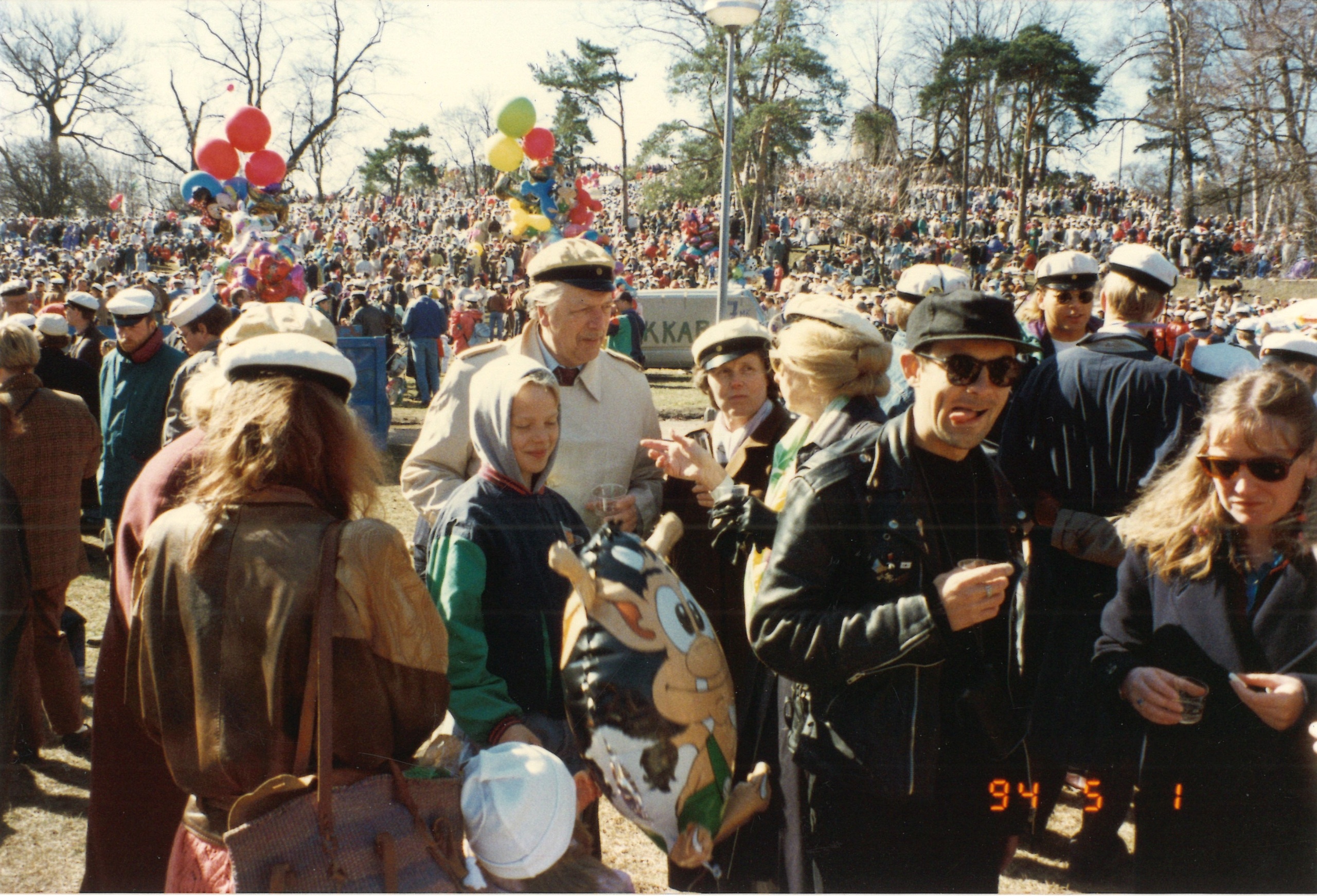
The annual Finnbrit picnic has moved from May Day to Whit Sunday. Both occasions are important dates in the traditional Morris-dancing calendar.
Here, without the Morrisers, is Team Finnbrit in Kaivopuisto in 1993/1994. Spot the mustard!
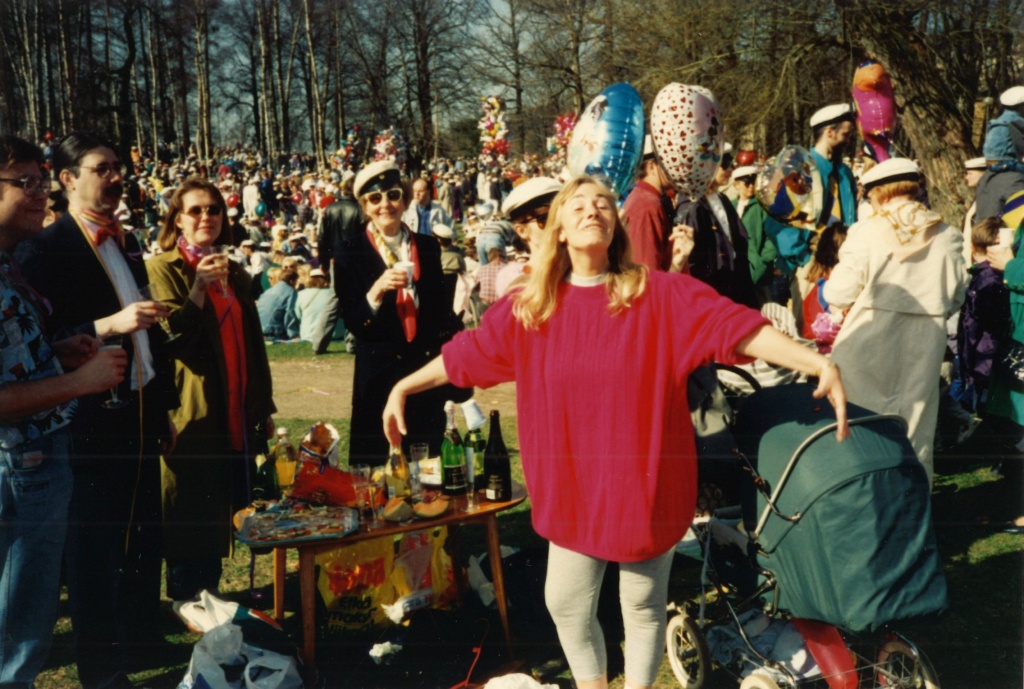
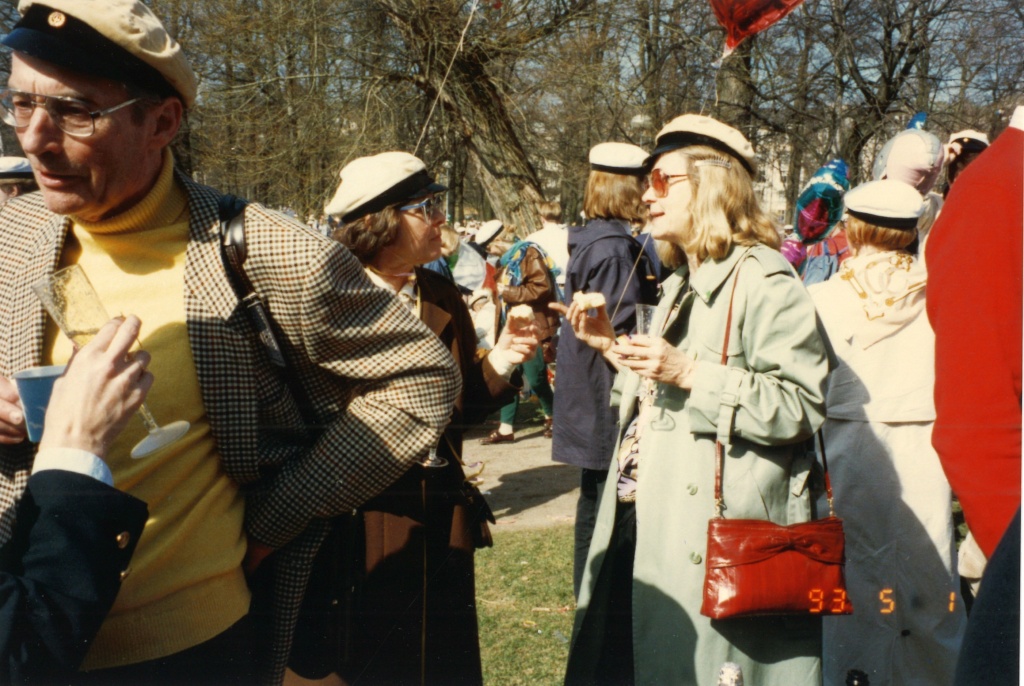
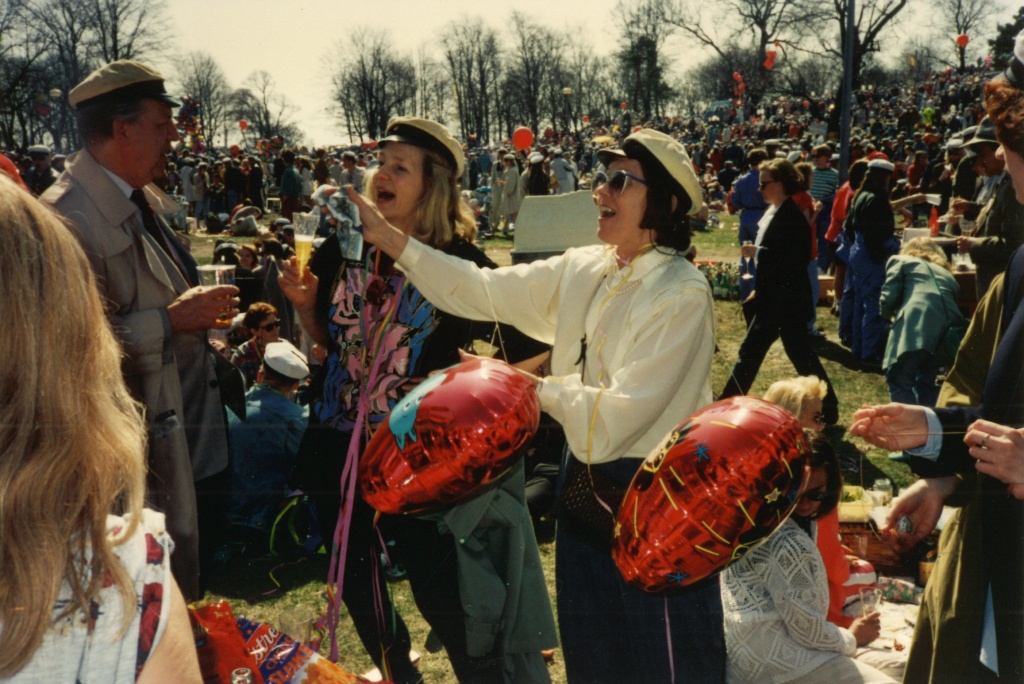
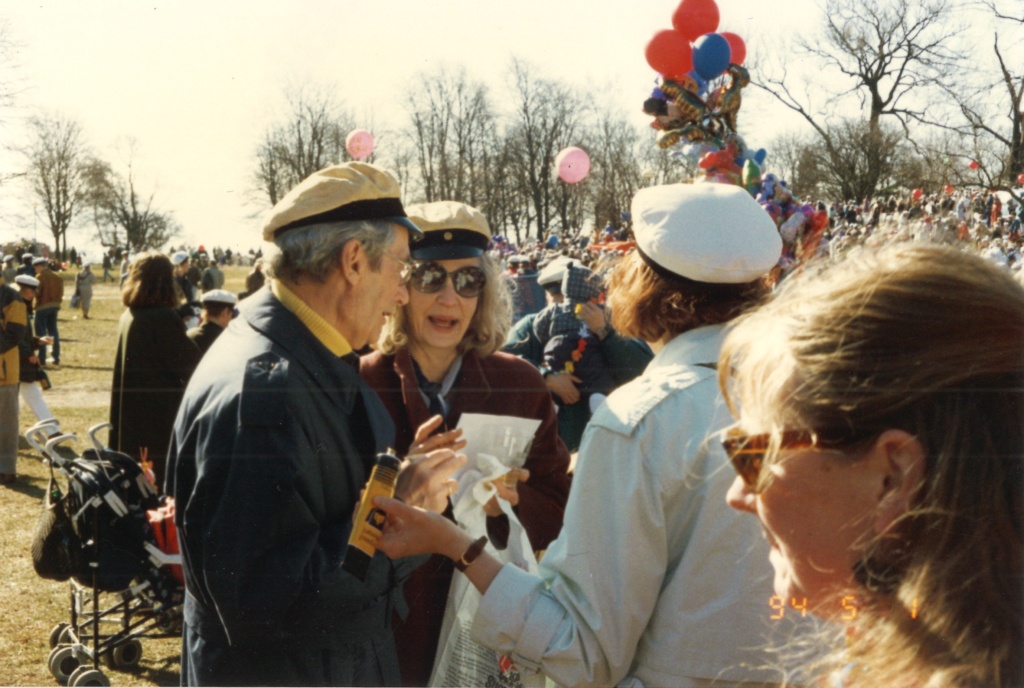
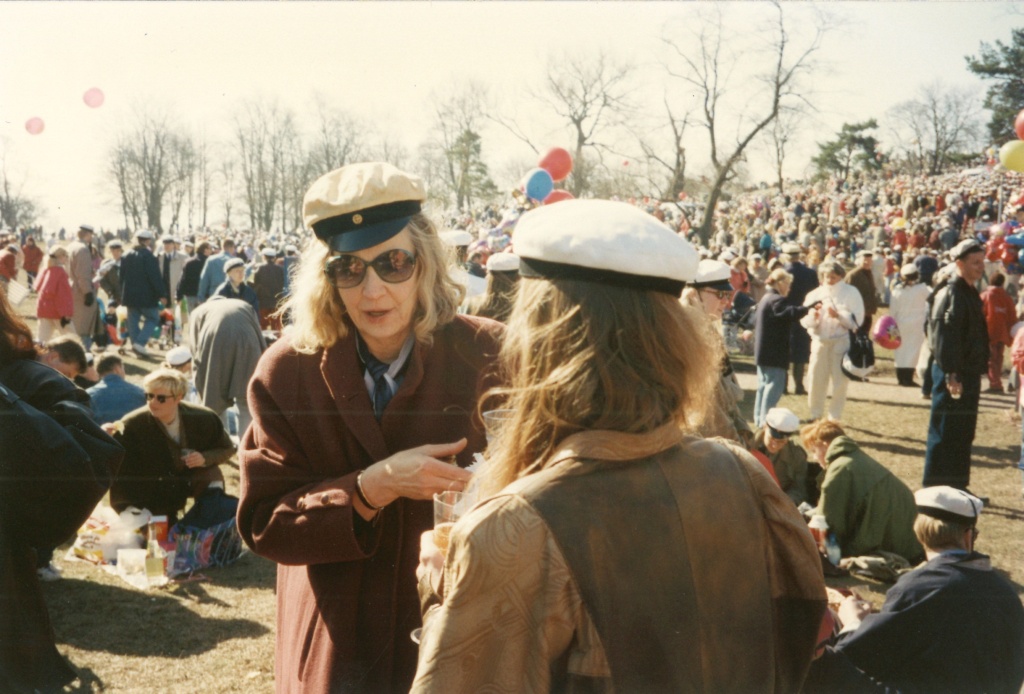
Finnbrit 41/100
A double-decker tour of Helsinki (2014)
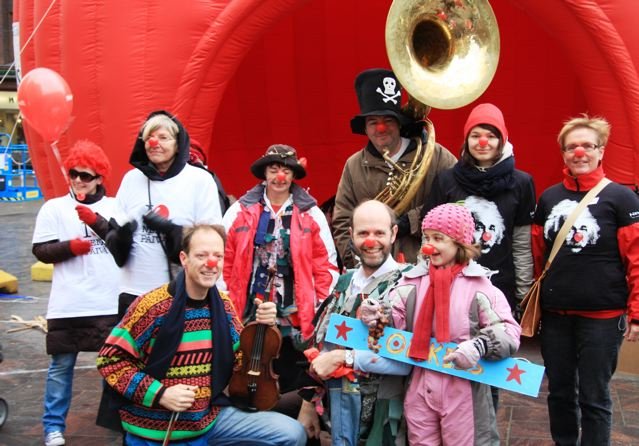
By Anthony Shaw
You don’t have to be a trainspotter to know what an anorak is, and you don’t have to be a nerd to enjoy the pleasures of riding on a seven-ton, six-wheeler, 97-horsepower, diesel-engined, scarlet-painted, double-decker London Transport bus*.
In 2014, Finnbrit called on the services of Jukka Silerinne and Londonbus Transport Oy for a tour of the May Day celebrations, starting early to avoid the crush of families and party revellers who fill the streets in the centre of town later in the day. The departure point was the Swedish Theatre where over 50 Finnbrit members and friends queued patiently (as one does). The bus arrived in style, sporting a Finnbrit banner, hung from the upper-deck windows.
Most of the passengers had probably not had much experience of riding these red leviathans since all routes in London are now served by modern 80-seat cruisers, many of them no longer sporting the red livery that coloured all the traditional London AEC Routemaster buses. But, for anyone who had grown up in twentieth-century London, the feel of the fuzzy upholstery, the tinge of diesel fumes and, above all, the jovial rumble of that six-cylinder diesel engine brought back memories aplenty. As a schoolchild, I had sprinted down the road (late leaving home), swung on the pole of the open, rear-entrance platform and collected used rolls of conductors’ ticket-paper before I had learned any algebra. The 38A or the 20 were my usual routes; both still run through the northeastern suburbs of my childhood!
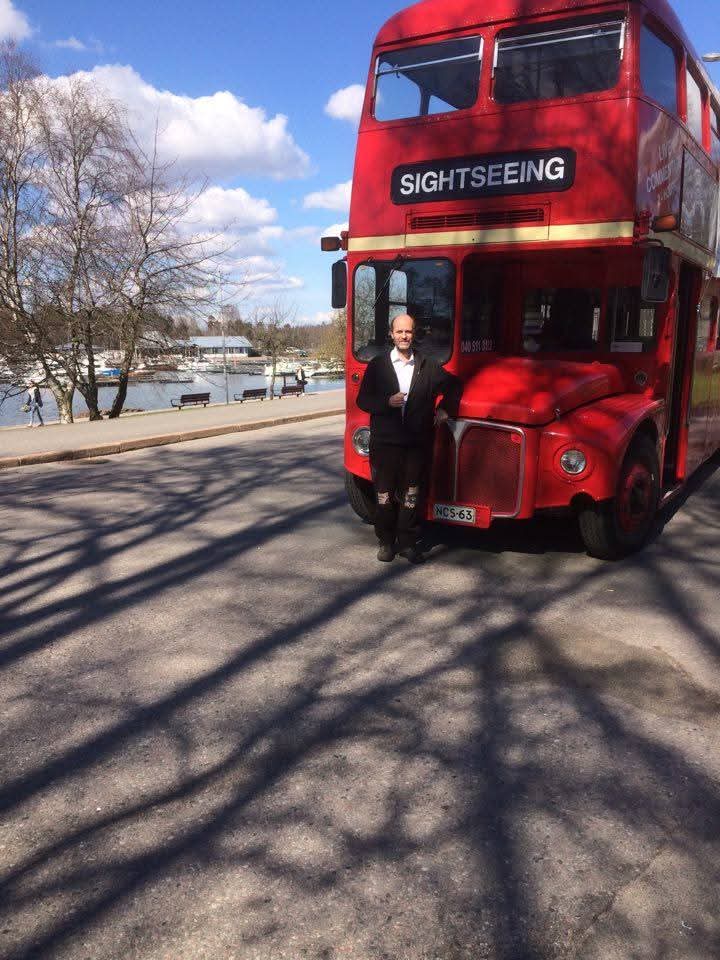
The route in Helsinki took in the traditional sights of the Market Square, the Sibelius monument and the Olympic Stadium before making a scheduled stop at the city’s new Musiikkitalo concert hall to stretch our legs. This bus stop also fulfilled the requirements of a safe place for a right-hand drive vehicle to drop off its passengers —the door being on the wrong side for normal roadside stops. Safety was of course Jukka’s prime concern, but fun and fascinating facts were also on offer with Finnbrit member Gerald Steinmetz, a registered city guide, talking and occasionally singing us through some less obvious details of Helsinki history.
Speed is not a feature of the London Bus tour of Helsinki but, on a holiday trip, who needs to be in a hurry? During our two-hour tour we probably covered 4 km of Helsinki streets: the more time you take to travel, the more you see. And with Gerald’s sometimes operatic contributions, the more you hear too!
*And now for your own enjoyment, and a taste of nostalgia on a London omnibus, we invite you to listen to this iconic recording of Flanders and Swann singing ‘Transport of Delight’ (1957) https://youtu.be/7yHrpPRYgYM?si=q1lavB5EhzbHGWWk (Lyrics here)
Finnbrit 42/100
Morris in pictures
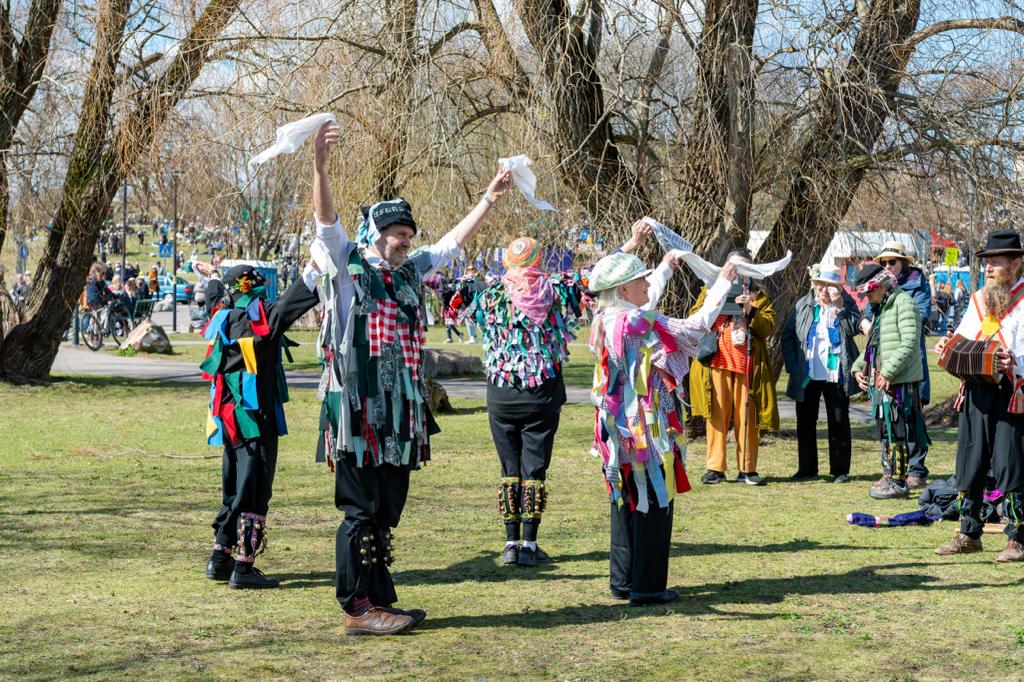
This series of pictures celebrates the world’s most northerly Morris Side: our own Helsinki Morrisers here celebrating May Day back in 2023 in Kaivopuisto. Pictures by Susan Christensen
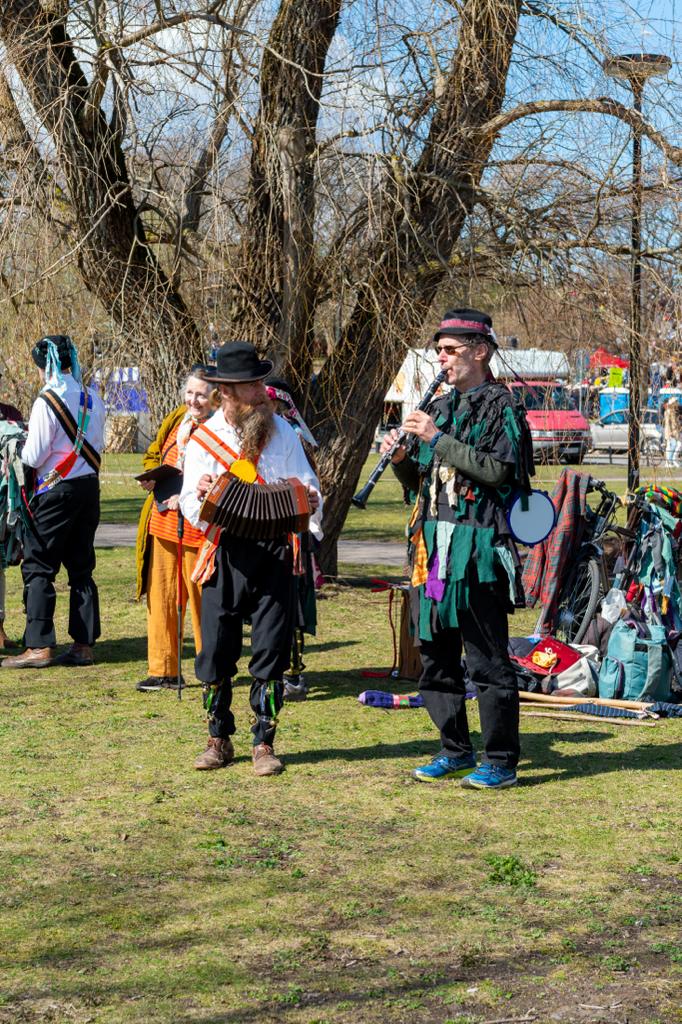
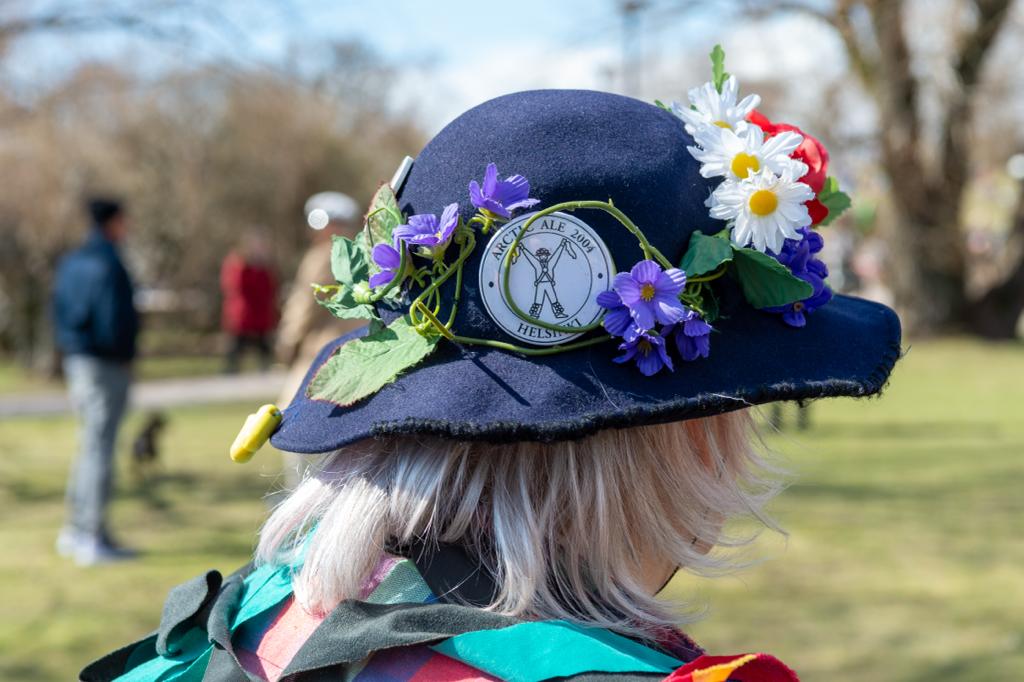
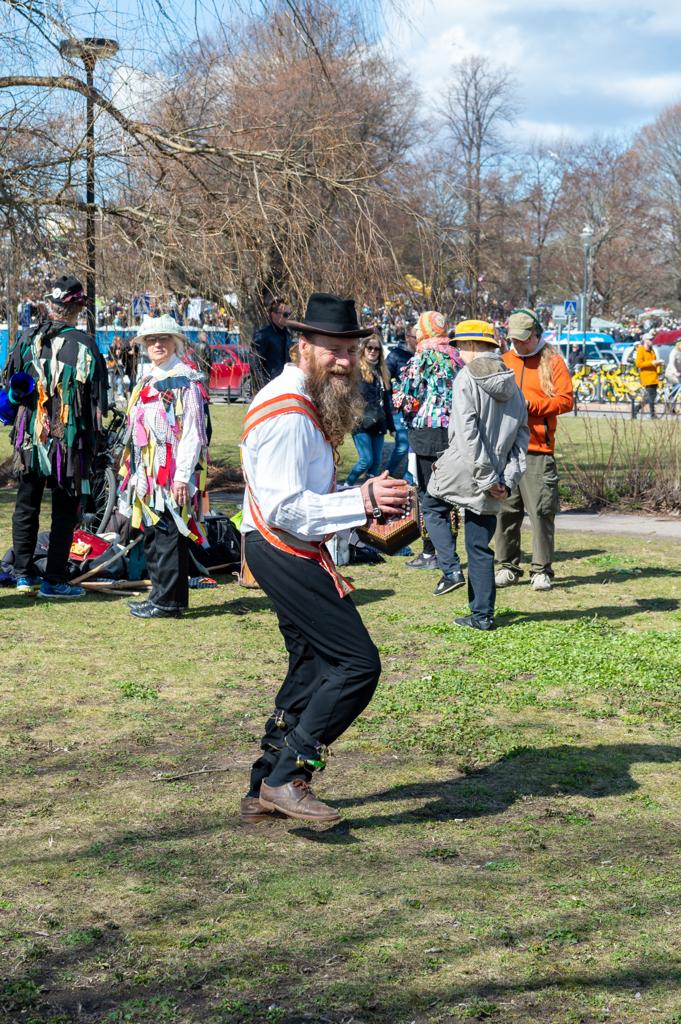
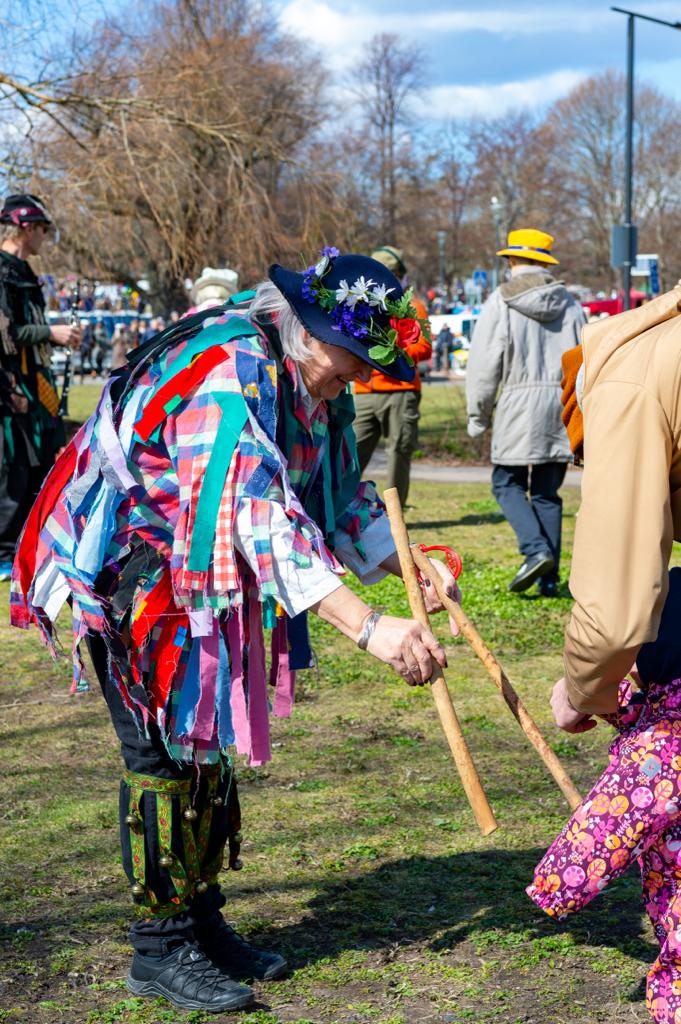
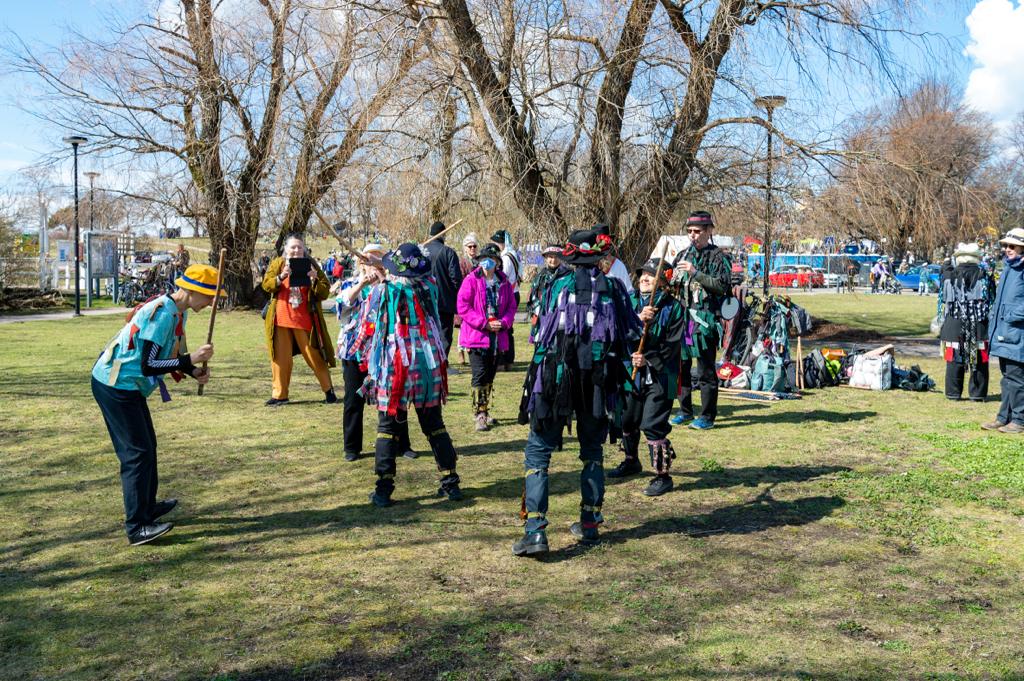
You can see the Helsinki Morrisers in action here: https://www.facebook.com/share/v/1Q5NXtiYxr/
You can read more about the history of Morris dancing at Finnbrit here: https://finnbrit.fi/finnbrit-100/#morris-dancing-at-finnbrit
The Helsinki Morrisers are always looking for new dancers. If you are interested in joining the world’s mostly northerly Morris side, contact Finnbrit for more information.
Finnbrit 43/100
Helsinki Morrisers’
Vappu Dance Out 2026

Friday, 1 May 2026, from 12:00
in front of Musiikkitalo, on the upper side towards Mannerheimintie
It is May Day, May the 1st, or Vappu as we call it in Finland. The Morrisers will start the day’s Dance Out at 12:00 in front of Musiikkitalo, on the upper side towards Mannerheimintie. From there, the Morrisers will then traipse their way towards Kappeli on Esplanadi aiming to arrive at 13:00. The dancers are accompanied, as always, by musicians on clarinet, squeezebox, penny whistle —and maybe a fiddle or two — playing traditional English tunes. Current styles of dancing include a mix of Border, Molly and Cotswold, as well as Helsinki traditions.
No registration needed. Show up and enjoy the performance!

The Helsinki Morrisers are a thoroughly mixed(up) Morris Dance side that started in 1993 in downtown Annankatu. The first performance took place on a sunny summer evening at the British Embassy. The Morrisers’ costume has changed considerably since then: the traditional baldricks are now made from a Marimekko design!
Since 1996, the Morrisers have been active members of the Arctic Morris Association along with Eken Morris from Stockholm. Ales (not beers, but an ancient word for a gathering of Morris dancers) have been held almost every year since then in either Helsinki or Stockholm.
Finnbrit 44/100
Whit Sunday Picnic
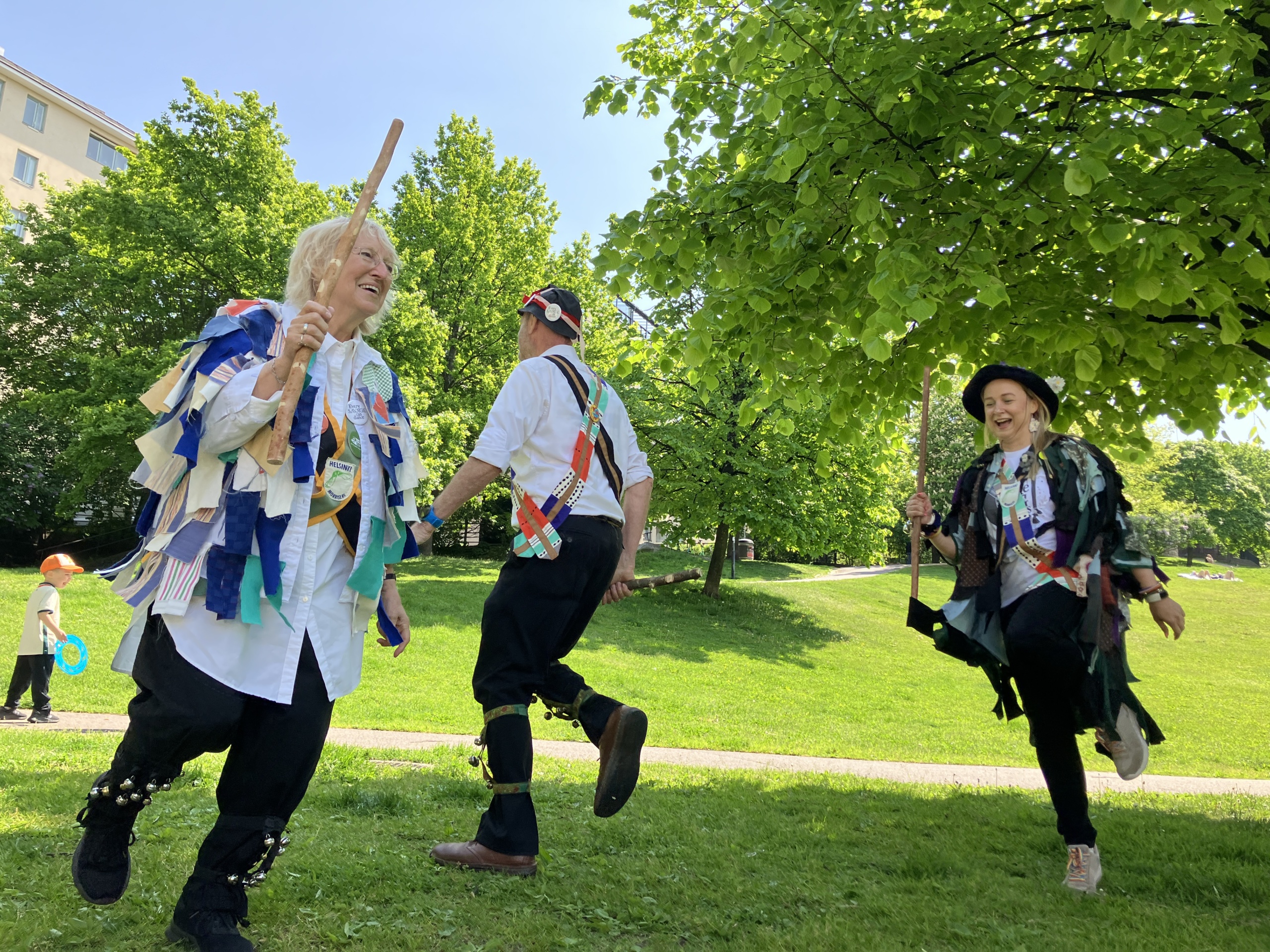
Sunday, 7 June 2025
12:00 – 14:00
Sinebrychoff Park, Helsinki
Welcome the summer with us at a potluck picnic on “Whit Sunday” (Helluntai) —which is not actually on Whit Sunday at all because we wanted to give everyone a chance to gather their strength after the big 100-year bash on the 23rd!
Bring food to share and a blanket to sit on. Finnbrit will provide some non-alcoholic refreshments. Fun for the whole family.
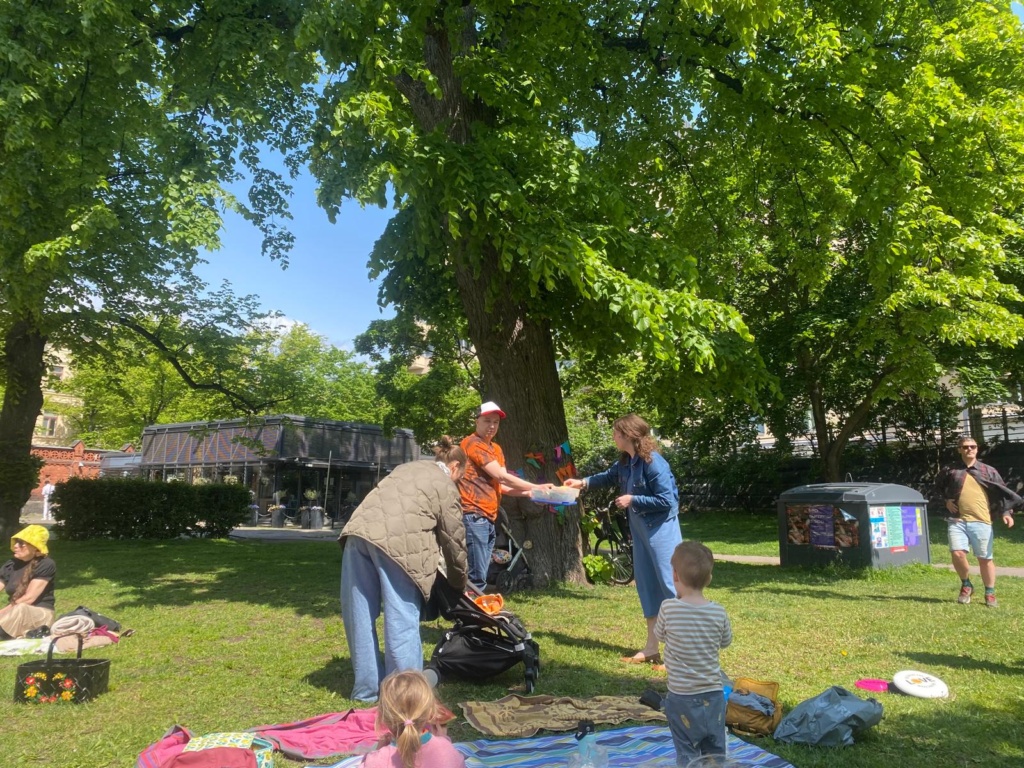
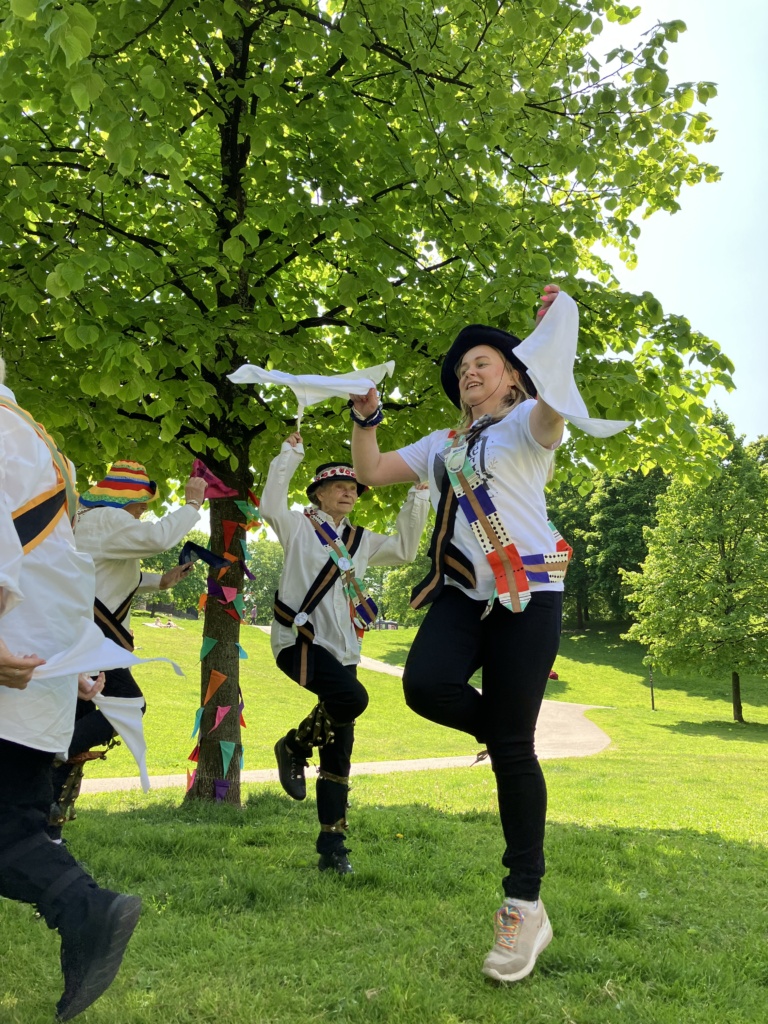
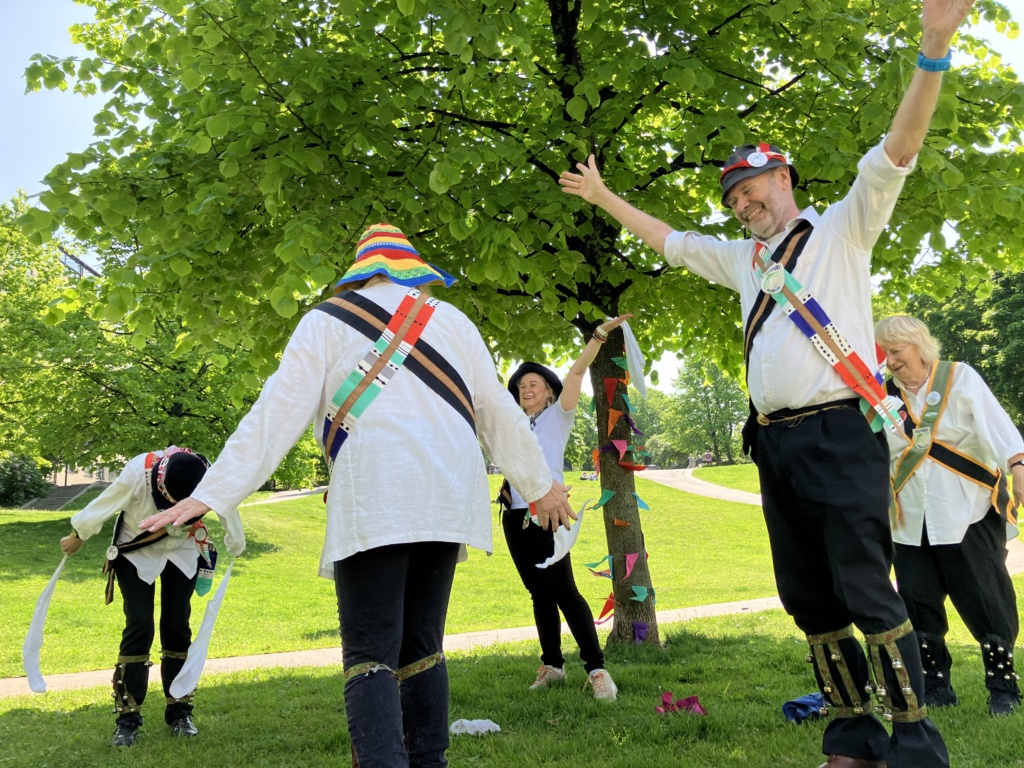
The Helsinki Morrisers will join in the fun: Morris dancing is a long-standing Whitsun tradition in Great Britain, and also now in Helsinki!
In case of bad weather, we will move indoors to Finnbrit (a short walk from the park).
Reserve your place here.
Finnbrit 45/100
A brief history of
Morris Dancing at Finnbrit
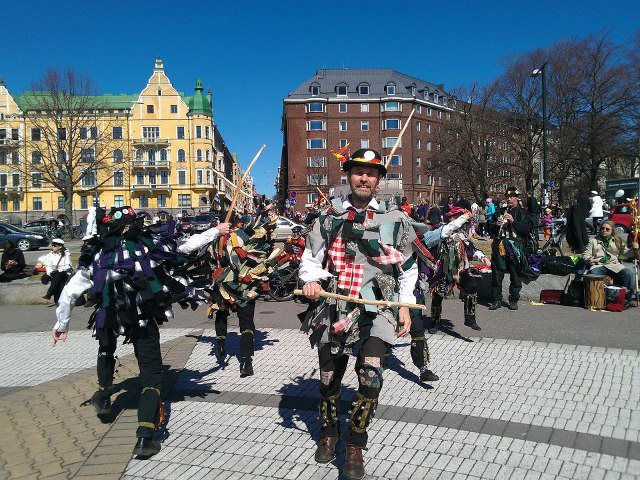
Sue Thrower interviews Anthony Shaw, one of the founders of the Helsinki Morrisers.
Morris dancing doesn’t have a huge following in the UK so I’m curious how it got started at Finnbrit.
Morris dancing is becoming more known and perhaps less ridiculed. It has this image of stupidity somehow, I think in a way people are proud of that. It’s taken seriously, but it’s something to laugh about as well. I was playing in an Irish band, and I realised that when you are playing music and people are dancing it is just so much more fun. Then an article about Morris dancers in a magazine by a guy in Stockholm caught my eye, so I tried to track him down. Eventually, getting an address, I wrote to him. He wrote a long letter back and was so encouraging.
It sounds as if it was the music that drew you into it, Tony.
Definitely, yes.
When did the Morris Dancing group start at Finnbrit?
We started off in 1995/6 but not at Finnbrit. It was at a little language school that was run by one of the founders, but we moved to Finnbrit probably not too long afterwards. Originally there were six of us, four Finns and two Brits, one of the guys was Roger Munn who is still around. I went to Sweden with a video camera having found the name of the organiser of the Swedish dancing team ‘Eken Morris’. I videoed their training session, came back here and we just copied what they were doing. And that’s how we started off. We continued liaising with the Eken Morrisers. After a few years, we went to Sweden and, the following summer, they came to Helsinki. They presented us with a book (a Handbook of Morris Dances) which gives detailed instructions for the dances and the music.
I’ve heard that you’ve done tours as a group. Tell me about the places you’ve visited.
We started dancing in public with a visit to Sweden.
We also dance outside here in Helsinki, especially on May Day (Vappu) which is a tradition for Morris dancing. In 2024, the Canadian Morris dancers visited us here in Finland. And recently, some of us visited Norway where a new Side is getting established.
Interestingly, that’s what’s different about Morris dancing compared to other folk dancing. While folk dancing has been a way for men and women to get together socially, Morris dancing is a form of ‘ritual dancing’. Traditionally, it was done partly for performance, partly for money –begging and collecting monies.
I know very little about Morris dancing but I have seen on TV, for example in Cornwall, they were dressed in black including black face paint and I have seen other Morrisers dressed in white, so do different groups have different costumes?
The traditional style is white with bells and colourful handkerchiefs and bells. In England, at the turn of the century, there was winter dancing especially around the English-Welsh border and that is where people have blacked up their faces. The Helsinki Morrisers wear white shirts covered in colourful ribbons and black trousers adorned with many bells.
Within the group, do you have separate roles as dancers and musicians, or do you share the roles?
Typically, there are three roles: one’s the Squire who’s the boss and typically gets elected every year. Then there is the Bag Man who is involved with the kit and the practical arrangements, and I think there is also one role for finances.
But would you swap around between playing instruments and dancing?
In some groups (also called ‘sides’) people do but, in our group, John is the main musician. He has never particularly wanted to dance so has become responsible for the music. In Sweden, there have always been people who both play and dance. It’s quite good that the musicians do know what the dancing is about: if you are just a musician, you would probably expect the dancers to follow you but with Morris dancing the musicians have to follow the dancers, which can be quite difficult.
Would the music be taken from this Handbook of Morris Dances?
Yes, the traditional melodies and village dances are all in there. The book was compiled, I’d guess, in the 1950s. While different villages might do the same dance, they could use different music, or they might use the same music played in a different way.
And it sounds almost as if it has its own language to describe the steps and the dances.
Yes, it does. Cecil Sharp, he’s the one that notated it – he started writing it down 1895 or so.
Finally, are there any stand-out moments for you with the Finnbrit Morrisers?
The most obvious answer is when we had the Ale in 2004. We had six groups come here, to Helsinki. Typically, in the Morris scene in England, they would organise their own gatherings: one side would invite groups from there locality to come, and they would organise accommodation and activities and dancing round the pubs. We did that in 2004 for a long weekend. Cynde was quite involved with that, organising the accommodation. There were UK groups from Cheltenham, Bristol and Brighton, then the Eken Morris from Sweden, the Finnbrit Morrisers and one other group. We did a couple of tours and we organised a sauna in the north of Helsinki. It was a fun gathering.
Finnbrit 46/100
Would you like to join Helsinki Morrisers? The mixed-gender side is very keen to recruit new talent – no prior experience required, just a sense of rhythm, fun and a willingness to turn up for rehearsals! Contact Finnbrit for more information.
A very important visitor:
Sir Edmund Hillary
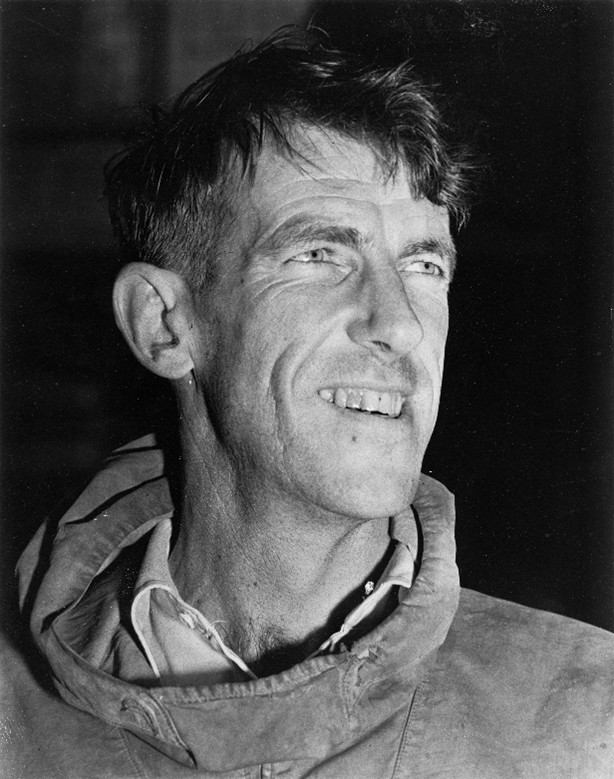
The New Zealand mountaineer and explorer Sir Edmund Hillary (1919-2008) visited the Finnish-British Society in 1953 shortly after his successful ascension of Mount Everest.
We have located a short newsreel in the Finnish archives, announcing the mountaineer’s visit to Helsinki. In this newsreel, Sir Edmund is greeted as his plane lands by the Envoy Extraordinary and Minister Plenipotentiary to Finland, Sir Andrew Noble. Sir Edmund is later interviewed by a journalist on the premises of the Finnish-British Society, where he meets local academics and Society members. In the newsreel, we can even recognise some of the furniture that the Society acquired in its early years , which is still in constant use in our Club Room! Unfortunately, little remains in the Finnbrit archive about Hillary’s visit to the Society, but we know that the Society hosted a well-attended reception in his honour. According to the minutes of a Council meeting, several bottles of sherry left over from that event were consumed soon after in a reception organised on the occasion of Sir Andrew Noble’s departure from Finland to assume a new post as Ambassador to Poland.
As part of the British expedition to Everest, Sir Edmund Hillary and Sherpa Tenzing Norgay summited the peak together on May 29th, 1953. News of their success reached the UK on the day of HRH Queen Elizabeth II’s coronation on June 2nd. Hillary was immediately awarded the KBE (Knight Commander of the Order of the British Empire). He later conquered many other Himalayan peaks and explored Antarctica and the Arctic. He also had a diplomatic posting as High Commissioner to India from 1985-1990. In his later years, he devoted his life to supporting the Sherpa people of Nepal.
The newsreel is available on the Elonet database, provided by The National Audiovisual Institute KAVI. https://elonet.finna.fi/Record/kavi.elonet_elokuva_158314 (The arrival of Sir Edmund Hillary starts at 03:52)
Finnbrit 47/100
Jean Sibelius’ Letter to the British Mission in Helsinki Dated May 1946
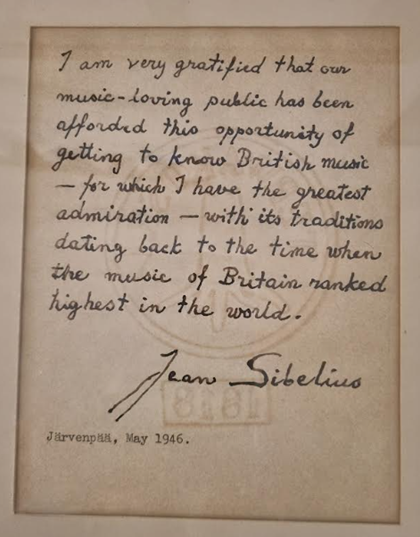
In May 1946, the British Council and the Finnish-British Society in Helsinki invited musicians from the United Kingdom to present British music for the Finnish audience at two concerts.
The first concert on 7 May 1946 was a recital of English songs by opera singer Edna Hobson, organised at the Great Hall in the University of Helsinki. Hobson was accompanied by pianist Kosti Vehanen, Professor Ilmari Hannikainen and Finnish tenor Jorma Huttunen. The programme consisted of songs by Thomas Arne, Granville Bantcock, Frederick Delius, and Ralph Vaughan Williams.
Hobson also performed at the second concert on 9 May 1946 which took place in the Sibelius Conservatory located behind the Parliament House. The first institute for music in Helsinki founded in 1882 had, in 1939, been renamed The Sibelius Academy. The second concert included music by Cyril Scott, Henry Purcell, Thomas Arne and Frank Bridge and a string quartet in G minor by Arnold Bax performed by the Sibelius Quartet.
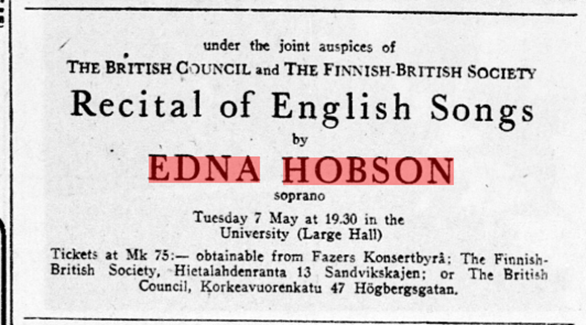
Both concerts were organised under the patronage of composer Jean Sibelius and the British political representative in Finland, Francis Shepherd. Jean Sibelius and his wife Aino Sibelius were present at the concerts, but Sibelius also sent a written message to the British mission in which he expressed his appreciation for the opportunity given to Finnish music lovers to get to know British music better. The concerts were widely commented on in the Finnish press, as was the message from Sibelius which was framed as a memory of the occasion.[1]
The two organisers of the concerts were the British Council and the Finnish-British Society.
The first office of the British Council Finland had opened in 1935 but was closed down in 1941 and reopened in 1945. The aim of the British Council was defined in 1941 as follows:
to create in a country overseas a basis of friendly knowledge and understanding of the people of this country, of their philosophy and way of life, which will lead to a sympathetic appreciation of British foreign policy, whatever for the moment that policy may be and from whatever political conviction it may spring.
The Finnish-British Society had an even longer tradition. It was founded in 1926 and is still today a very active promoter of cultural relations between our two countries. The Finnish Sibelius Society was founded in December 1957 a few months after the death of the composer, but the first British Sibelius Society had been founded already in the 1930s. One can thus say that the appreciation of the music of Sibelius has been a uniting factor in the relations between our two countries.
Helsinki, 11 May 2026.
Gunilla Carlander – Reuterfelt
[1] Ia. Hufvudstadsbladet, Nya Pressen 5,6,8 and 9 May 1946.
This text was first written for the use of the British Embassy in Helsinki and we share it with their permission.
Finnbrit 48/100
A visit from Her Majesty
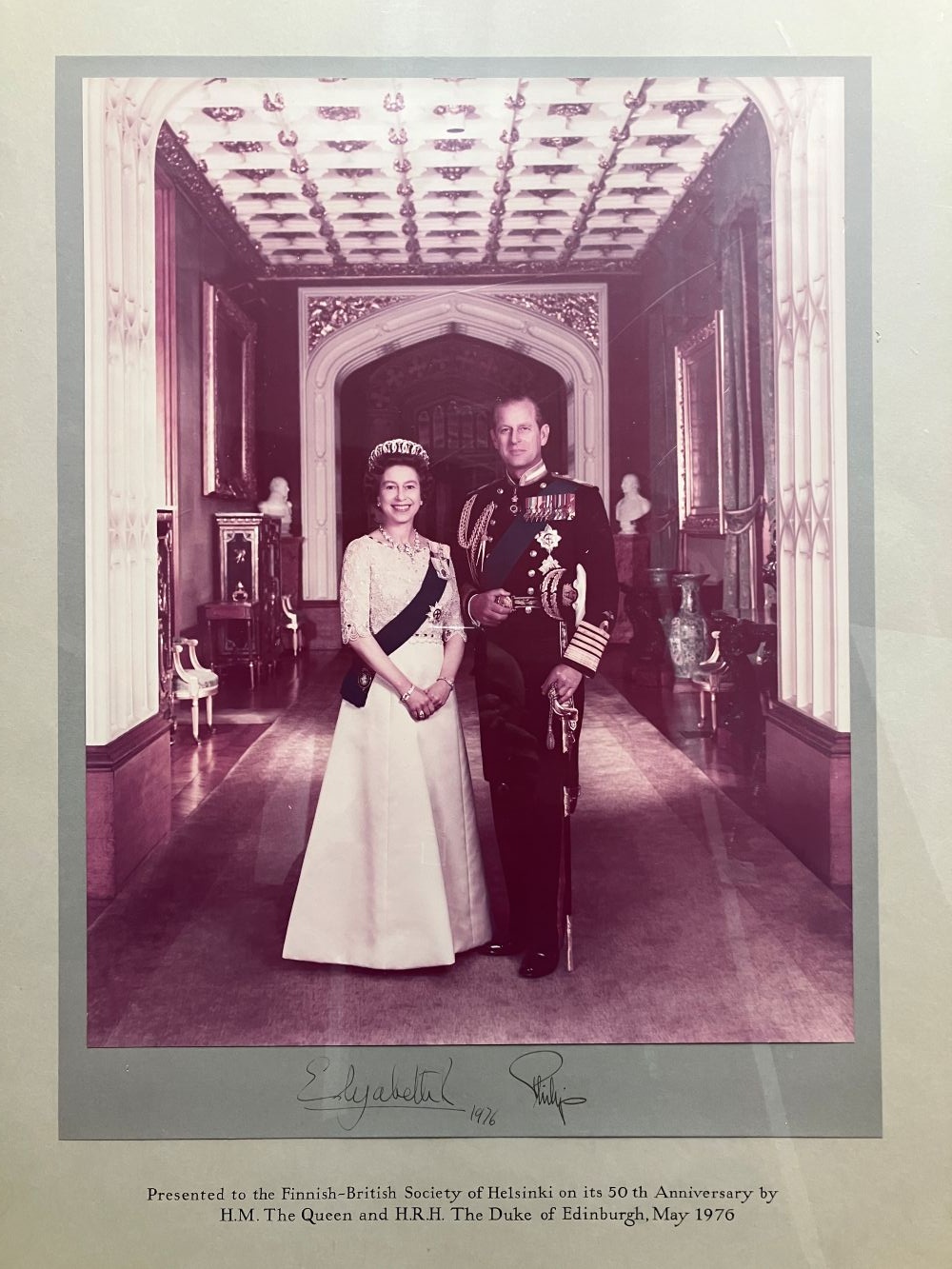
The picture of H. M. The Queen Elizabeth II and H. R. H. The Duke of Edinburgh Prince Philip on the wall of the Club Room was presented to the Finnish-British Society of Helsinki in May 1976.
Forty years later, in 2016, we sent a letter to Her Majesty and received a reply: “Her Majesty remembers her visit to Finland with great fondness and much appreciates your thoughtfulness in writing as you did.”
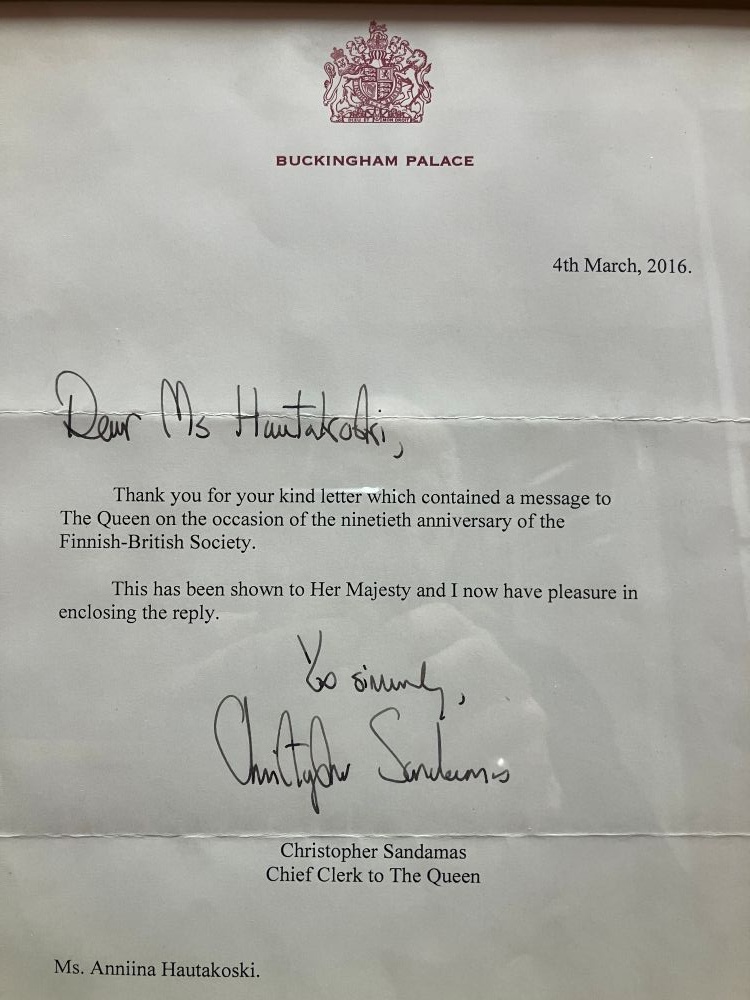
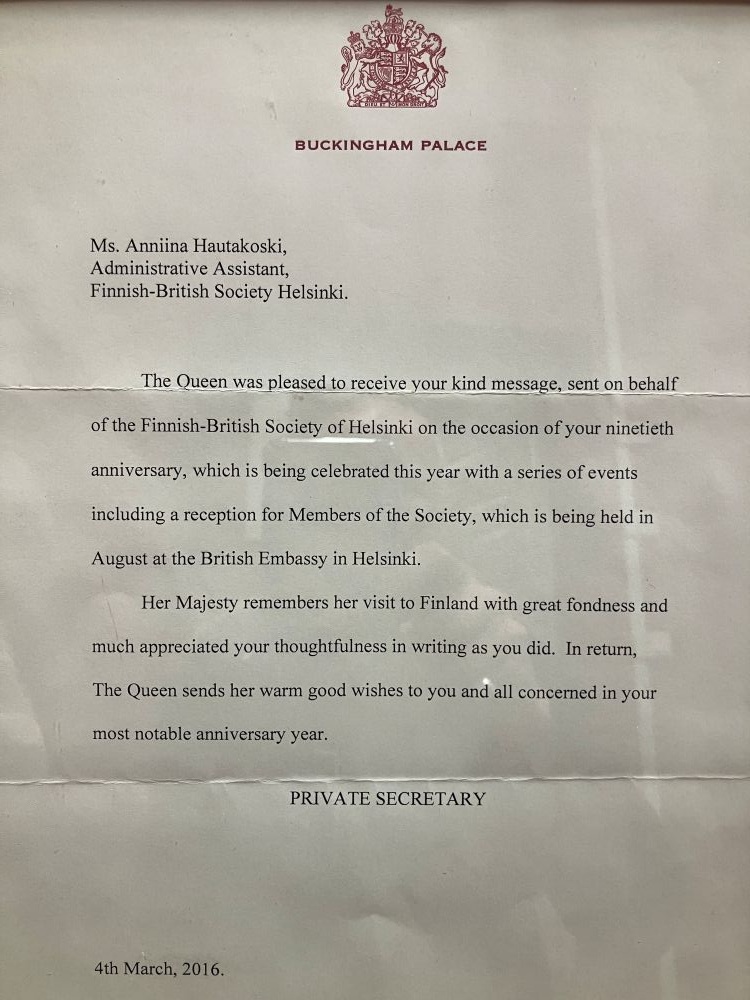
You can read more about the royal couple’s visit to Helsinki here and here (text in Finnish only).
Finnbrit 49/100
When Mark Shackleton met the Queen
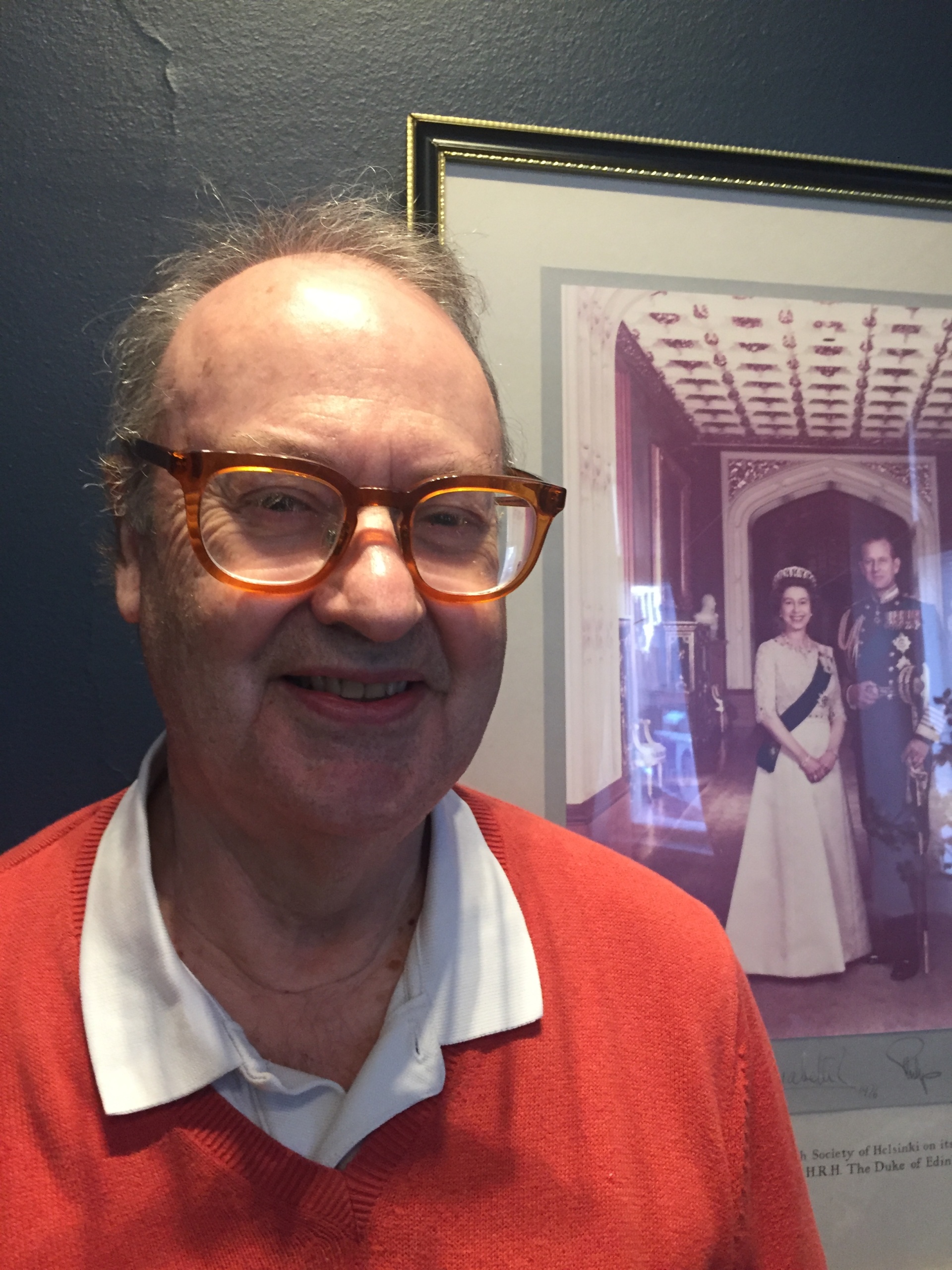
Click on the play-button to hear about the time when Mark Shackleton met the Queen in May, 1976.
Finnbrit 50/100
Mr Jaakko Kahma, founder of the Finnish British Society
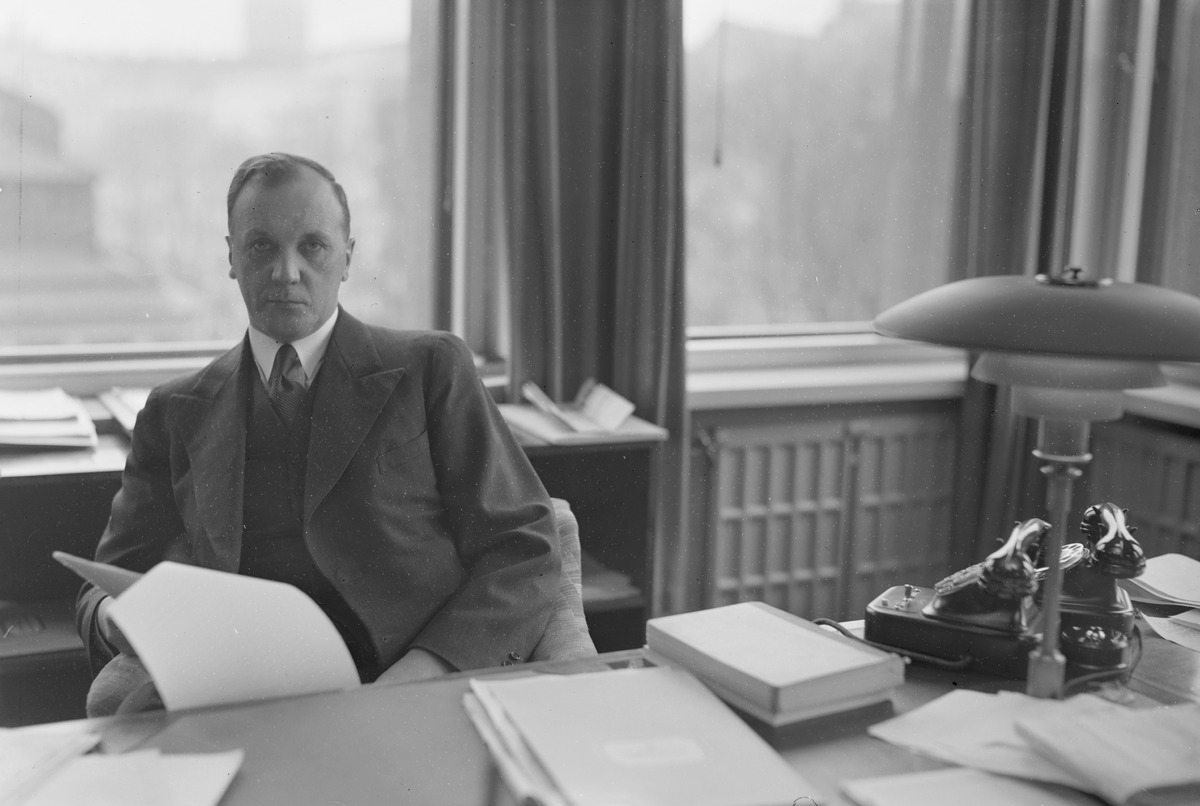
The Society held its inaugural meeting on 15th April 1926, thanks to the initiative of Mr Jaakko Kahma who was keen to promote trade between the UK and Finland and strengthen friendship and cultural relations between the two countries.
Kahma was born in 1886 in Ilmajöki, in southern Ostrabothnia. As a young adult, he worked as an office clerk, manager and later in a hardware store in Vaasa. Still in his twenties, he started working in newspapers in Vaasa, later becoming editor-in-chief of the Suur-Savo newspaper in Mikkeli and, in 1916, an editor for the Maaseuden Tulevaisuus newspaper based in Helsinki. After the Civil War, he worked in private companies mostly dealing in cereals, grains and milling.
Kahma was Director of the Export Association of Finland from 1928 to 1953 during which time he co-founded the Finnish Industrial Federation. In 1938, he founded the Talouselämä newspaper where he remained until 1958 as managing director and chairman of the board. A self-taught economist, he did not limit himself to writing newspaper articles but published more than 10 books between the 1920s and 1960s on the national economy, export and domestic industries, and export and customs policy.
He was active in reforming trade, industry, and rural affairs, representing Finland in trade conferences around the world. He was also interested in politics, a member of the National Progressive Party, and friends with Risto Ryti, a like-minded anglophile.
Mr Ryti and his wife Gerda Ryti were both active members of the Finnish-British Society in its early days. Indeed, Mr Ryti also served as President of the Finnish-British Society before he was President of Finland (1940-1944). Other notable founding members of the Finnish-British Society were Eljas Erkko, a newspaper publisher and diplomat, and Mrs Ester Ståhlberg, a well-known writer and wife of President Kaarlo Juho Ståhlberg, Finland’s first president.
Source: https://apurahat.skr.fi/skrfi/NimikkorahastotLiittyma.aspx?action=nimikkorahastoesite&numero=282490
Photo (CC 4.0) : https://finna.fi/Record/museovirasto.56DED6BD81BEBDC62929CB068DE4ED9E
Finnbrit 51/100
Diana Webster in Private Lives (Svenska Teatern, 1957)
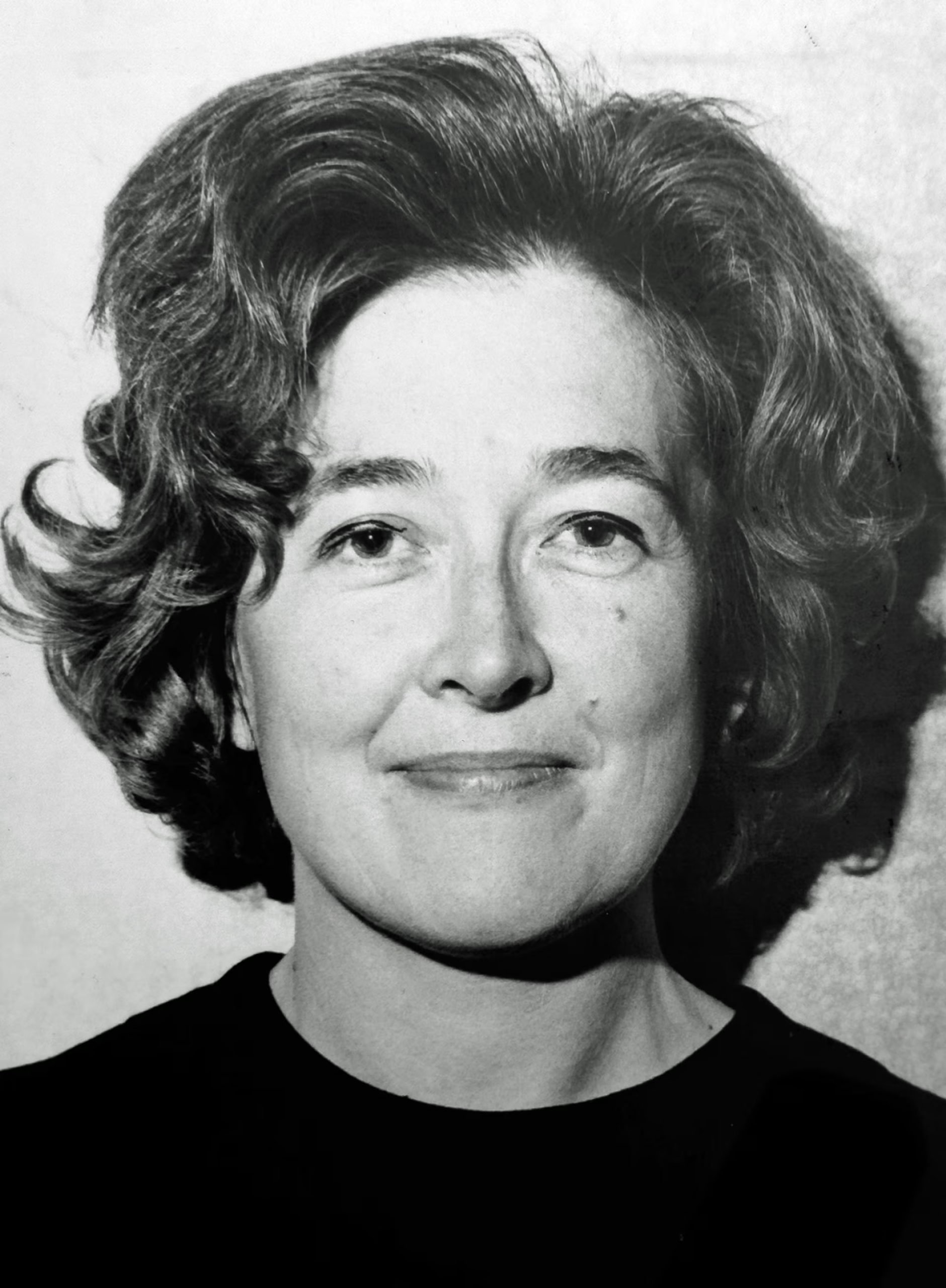
Picture credit: Helsingin Sanomat
Diana Webster (née Colman) arrived in Finland in 1952. She had just graduated from St.Hugh’s College, Oxford, and was about to embark on her first teaching post for the British Council in Turku/Äbo. The following year she moved to Helsinki and began a remarkable career teaching English language and literature at the University of Helsinki, combining this with extensive work for Finnish radio and TV as well as writing scores of textbooks and other materials for learners of English over the coming decades. More recently, Diana published two books about her life in Finland: Finland Forever which tells the reader about her arrival and early experiences in Finland and Finland Forevermore which covers the period from 1953-1963 and gives a fascinating account of life in Helsinki and beyond, during the mid 20th century.
In addition to her burgeoning career in academia, Diana became involved with the amateur drama group at the Finnish-British Society, nowadays called the Finn-Brit Players. Although some might refer to this as am-dram (amateur dramatics), the Finnish-British Society’s drama group was putting on a play every year, usually on the Pienoisnäyttämö stage at the Kansallisteateri (National Theatre)! In 1957, the chosen play was Noel Coward’s Private Lives to be performed at the Svenska Teatern (Swedish Theatre) directed by Kingsley Hart, a fellow academic at the university and accomplished actor.
In her autobiography, Diana tells us, “Until then, I had not attempted glamour and was quite surprised by the dramatic effect of the clothes, since they instantly made me feel far more sophisticated than I really was.” There is a picture of Diana in her glamourous dress on the cover of Finland Forevermore.
The play is a witty comedy about a divorced couple (Elyot, played by Tim Andrews, and Amanda, played by Diana) who discover they are honeymooning on the Riviera with their new, unsuspecting spouses in adjacent hotel suites. The play highlights the couple’s volatile, love-hate relationship as they fluctuate between passionate romance and destructive fighting.
Indeed, in Act Two just before the interval, there is a scene where Amanda and Elyot, now living together in Amanda’s flat in Paris, have a particularly violent quarrel. Diana explains the scene in Finland Forevermore:
There was a sofa in the room, and we decided to play the scene out physically, so that we rolled, fighting and yelling, from behind the sofa, over the top of it, onto the sofa, and then off it onto the floor. It was effective and we had rehearsed it many times […] It had worked fine for the first two performances, but on this last night, we somehow got into the wrong positions and Tim was on top of me when we rolled onto the floor. I put out a hand to save myself. It received the total weight of the two of us. There was a nasty crack […] The curtain fell.
In 2007, in an article for the magazine Nya Argus, the author Dr Kaarle-Juhani ‘Nalle’ Valtiala remembers watching the very same performance:
One evening at the end of the fifties, I witnessed the unforgettable beginning of Private Lives (…) Sparks literally flew from the performance of these two amateur actors… The second act ended in an unparalleled physical confrontation…. a life-and-death wrestling match. The curtain fell, but a continuation never came.
The ominous crack that Diana had heard during her final utterances in Act Two was rather more serious than first imagined. As she left the stage and entered the wings, she realised that “My thumb was hanging down beside my wrist, like the broken branch of a tree.” She was rushed to hospital in an ambulance and, with no understudies waiting in the wings, Kingsley Hart had to politely request the audience to leave the theatre. Diana, in full makeup and her glamourous costume, spent the rest of the evening on the operating table. And Nalle Valtiala never did find out what happens in Act Three!
Diana was a regular visitor to Finnbrit over the decades since she arrived in Finland. Her numerous talks, reflecting on teaching English in Finland and the changes that have taken place in education, women’s rights, politics, and the social and economic conventions in Finland since the 1950s, were always very popular events at Finnbrit in Kaivopuisto and Fredrikinkatu.
I particularly remember a lovely evening in the Club Room on Fredrikinkatu in 2013, when Diana and her daughter, Victoria, presented So Many Everests (2012), an inspiring account of Victoria’s astonishing journey to becoming a doctor, conquering cerebral palsy and many other obstacles along the way. Diana’s son, John, has also visited Finnbrit to talk about his film Recipes for Disaster (2008).
Diana Muriel Theresa Webster MBE passed away in March 2026. Diana was a true friend of the Finnish-British Societies in Turku and in Helsinki for over seventy years. Finnbrit would like to extend its condolences to Victoria and John and also to her extended family and friends.
Text by Penelope Roux
Finland Forever https://www.finlandiakirja.fi/en/diana-webster-finland-forever-d09003?srsltid=AfmBOorgFKaCz-ZTcIaAwse2N3kdGuJKI1ozk8rZK5w4LfYfa0qhh-m7
Finland Forevermore https://akateeminen.com/tuote/diana-webster/finland-forevermore-helsinki-1953-1964/9789515237187
So Many Everests https://www.amazon.co.uk/So-Many-Everests-Cerebral-Consultant/dp/0745955959
Finnbrit 52/100
Marjatta Kurejoki talks about her time at Finnbrit
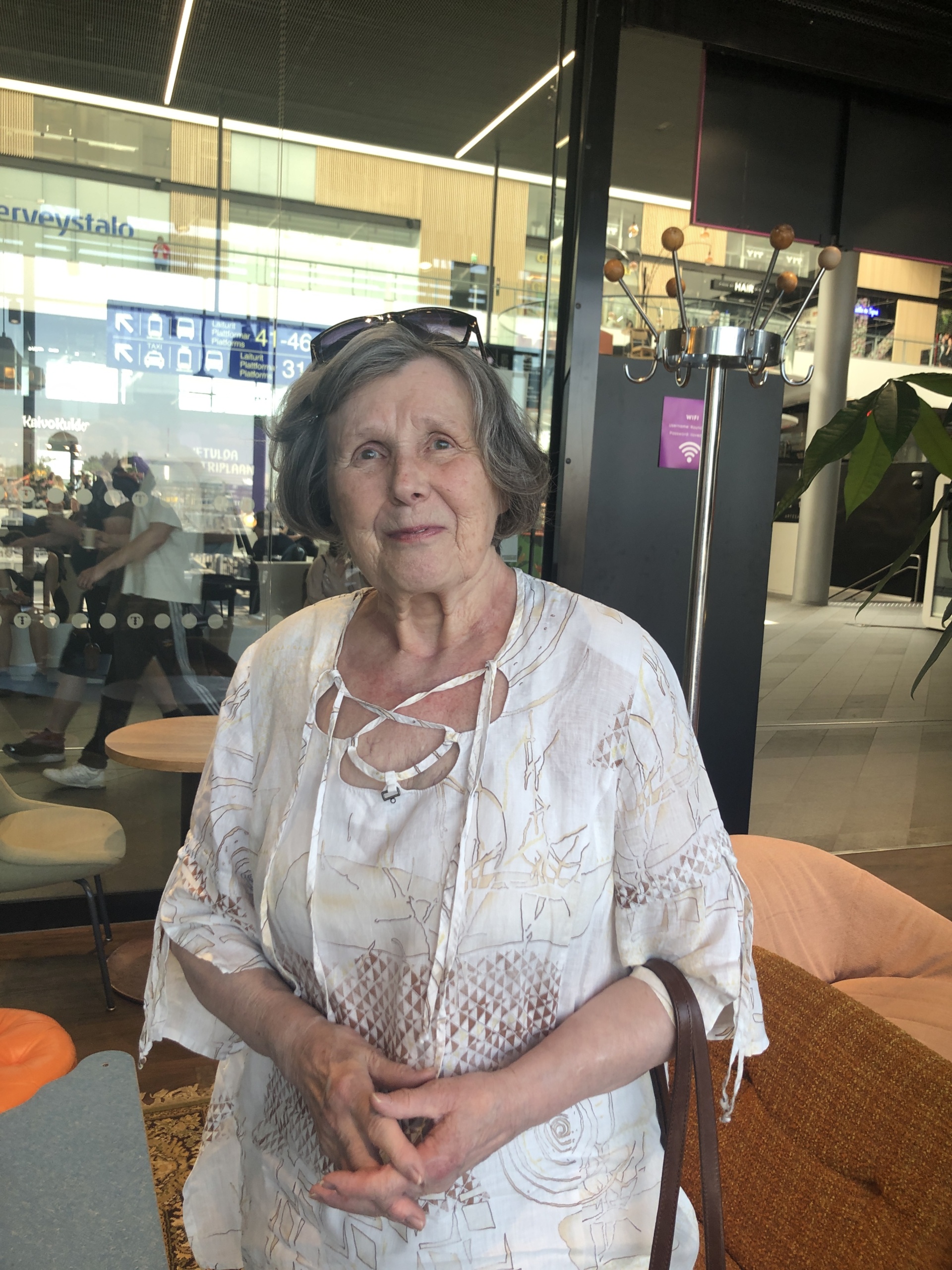
Marjatta was Administrative Secretary at the Finnish-British Society during the heyday of its involvement in English teaching in the country. She started work in the grand premises in Puistokatu in 1977, shortly after getting married. During the years up to her departure in 1995, the number of teachers employed rose three-fold as Finland became more and more integrated in Europe and the West, and as the Society itself became less hierarchical and more socially active.
How did you find out about the position at the Finnish-British Society?
Truth to tell it was my husband’s contact with Marja Salo’s husband, that got me the job – they were old army buddies! Marja was the Director of the Society at that time.
Did you study English before you started work there, Marjatta?
Not at all! I had the same experience as most other Finns at school in the 50s and 60s, just translating texts back and forth in English and Finnish. I think I never spoke a word of English in school. But I had a big help from my husband who was a sales rep for a firm from Lancaster in England, Storeys –he took me to visit there and in Manchester. Such lovely warm people!
You met a lot of British people down at Puistokatu, of course.
There were quite a lot of functions there, big business events with people from the Embassy. But I was quite used to that ‘chit-chat’ through my husband’s contacts. I’d had to learn that quickly, and the etiquette, you know like leaving a little wine in your glass for the toasts.
And all those teachers, you must have seen so many come and go.
Oh yes, I can’t imagine how many now, more than 30 with all the freelancers who started later. The full-time teachers usually came straight from university, in the UK, so they were very young, 22 or 23, and often quite lonely. But I’m not going to mention any names! I was a substitute mother for them. They didn’t understand a word of Finnish, of course, so I had to take them to the shops and show them what to eat, and everything!
Some of the teachers we had were so interesting. I must mention one, Gisela von Bonin. She had been a model in her youth, working in Paris, I understood – and so, so elegant. She taught fitness classes to the wives of the Ambassadors (who were all men in those days, of course). But she was the most down-to-earth, straightforward person you could ever hope to meet, no airs and graces at all. She was a real lady.
Now it’s 30 years since you left the Society, Marjatta. Do you have any special things left over from those times?
Well, many good memories I’m happy to say. They were golden years in Puistokatu (Ed- Finland’s economy was booming before the recession of the 1990s). And yes, I still have a Finnbrit tee-shirt. I’ll see if I can find it for you!
Finnbrit 53/100
Brenda Tuomainen remembers Finnbrit and the British community in the 1960s
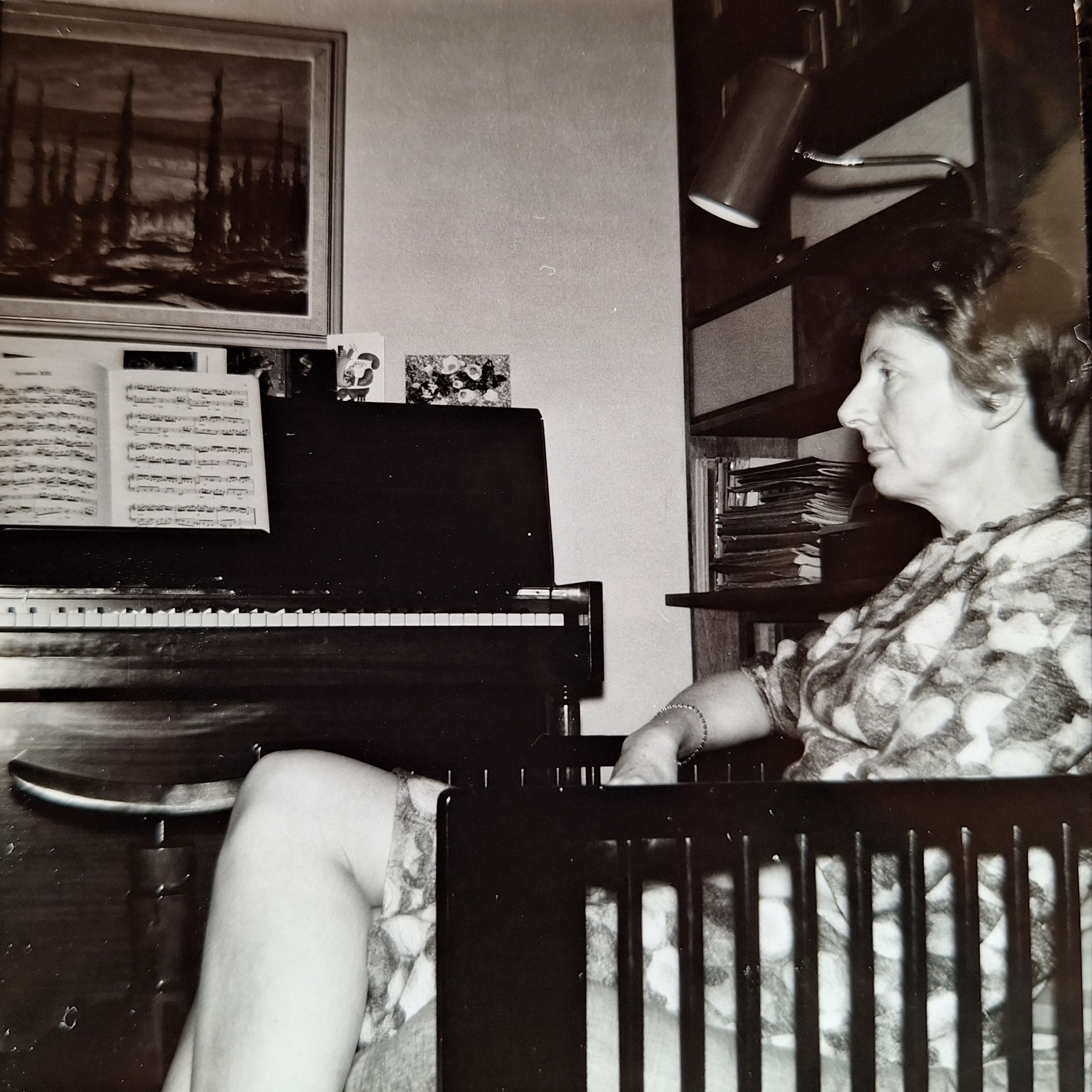
By Tony Shaw
I recently met Brenda over a cup of coffee and a Digestive biscuit in the crypt of the Mikael Agricola Church after she had been accompanying singers on the piano at the Sunday morning family service. The congregation was rather sparse, but all had remained in their seats after the ministers had processed out of the church and sat listening as the sound of Brenda’s playing echoed around the columns of this lofty Lutheran church in downtown Helsinki. Even if Brenda is not as nimble as in her youth, her fingers are —the music rang through the nave as lightly as the 4- and 5-year-olds ran about in the crypt at the after-service coffee!
Brenda first moved from Weybridge in Surrey, England, to Finland in 1961 after working for a few years as a primary school teacher. She had finished her own schooling just as the war ended and, with the post-war dearth of teachers, she was able to fulfill her training requirements in just two years. She started work as the kindergarten teacher in the Puistokatu premises in 1962. She doesn’t remember the name of Director of Finnbrit in those days, but one of the administrators was Marjatta Berglund. Brenda had a hand in the establishment of the International School of Helsinki in 1963, then known as the British Preparatory School. The school had employed an English teacher, full-time, for the first year but, apparently, that teacher had not seen eye-to-eye with the governing board and left after one year. Despite her pregnancy, Brenda stepped in to help out until replacements could be found in the UK.
Although never a full-time Finnbrit teacher or secretary, Brenda did take part in activities at Puistokatu during those decades. She describes the Society at that time as ‘very much an adjunct of the Embassy’: working as an English teacher meant many invitations to join cocktail parties after work. ‘I refused as many as possible. I couldn’t stand hanging around talking to people I didn’t know and didn’t particularly want to know.’ But she seems to have survived these pressures and kept up her contacts with Finnbrit, teaching some private lessons and helping run the English Women’s Afternoon Tea Group which continued up until the early 2000s. From her precise, slightly clipped diction, she is a living example of one of those very ‘English Misses’ referred to in many of the records of early teachers in the country in the 1940s and 50s as described by the author and traveller Diana Ashcroft in Journey to Finland (Muller, 1952).
Finnbrit 54/100
The Finnbrit Knitting Club
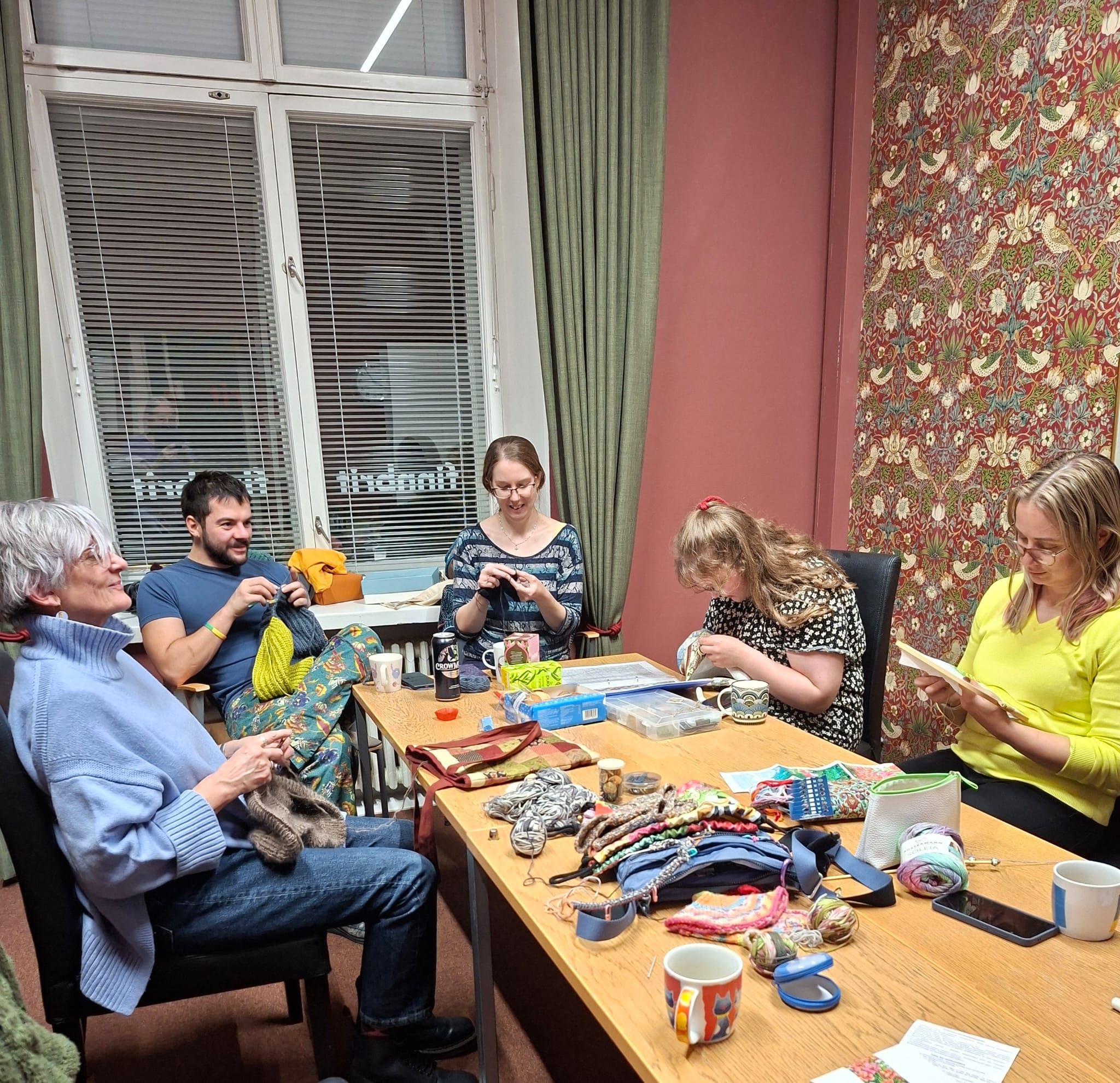
Mark Shackleton interviews Cynde Sadler about the Knitting Club, and two regular participants share their stories on knitting at Freda, and more.
MS: Could you tell us a bit about the Knitting Club?
CS: I started the Knitting Club via IESAF in 2013. We usually meet at the Finnbrit premises twice a month on Thursdays from around 6 pm to 8:45 pm from September to May.
MS: What is IESAF?
CS: The International English Speakers’ Association of Finland (IESAF). It’s an all-volunteer organisation of international English-speaking people living in Finland.
MS: How many Knitting Club members are there?
CS: The club is very large if we count the Facebook members, but usually about eight to twelve people show up on any given day. Most of the attendees are female but we have several men who turn up from time to time. Our members are from all over the world, including Finland.
MS: What kinds of things do you do?
CS: A typical meeting usually starts with preparing the tea and spreading the table with snacks. People knit, crochet, cross stitch, sew, eat treats or anything else they would like to do, including nothing at all. If a new person joins who doesn’t know how to knit or crochet, it’s the perfect place to get started with help and encouragement. Some of the regulars bring leftover yarn and other supplies they no longer need to share with the group.
MS: What attracts people about the Club?
CS: It’s a perfect place for life education. The chats and discussions among people from many different cultures and walks of life can be mind boggling! I remember one evening when women told the stories of their weddings, which are very different around the world, from arranged marriages, mixed marriages to eloping! There was a lot to learn from many different cultures. Each season of Knitting Club at Finnbrit is different, and it even varies each week. We never know what to expect!
MS: What are your future hopes for the Club?
CS: For many of our knitters, the knitting club is their first visit to Finnbrit, but they soon find out about all the other activities that are on offer through their membership. I hope the knitting club continues to thrive and be a safe, comfy place for people to feel at home, no matter who they are or where they’re from.
If you are a keen knitter or if you are just looking for a nice place to have a cup of tea and a chat, come along to the Finnbrit Knitting Club. It’s free for Finnbrit members.
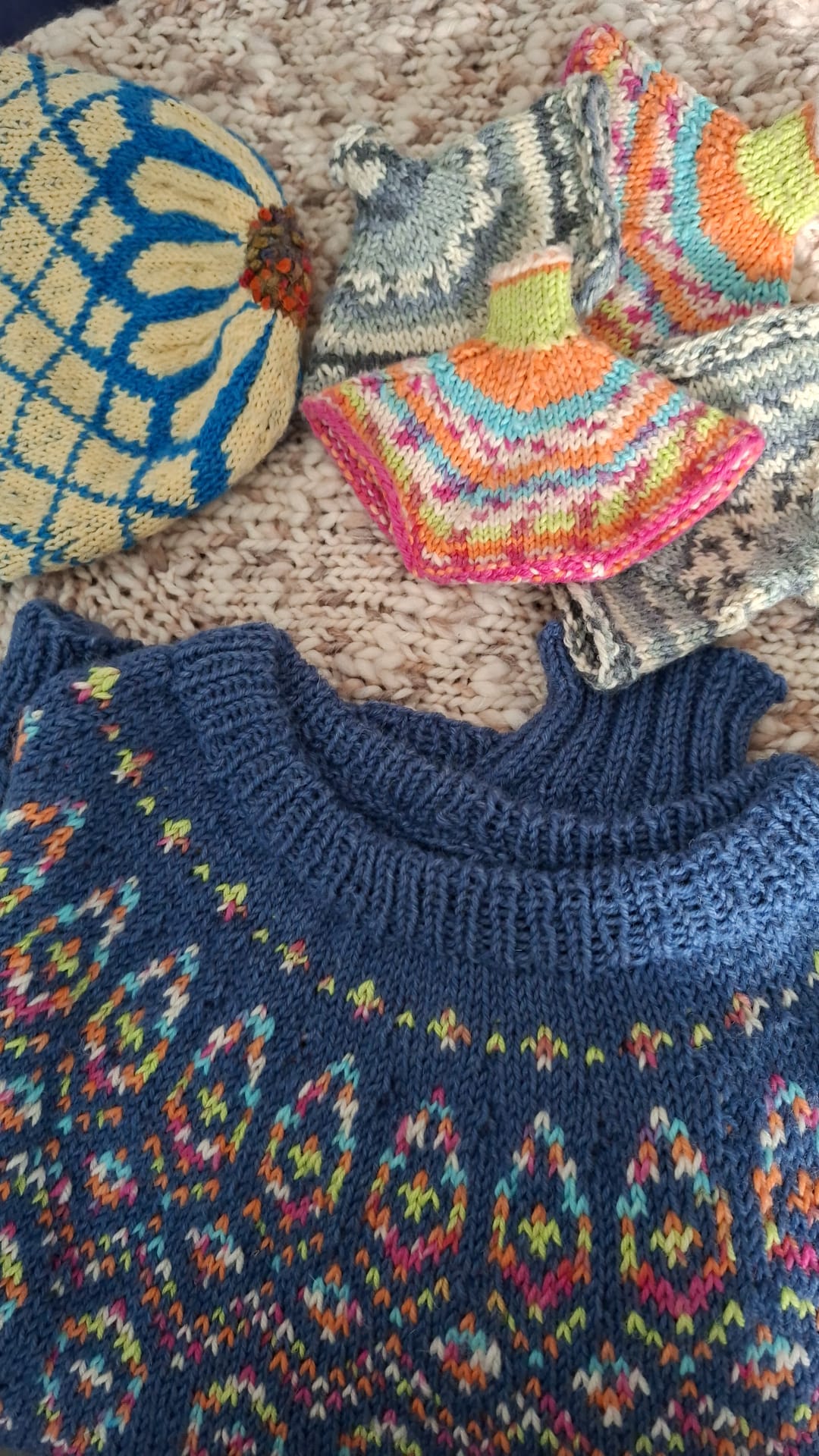
Stories from the Knitting Club – Chiara:
In 2020, I started knitting again after a long break. I was looking for a place where liked-minded people meet to exchange tips, and I also wanted to increase the non-work-related friends and acquaintances. I googled until I found a place compatible with my working schedule.
The first couple of times were online (COVID) but then I met the others face-to-face for the first time on a beach in Espoo! Loved it, even if there were only three of us at the time.
I definitely made new friends and attended other events. Mahjong is whispering “come, come you’ll have fun with me” but, so far, I am too distracted to listen properly.
I’ve attended Naked Ladies obviously (Ed: a clothes-swap event held 3-4 times a year). And a (weird) Finnish movie on cinema nights.
Several other knitters came via ECHA (the European Chemical Agency, here in Helsinki) and have also joined in several other Finnbrit events and become members of Finnbrit.
Stories from the Knitting Club – Emilie:
I heard about the Knitting Club from a friend who was working at Aalto when I was working there. I was quite busy back then, so I didn’t join right away but I finally joined in 2021 during COVID. It was online knitting meetings at first, but I enjoyed the atmosphere of chatting and relaxing and never left since then.
I am a rather slow knitter. I love knitting in the round and try to learn a new technique each year or expand my knowledge from a previous technique. It depends on the years and how busy I am, but I try to learn new things and also enjoy repeating some patterns I like. I usually have two or three works in progress at the same time. I’d rather invent my patterns than follow existing ones.
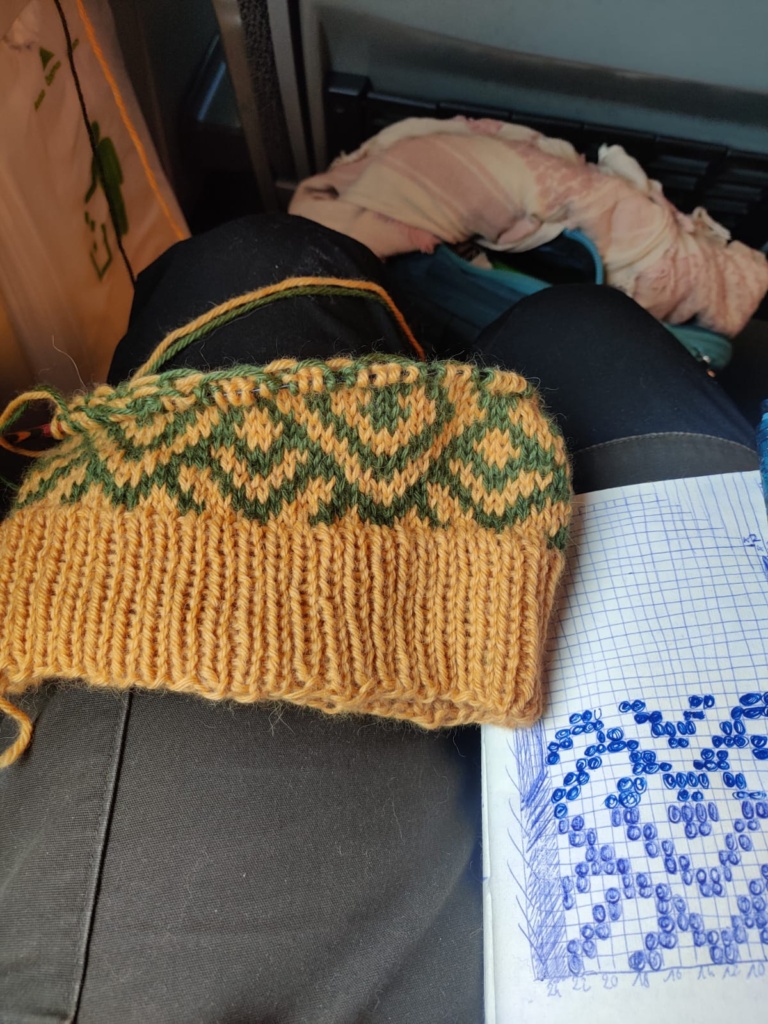
What I love most about the Knitting Club is the atmosphere, it is always warm and welcoming. It feels like being in a family, where everyone chats and has tea. The conversation topics are always fun. There’s always something to learn. At the same time, I feel that there’s no need to perform or be good at something, we are just welcome as we are.
I have attended a few talks and the open night at Finnbrit a few times. I went to a Thanksgiving dinner, organised by Finnbrit and a rugby team. Also, I finally attended the presidential ball viewing last December, very “Knitting Club” style, with some food shared and knitting while watching and commenting on the dresses and outfits. It was a fun time.
I really enjoy how Finnbrit is organising and supporting activities for the community. Thanks to the support of Finnbrit, I organised some henna tattoo workshops a few years ago, and Finnbrit helped me organise my first art exhibition in September 2025. I would not have dared to have an exhibition without their support. I met some lifelong friends here. It’s something precious.
Text by Mark Shackleton
Finnbrit 55/100
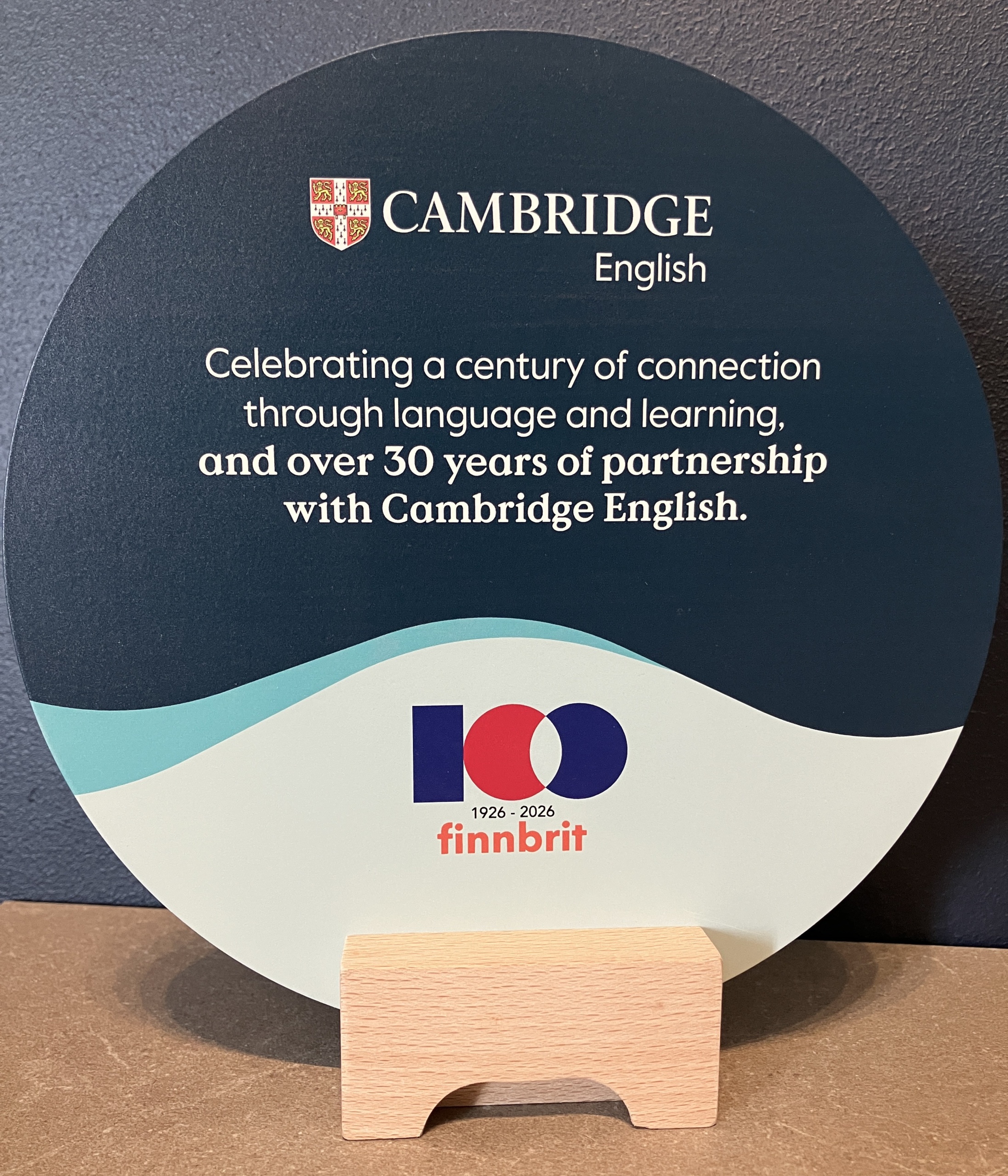
Finnbrit 56/100
FB at Freda
By Tony Shaw
A little corner of Britain
Up a flight of worn stone stairs.
A small corner in Eira
Where Brits outnumber the locals –
A very strange state of affairs.
A stolid room and solid chairs
Black wood and well-worn leather.
Teachers coming and going,
Examinees sitting silent, to wait
For counsel with significant others.
Elsewhere a hubbub of conversation
Later an evening of the same
Some here for evaluation
Others linguistic salvation
In a cultural cauldron without shame.
A taunting teasing loss of time
A hallowed haunt for one and all.
On Fridays full of ageing folkies
Sundays full of squealing tinies
Buggies lined up wall to wall.
Old and young here thrown together
Presidents old and royal Windsors
Regular folks and the hoi polloi
Working, walking, ever grateful.
Of this haven for passing visitors.
The Finnbrits of Helsinki
Quite a strange mix of names
From folk dancers in a blue tint painting
To Big Ben proud on another wall
All learning as someone wrote
To play up, play up and play the game!
(“Play up! play up! and play the game!” is the famous concluding refrain of the 1892 poem Vitai Lampada by Sir Henry Newbolt. It represents a Victorian-era ethos of courage, duty, and sportsmanship.)
Finnbrit 57/100
Selfie Corner competition
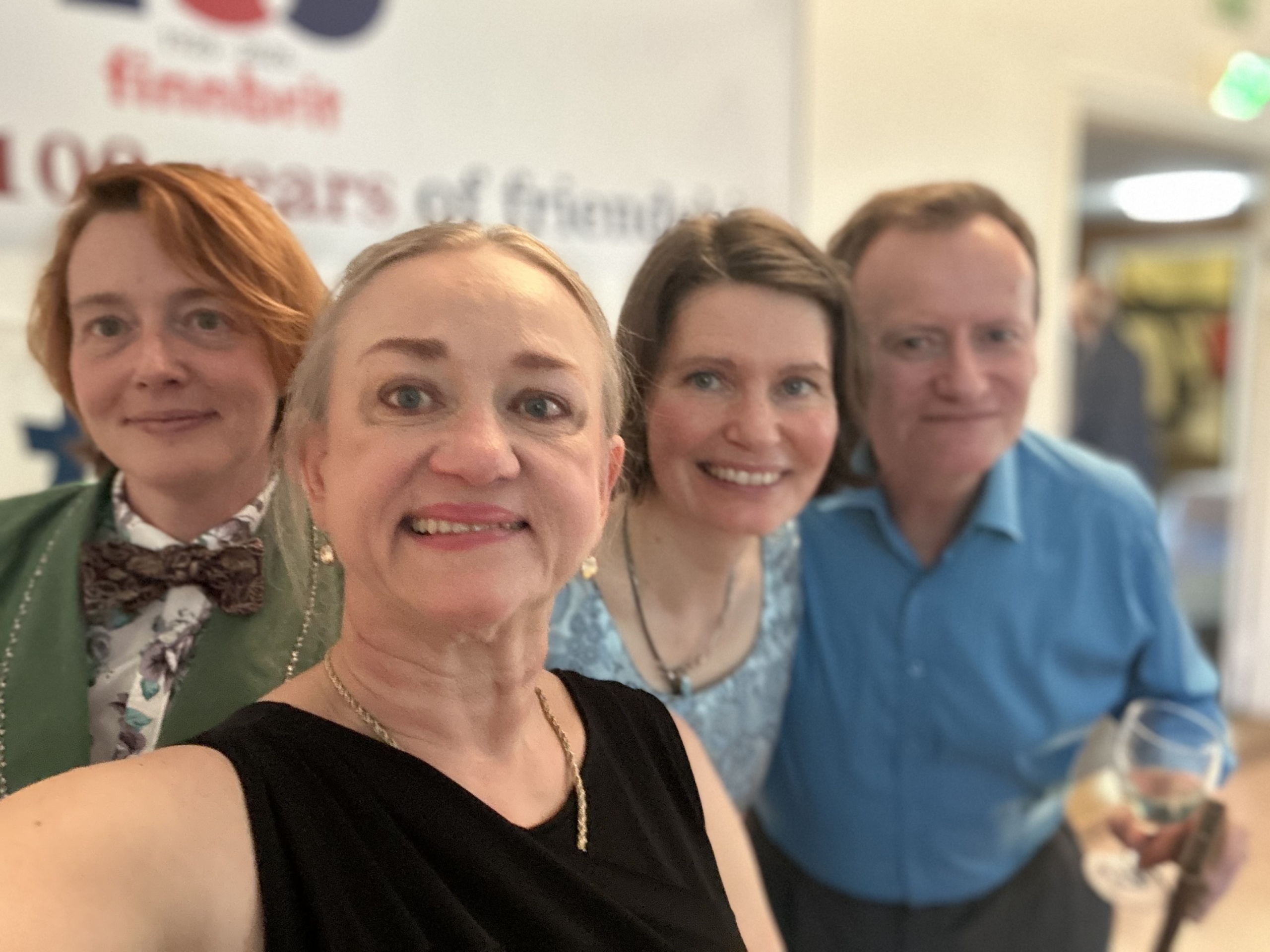
The winning entry from Mira Montell (pictured 2nd from left).
What a truly wonderful evening our 100th Anniversary Party on 23rd of May turned out to be! It was a fitting celebration of Finnbrit’s remarkable history, bringing together members, friends and distinguished guests in a warm and festive atmosphere.
A heartfelt thank you goes to all our performers, our dedicated volunteers, and every guest who joined us – your enthusiasm and support made this centenary celebration truly special.
We were delighted to host a special Selfie Corner competition provided by the Finnbrit Language Centre, to capture the spirit of the Anniversary Party. Guests were invited to share their favourite pictures, and we were blessed with some fantastic entries! A big thank you to everyone who took part and helped record memories of this historic occasion. The lucky winner was Mira Montell. She will be treated to a traditional afternoon tea for two at Salutorget.
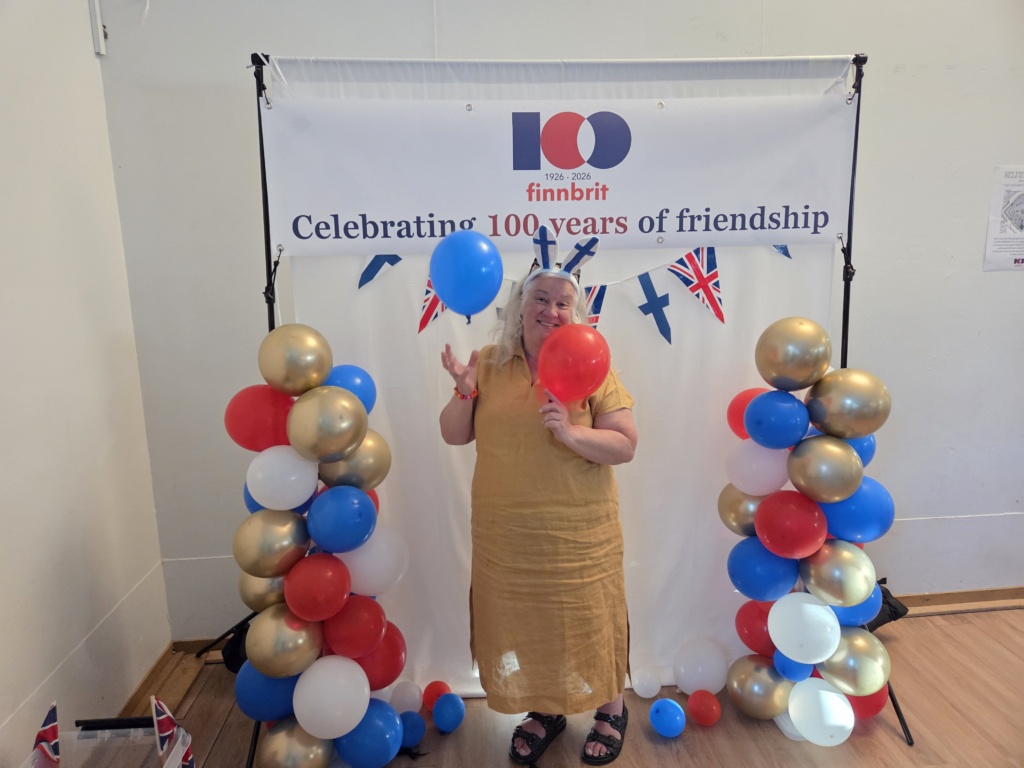
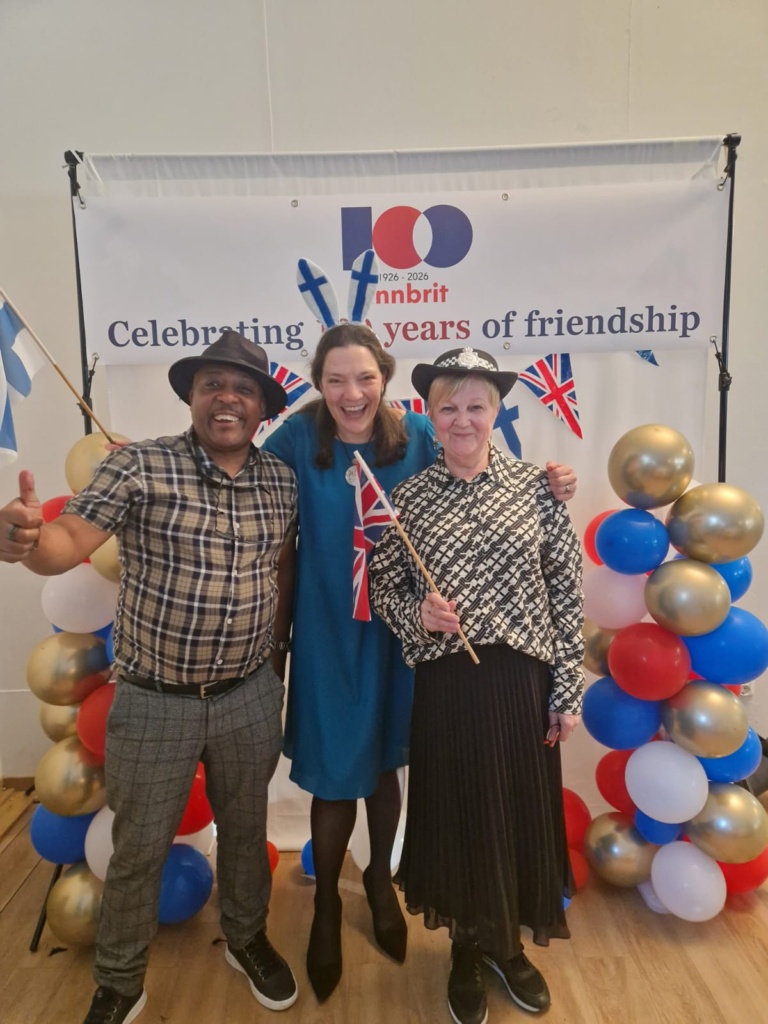
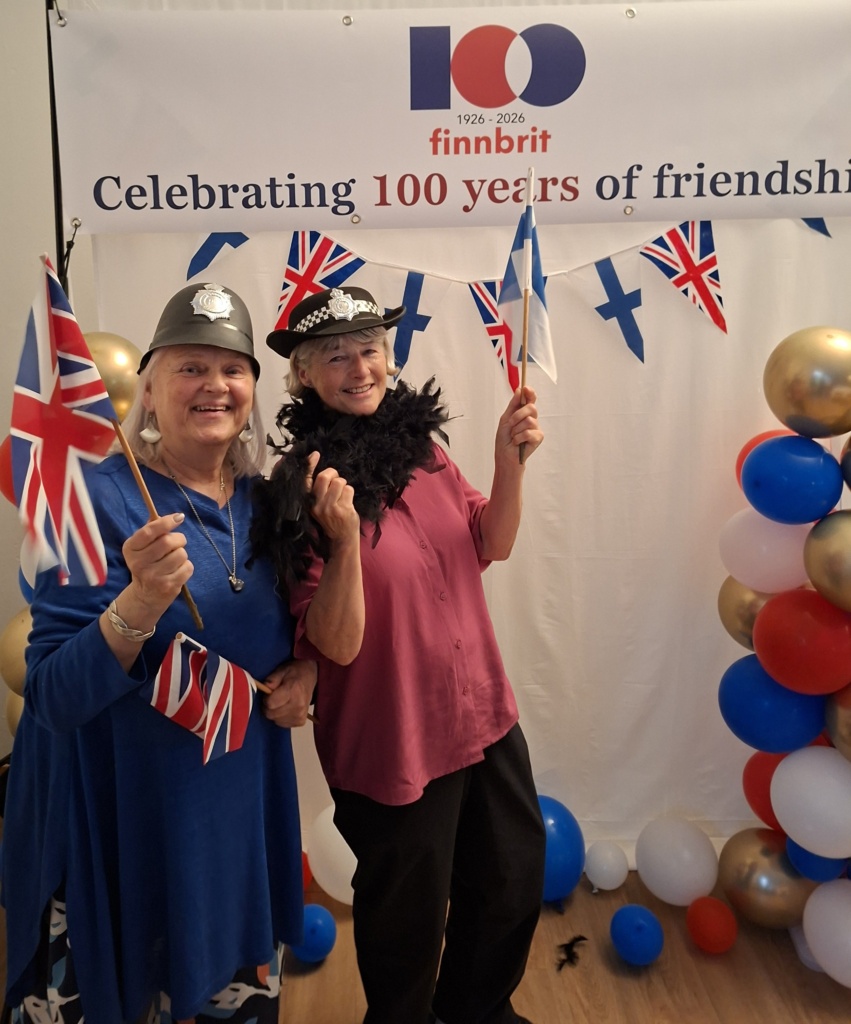
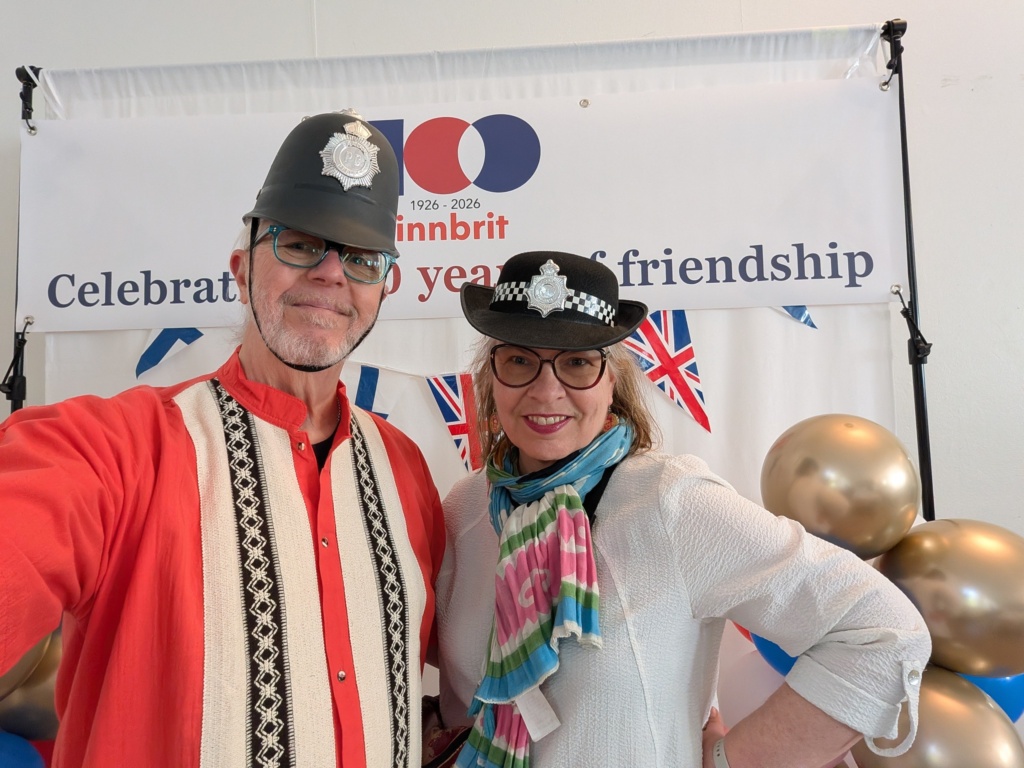
Finnbrit 58/100
Finnbrit Open House 2026
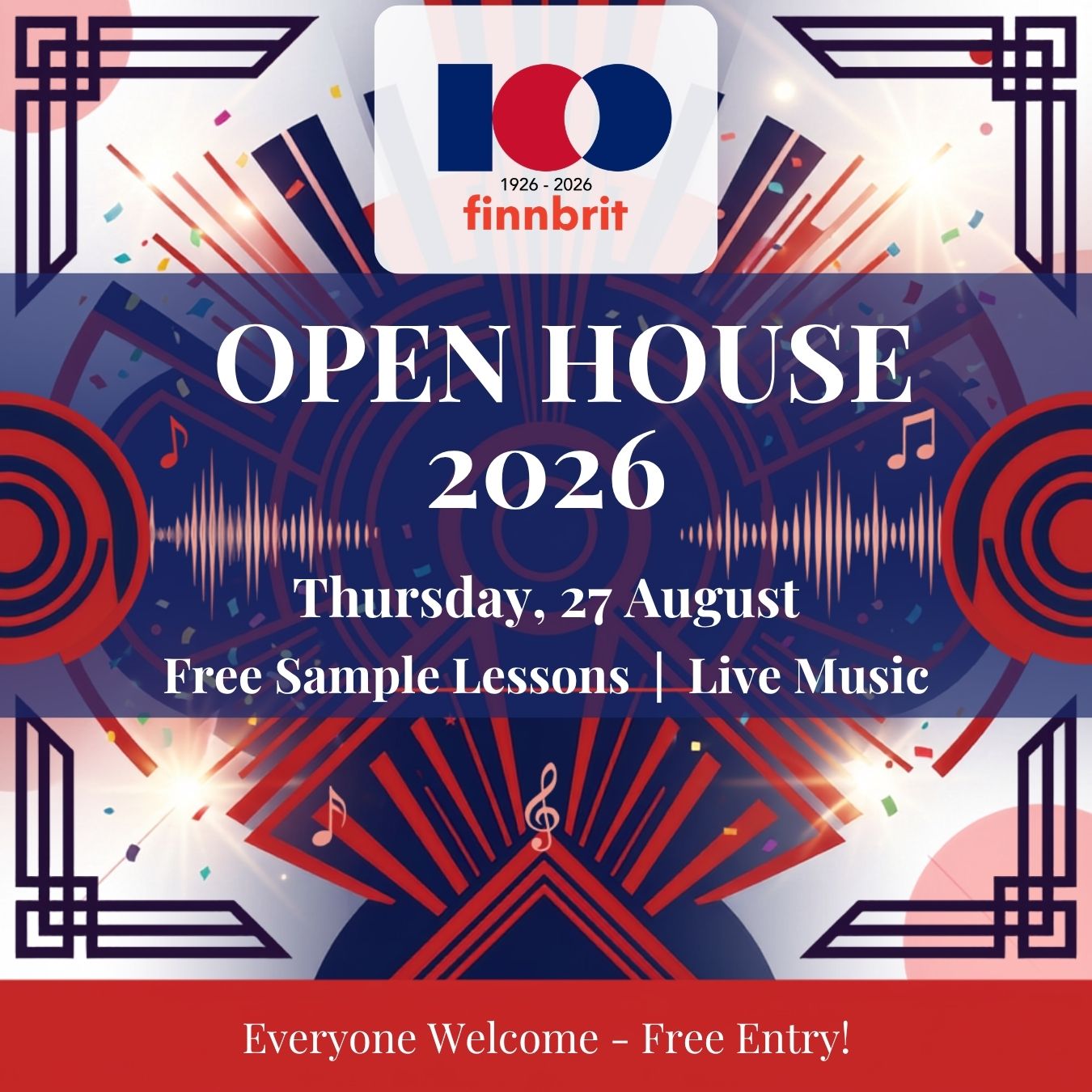
Welcome to a day full of exciting activities and good company at Finnbrit!
We open our doors to the public on Thursday, the 27th of August for the annual Finnbrit Open House. During the day, you can visit us for free lessons with our expert language trainers and free English level tests. During the evening, our premises will be filled with lively entertainment, including some wonderful live music. Come and see what Finnbrit is all about!
Open House Schedule
Free Lessons and Tests (booking required)
12.00 – 12:45 From Self-Doubt to Self-Confidence Book now
13:00 – 13:45 The Benefits of Learning English Book now
13:00 – 15.00 Free Level Testing Book now
14:00 – 14:45 Small Talk in English Book now
15:00 – 15:45 Boost your Vocabulary Book now
16:00 – 16:45 Prepositions – The Curse of the English Language Book now
17:00 – 17:45 Finnish Language Café Book now
Entertainment (more details coming soon)
The evening entertainment will include live music from the Finnbrit Folk Club Band.
You will also have the chance to hear about our clubs and the meet Finnbrit members.
Schedule is subject to change
Finnbrit 59/100
British Intelligence Officers in Helsinki
from the 1910s to the 1940s
Picture: Juho Kotakallio PhD
Friday, 4 September 2026
18:00-20:00
Reginald Walter “Rex” Bosley (born 1909 in Erdington, UK) was a member of the Helsinki Finnish–English Society, later named Finnish-British Society. He appeared as an actor in the amateur theatre organised by the society.
Bosley was also an intelligence officer of the United Kingdom’s foreign intelligence service, MI6, also known as the Secret Intelligence Service (SIS). In Bosley, the British government had a significant informal channel of communication with Prime Minister, later President, Urho Kekkonen.
Bosley had the nickname The Ferret and his intelligence officer codename was Taulukauppias (“art dealer”).
Join us at Finnbrit for an evening of insight into the largely overlooked British intelligence presence in Finland — a young country neighbouring one with huge power — and the intelligence services that operated beneath the surface during the years on both sides of Finland’s independence.
Juho Kotakallio PhD completed his doctorate in general history at the University of Helsinki with a dissertation on British intelligence activities in Finland between 1918 and 1941. As a historian, he has specialised in international relations, particularly intelligence history. Kotakallio has also completed a Master’s programme in Cyber Security at the University of Jyväskylä.
Finnbrit 60/100
On a Jetty — a Memory Loiters
Memories: some linger; many fall uncertain; some recall affections; others rouse discomfiture.
We stood on a Helsinki jetty, one agreeably balmy evening — in August … I think. They was dressed in a pale suit — was it …? They held a glass of wine. I, a Lapinkulta … possibly. We talked of Finland; of the seasons.
Privately, I recalled a job interview: long, warm summer days; lakes; saunas, they’d said; white nights — no mention of mozzies! And snowy winters; skiing under bright blue skies. Was they selling a tourist destination …?
Whatever, I came, and I remain, nearly half a lifetime later — accumulating more memories.
RM
Finnbrit 61/100
A Letter from Oulu
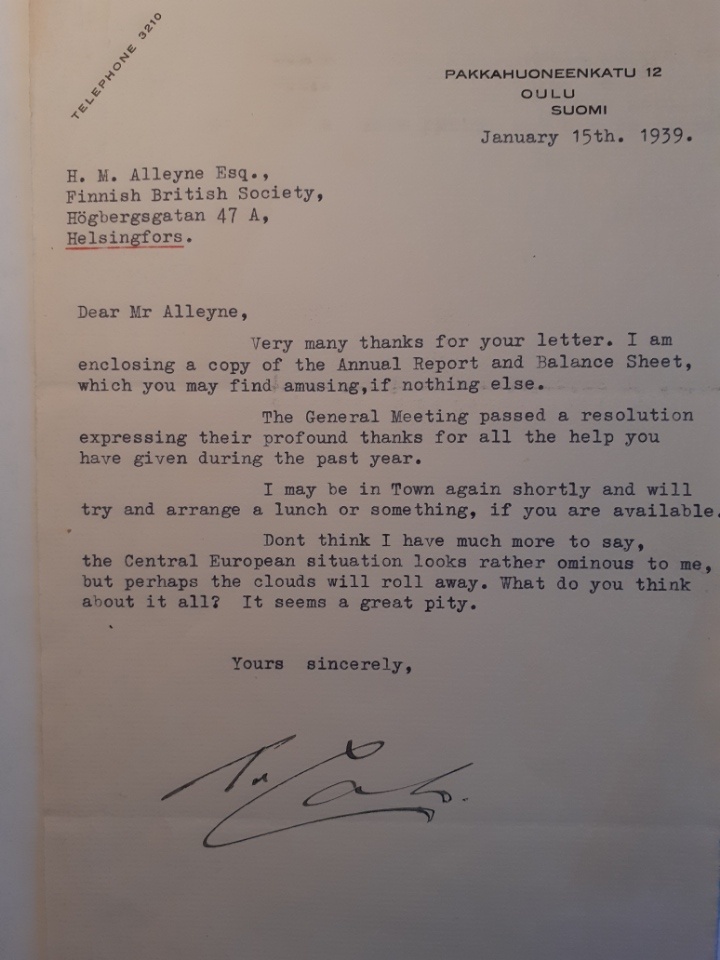
There are a number of large boxes at the Finnbrit premises containing documents relating to the Finnish- British Society in Helsinki that go back to the 1930s. It has made for fascinating reading.
Here is a letter dated January 15th, 1939, sent by the Chair of the English Club of Oulu to the Chairman of the Finnish-British Society in Helsinki: “I am enclosing a copy of the Annual Report and Balance Sheet, which you may find amusing, if nothing else.” I love the suave, sophisticated tone, but one wonders what could be amusing about a balance sheet. Cleverly appropriated funds? Laughably small turnover? We’ll never know.
The English Club of Oulu was founded in 1935, just seven years after the Finnish-British Society in Helsinki. It’s heart-warming to read that Helsinki gave significant help to the Oulu friendship society during those early years. But this pleasant personable letter ends on a note of disquiet: “the Central European situation looks rather ominous.” Yes, indeed. Less than nine months later the world would be embroiled in a terrible war.
Text by Mark Shackleton
Finnbrit 62/100
Churchill and Mannerheim: Comrades in Arms
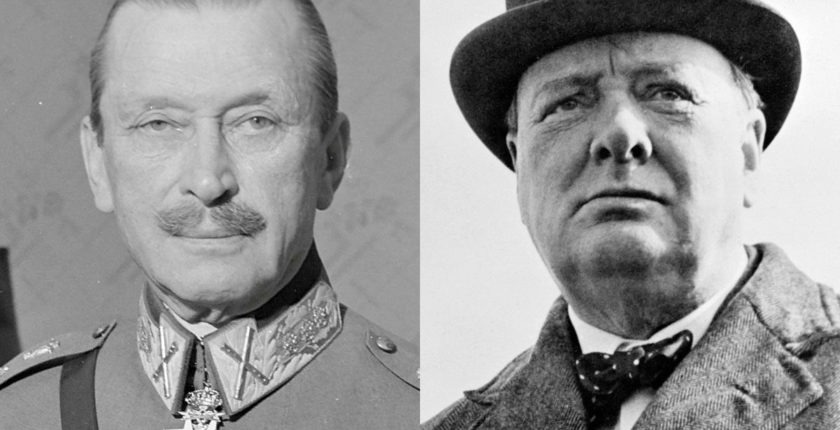
The Second World War marked a break in the Finnish-British Society’s activities. Whilst formally declaring war on Finland, under Winston Churchill Britain never took action against Finland, largely thanks to Churchill’s admiration for Marshal Mannerheim.
Churchill was “deeply grieved” at having to declare war on Finland, and on November 29, 1941, telegrammed privately to Mannerheim in the hope that his comrade in arms would cease military action against Russia on the Eastern front and in effect opt out of the war:
I am deeply grieved at what I see coming, namely, that we shall be forced in a few days, out of loyalty to our Ally Russia, to declare war upon Finland. If we do this, we shall make war also as opportunity serves. Surely your troops have advanced far enough for security during the war and could now halt and give leave. It is not necessary to make any public declaration, but simply leave off fighting and cease military operations, for which the severe winter affords every reason, and make a de facto exit from the war… My recollections of our pleasant talks and correspondence about the last war lead me to send this purely personal and private message for your consideration before it is too late.
Mannerheim writes back:
I thank you for your courtesy in sending me this private message. I am sure you will realise that it is impossible for me to cease my present military operations before my troops have reached positions which in my opinion would give us the security required.
He adds that he too would be “deeply grieved” if his attempt “to safeguard Finland” led to war with Britain, and closes by saying, “It was very kind of you to send me a personal message in these trying days, and I have fully appreciated it.
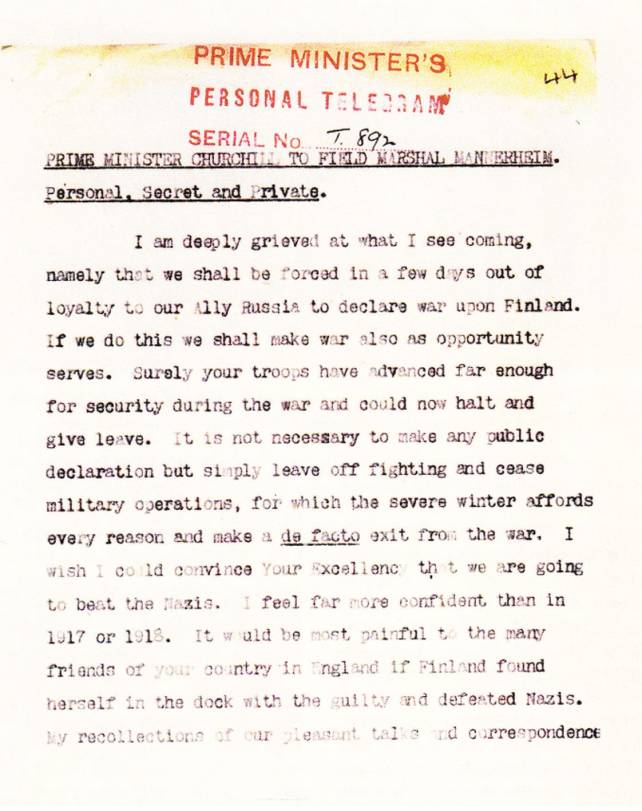
As one commentator has put it: Was there ever such a polite declaration of war between two countries?
Text by Mark Shackleton
Finnbrit 63/100
Arriving in Finland
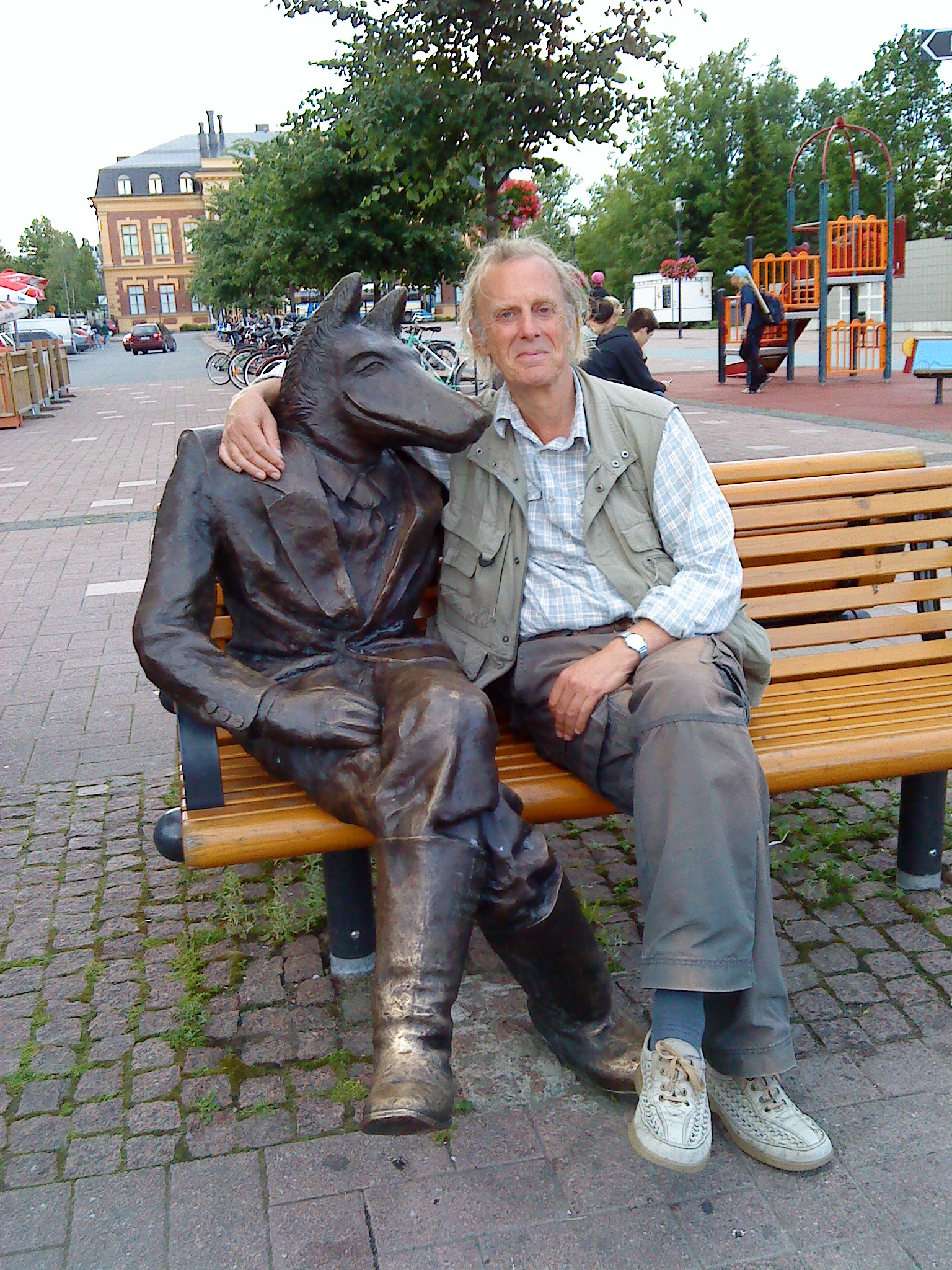
By Andrew Chesterman
Introduction: During its 100-year history, Finnbrit teachers have been assigned to teaching posts all over Finland. Andrew headed for Savonlinna in 1968, where the tables turned and his students delighted in tutoring him as he faced the task of learning Finnish.
I was to arrive in Finland in the glorious late autumn of 1968. A group of about 25 of us, under the auspices of the British Council, were to take a Russian boat from Harwich, which was en route for Leningrad (as was). A couple of days before departure, however, no tickets had arrived, and my parents were getting a trifle concerned that their son was cheerfully preparing to set out for the Arctic without the necessary paperwork! The British Council calmly informed us that the tickets for the whole group were being posted to me, and I was to distribute them in Harwich. They turned up the next day, and our group was able to set off for its Nordic adventure. One of our number, Mike Peacock, had been to Finland before and taught us the wonderful song Ison Talon Antti ja Rannanjärvi. We had no idea what anything meant, but were soon singing with gusto, accompanied by Donald Adamson’s guitar. Our group was to be scattered all over Finland, but we kept in touch and, later, even made a memorable trip to Leningrad and Moscow.
I was headed for Savonlinna, having chosen this destination over the British Council’s other offer, Bogotá, in Colombia. Finland would be cooler, I thought. I had taken the opportunity to listen to a few bits from the Linguaphone Finnish tapes in the university language lab. Finnish sounded, hmm, different. But I had read French, German and Spanish at university and spoke the Queen’s English fluently. I was ready for anything.
What I was not prepared for was my first sight of Finland. I came up on deck before breakfast on the last morning as we were moving gently through the archipelago, on a smooth sea with the sun shining. Rocky islands slid by, trees, more trees, small houses… I was overwhelmed by the beauty of it all. I felt, immediately, that this was to be my home, my natural place.
The only Finn I had ever met was a musical friend of my father’s. He had been invited to supper a few times and enjoyed my parents’ conversation. Matti Kilpiö was a scholar of Old English, a singer, a musician: a cultured humanist gentleman of the highest order. Clearly, other Finns would be similar. He and I met up again some years later, when we were both working in the Helsinki University English Department, and I became very fond of his whole family. However, I never met anyone remotely similar!
On our arrival in Helsinki, we endured a few days of orientation, during which our group were offered some talks on Finnish history and culture, with special emphasis on the dreaded Culture Shock and how to cope with it. I, fortunately, escaped this fate having spotted a packet of cornflakes in a Helsinki grocer’s window: just like home! Nowdays, I get an emotional sense of ‘coming home’ when the Finnair plane lands at Helsinki Airport.
In Savonlinna, I was given a warm welcome by the local Finnbrit committee, chaired by Mrs Auvinen. I was handed a report from the teacher who had been there two years previously, because the more recent report seemed to be missing. I later learned that my predecessor had given up, halfway through their assignment, and returned to Britain. Later, I thought of this poor Brit when I heard about a teacher assigned to Oulu: the story was that she had turned back from Oulu Airport as soon as she had arrived; Culture Shock with a vengeance!
I was lucky. For the first months, I was kindly given bed and breakfast by the family of one of the Savonlinna Hospital doctors, the Haikonen family. They lived in a lovely terraced house directly overlooking the lake. I learned the sauna rituals and even took a dip through the ice. I loved the views as I walked around the town.
I made slow progress with learning Finnish: analysing the menus in the cafes where I had lunch, trying to make sense of Aku Ankka and swapping roles with a group of schoolchildren. When we met after school, the pupils would try to teach me Finnish. I would kid them that Finns had no sense of logic: wearing a hat inside the head (hattu päässä), and socks inside one’s feet (sukat jalassa)! Sitting in a table (istua pöydässä)! What do pineapples have to do with operas (as in oopperavoileipä)? How can you manage without he and she? Much laughter on both sides. How on earth do you manage without definite and indefinite articles? What do you do instead? This last question eventually led me to a PhD topic.
AC, suomalaistunut britti (A FennoBrit)
Finnbrit 64/100
Teaching English at Puistokatu
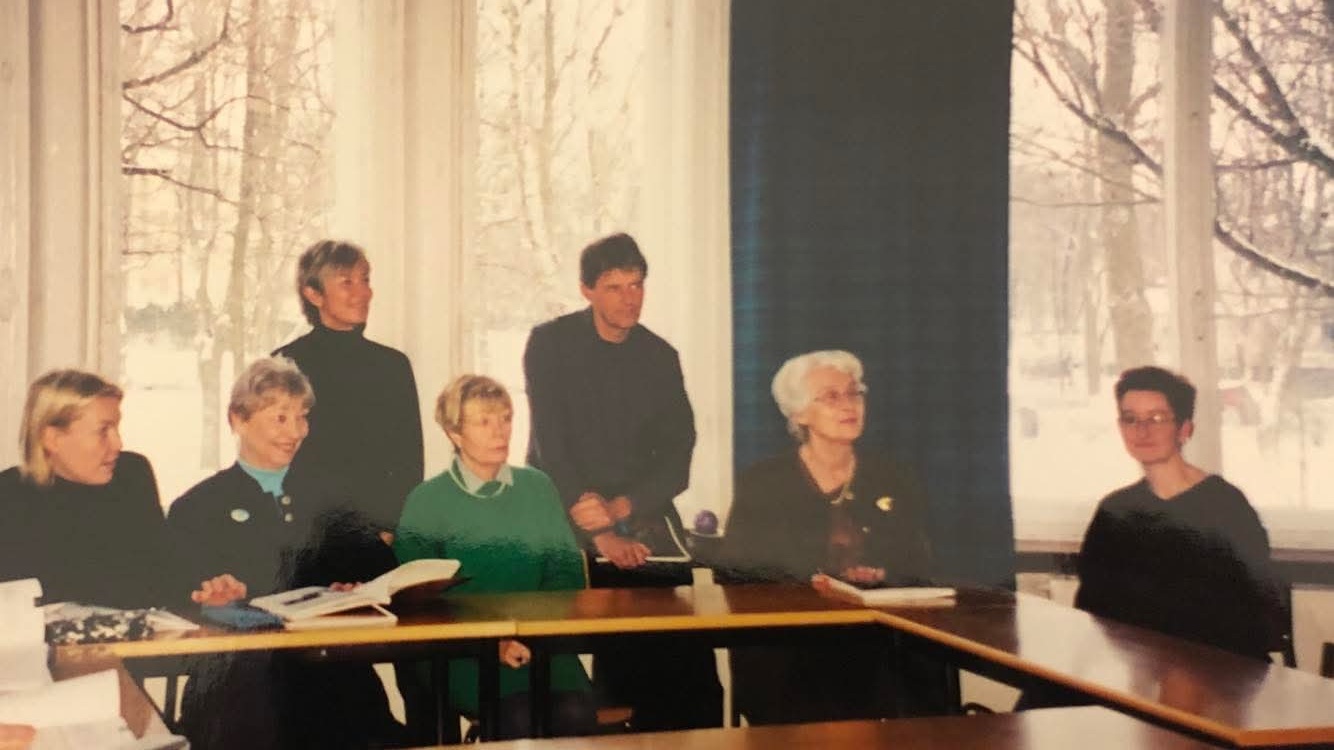
The classrooms of the Finnish-British Society down on Puistokatu were elegant rooms – the premises had earlier been the home of Arvo Ylppö, the renowned creator of Finnish medical care for the newly born (which included the Baby Box provided free to new mothers: a 90x50cm cardboard box filled with baby care products, that could even be used as a crib for the newborns). Many rooms* featured a large kaakelliuuni, the traditional tiled wood-burning stove, the ceilings were over three metres high, and two of the classrooms looked out onto the grassy parkland of Kaivopuisto or Wellspring Park, where originally a spa had been located during the Russian period of Finnish history.
In the days prior to Finland’s accession to the EU in 1995, the demand for language teaching in the capital was considerable, with many ‘cowboy language schools’ offering expensive ‘tailor-made’ courses to unsuspecting but aspirational Finns at exorbitant prices. The courses at Puistokatu were also not cheap, but many had long been linked to the graded language exams run out of the University of Cambridge. Apart from these very structured general English courses (followed by lengthy day-long exams held there twice a year) there were other more specifically targeted ones. Courses for lawyers, for secretaries, for doctors were all run by teachers who often had little or no personal knowledge of the subject! I felt rather fraudulent teaching a course in commercial English when my only knowledge was remembering my father’s tales from his shipping office in the City of London. But with my Teachers Copy of the set book and, of course, a tie at my collar, I bull-necked my way through the lessons!
The students were generally in their 20s and 30s and, in those days of monoculturalism, were almost exclusively Finnish. Some were funded by their employers to upgrade their skills, and almost all could expect a modest bonus on their salaries if they attended a course; possibly more if they passed an exam accredited by that illustrious British seat of learning! The highly decorated printed certificates were much valued, and the Society even offered their own assessment certificate: an elaborate document, prominently featuring the Society’s stamp and the teacher’s signature.
In line with the elevated prestige of its address, the decoration in Puistokatu was sombre. Dark panelled walls predominated in the central Club Room, the largest of the rooms where reposed the black leather sofas, reputedly of Russian origin, donated by founders of the Anglican Church in Helsinki following the revolution in the east. Students awaiting the start of their classes would sit in silence there, possibly overawed by the formality of their surroundings. Above them on one wall was a formal portrait of Queen Elizabeth II facing, on an opposite wall, photographs of a selection of recent Finnish presidents.
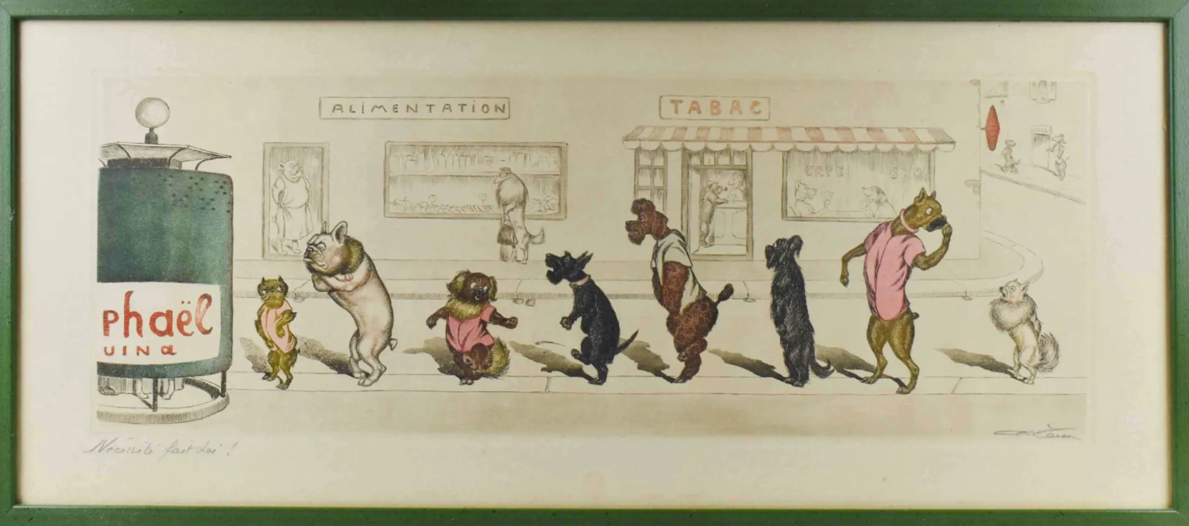
The decor was grand, and the demeanour of most who entered there was usually demure. However, two features of the establishment somewhat mitigated this status. First, were the dimensions of the toilet facilities: a small room off the entrance hall, possibly added when outdoor facilities of earlier years were upgraded. On the door hung a cartoon drawn by French artist Boris O’Klein, with the warning caption ‘We apologise for the inconvenience of our convenience’. The second was the behaviour of some students after the well-attended Christmas parties. In contrast to the inhibited reserve that they demonstrated in the classrooms, on these occasions tongues were liberated and loosened, and the language flowed —like the waters in the old Wellspring Park spa, maybe?
* One teacher recalled having to teach classes there in the 1970s while wearing a hat and overcoat during a particularly chilly spell of weather.
Text by Anthony Shaw
Finnbrit 65/100
Penelope Roux interviewed by Mark Shackleton
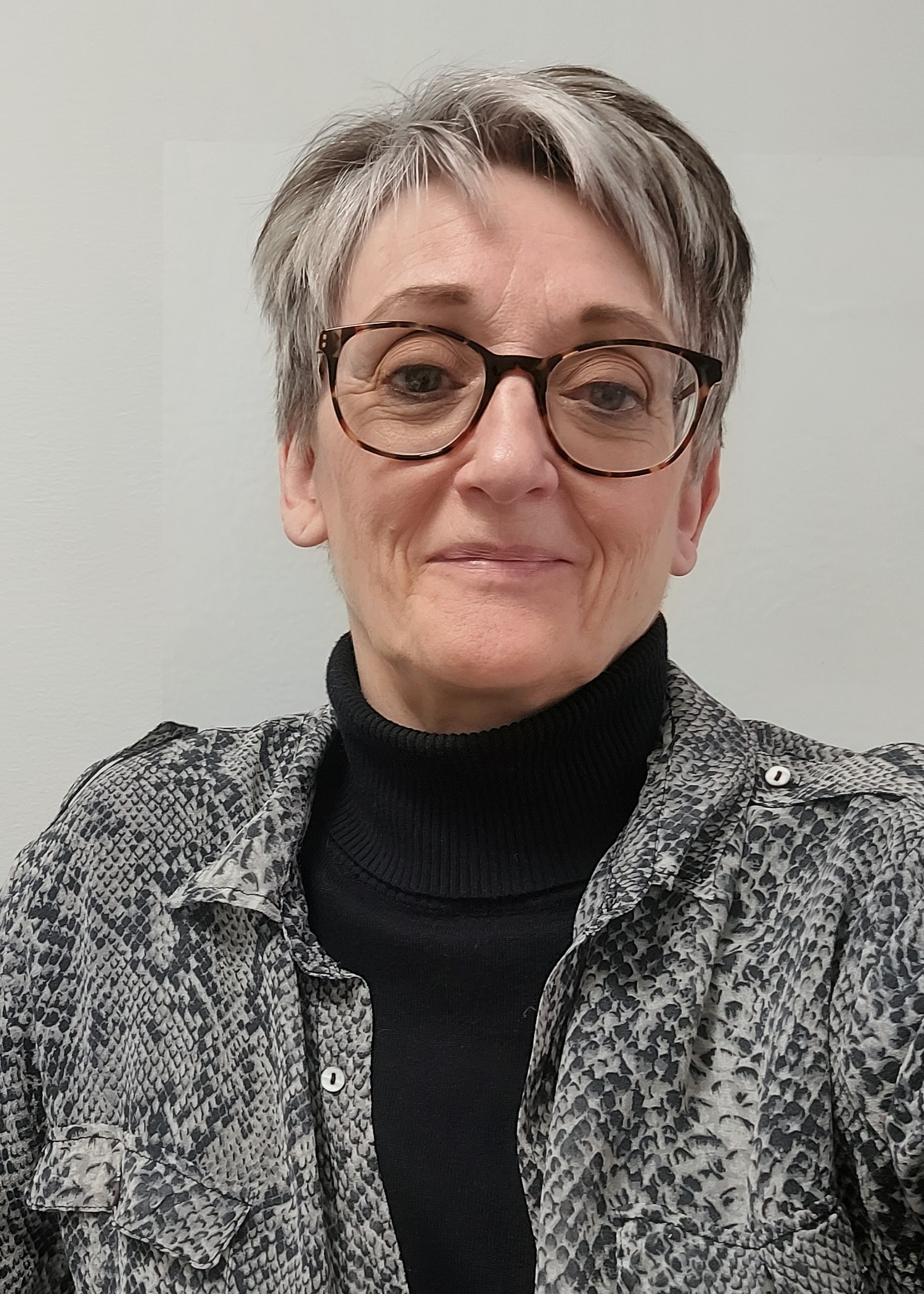
Mark: Can you tell me a bit about the work you did before you became a Finnbrit teacher in Helsinki?
Penny: Before teaching, I had a 20-year career in a multinational computer company, working mostly in accounting, finance and audit. I was based in France for most of that time, but I also travelled all over the world for my work and spent about a year in the USA, based in Massachusetts. In 1999, I decided I had had enough of corporate life (which was not really compatible with having three small children) and I enrolled in a one-year teacher training programme at the University of London in Paris. I just managed to finish the course before moving to Hungary as an ex-pat spouse! I didn’t have a work permit for Hungary, so I spent a couple of years enjoying the cultural scene of Budapest and helping my own children to switch from French (their first language) to English.
Mark: What brought you to Finland?
Penny: Nokia… my Finnish husband was offered a job in Espoo in 2001! Initially, we didn’t plan to stay here permanently but we quickly realised that this was home! My first teaching job was with Espoo city, teaching English to children in primary school. I also began teaching on a freelance basis in several different private language schools.
Mark: What kind of classes did you teach at Finnbrit?
Penny: My first contact with Finnbrit was as a level testing examiner. I did my initial training in Copenhagen with another teacher from Finnbrit. Those first speaking tests were quite scary. It is a high-stakes exam for the candidates, and the results can transform lives, so the examiners have a huge responsibility to ensure everyone is treated fairly. I loved that work: there was a wonderful team spirit among the Finnbrit examiners, invigilators and administrators. Everyone in the team was very professional. And the test-takers were amazing: I learned so much from listening to candidates from all over the world. At times, it was a humbling and also quite an emotional experience.
As for teaching, if I remember correctly, I visited a lot of law firms and banks! It is wonderful to get a glimpse inside some of those company headquarters located in the beautiful Jugend-style buildings in the city centre. I was mostly teaching English for business but with a focus on communication skills: giving presentations, negotiating, making proposals, pitching ideas and, of course, the biggest challenge of all: small talk! I also spent a couple of years commuting to the airport twice a week, delivering Boost your English to Finnair cabin crew.
As for English classes held at the Finnbrit premises, I taught Sounds Good–a pronunciation course–many times. I also taught Stepping Stones—a coursebook I had co-authored, published by Finn Lectura, which targets more mature learners. And, of course, I ran several courses of advanced English for business with some fascinating participants from a wide range of professional backgrounds: retail, healthcare, IT, engineering. For sure, I learned something new every day; I hope my students did, too!
Mark: How did you find Finnish adult students? Were they much different from other language classes you’ve taught?
Penny: At Finnbrit, most of the classes typically have as many non-Finnish adults as Finns which brings new perspectives on language and culture into the classroom. In that respect, I don’t think my classes were so different from others I had taught elsewhere. Every student is different in terms of the personal goals they have for their own language proficiency. Not everyone is aiming for grammatical accuracy. Some students just want to feel more confident. I remember one student telling me that they often told jokes when giving presentations in Finnish but didn’t know how to tell jokes in English. Now that was a challenge! Another student told me that her goal was to speak like someone who had had a prestigious private school education in England.
Mark: A big question – but what in your experience are the strengths and weaknesses of Finns as English language learners?
Penny: That is a really big question because Finns as language learners have changed considerably over the 20 years that I have been teaching in Finland. If I focus on the here and now, I think Finns, especially young adults, have gained hugely in confidence and fluency. However, there is maybe less motivation to achieve the highest levels of proficiency. I’m thinking of those little ‘fossilised’ errors in the use of articles (a, the) and prepositions, punctuation differences and Finnglish sentence structures! I’m not sure this constitutes a weakness, though: maybe ‘good enough’ is enough.
Mark: More recently you worked at the Helsinki School of Business. What do you think needs emphasizing in Business English classes for adults?
Penny: Yes, I was Programme Lead at the Helsinki School of Business before I retired in May, 2025. Helbus teaches its Bachelor’s and Master’s programmes in English (but not specifically ‘business English’). However, throughout the programme, there is a focus on the development of interpersonal communication skills and helping students to adapt their English for different practical situations; these are skills which are transferable to working life.
Mark: Looking to the future, should more or less effort and resources go into learning English as a lingua franca for business people in Europe?
Penny: The use of generative AI will have a massive impact on how English is used in business. AI tools already exist for translating texts, editing and proofreading, summarising and synthesizing information, creating presentations and even copywriting and creating documents such as contracts. Will this mean that individuals and companies feel less inclined to invest resources in language training? Possibly. On the other hand, AI will also make personalised language training much more accessible. I do think it will be a shame if the human element–the teacher, classmates–no longer has a role in language training. What if all non-native speakers end up sounding like chatbots when they speak English?
Generative AI can produce texts which are faultless, grammatically, but they are often bland, generic and formulaic. I would much rather read an essay or an article that has a non-native flavour to it and the genuine voice of the author with their unique idiolect coming through.
Finnbrit 66/100
Mark Shackleton: My First Day with Finnbrit in 1975
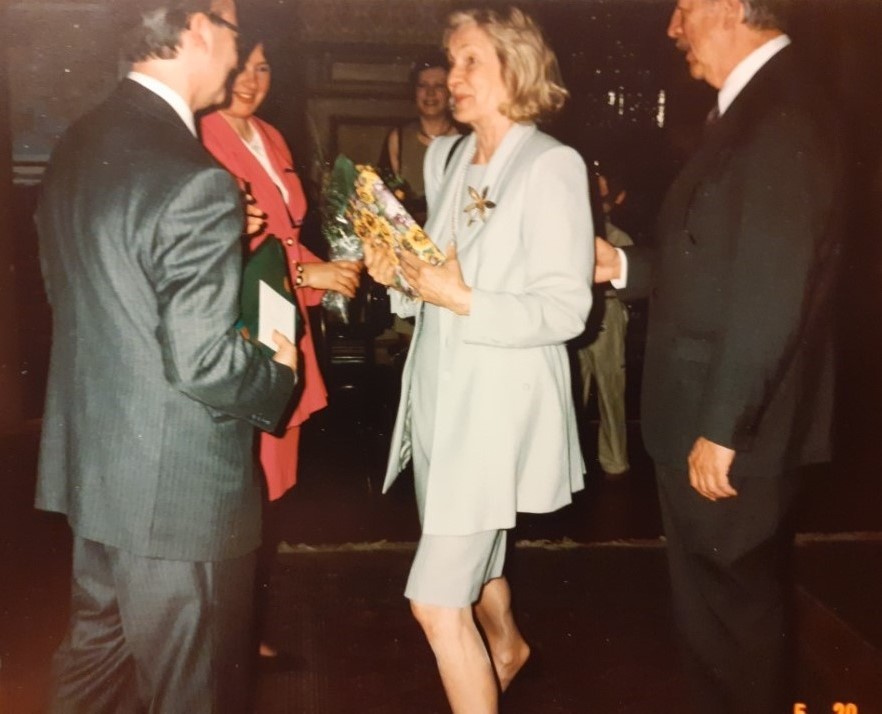
Click on the play-button to hear about Mark Shackleton’s first day with Finnbrit in 1975.
Picture – Mark Shackleton (left) with former Finnish-British Society Director Marja Salo.
Finnbrit 67/100
We wrote the book on it!
Pictured (left to right): Penelope Roux, Christian Evans & Henry Loveless
Finnbrit’s teacher-authors share the secrets of writing coursebooks for language learners.
We’re a small community at Finnbrit, but good things come in small packages.
Among our number are some truly remarkable people, with amazing knowledge and experience and our teachers are no exception.
We must be doing something right because there are currently at least ten English coursebooks written by Finnbrit teachers available in bookshops, and at least three more on the way.
We asked three of our teacher-authors about the secrets to writing a good English coursebook for adults.
Henry Loveless: English teacher, copywriter, gardener, orienteer, father of two. From Bristol, UK, now living in Helsinki, Finland. Co-author of the Come Along series.
Christian Evans: English teacher for 30-odd years, football dad, Westie servant, half Welsh – half Finnish. Living in Kirkkonummi, Finland. Co-author of Around the World -Matkailuenglantia (Travel English)
Penelope Roux: Semi-retired after more than 20 years working in education and 20 years in business and finance. Beekeeper, gardener and active Finnbriter living in Espoo and Raasepori. Co-author of Stepping Stones and Voices and Echoes.
How do you start writing an English textbook?
HENRY
Otava / Finn Lectura came to us individually with the idea. They had a clear idea about the market that needed a textbook. Then as a writing group, we started to plan the structure, the content (topics, grammar, vocabulary, etc.) and we talked about the things we would like to do. Once we had a plan, we started to divide the work. Like any new job, there were so many pieces to organise at the beginning, and it was very confusing, but soon it all made sense. By the time we had written the first half of the book, we had a pretty good working system; we also had thought of a name: Come Along.
PENNY
I could write a whole book about how to write a coursebook! First, you need to build your writing team, ideally authors who share your vision to avoid wasting too much time arguing over the process or content. There is a lot of preparation to do before the writing starts. For example, I think it’s helpful to agree on a framework, such as the ‘can-do’ statements from the European Common Framework of Reference (ECFR) and then the profile of the learners who will be using the book, so the writing team has a coherent approach to producing materials that are appropriate, relevant, and also sufficiently supportive and challenging.
Personally, I prefer to work in a team, meeting regularly to review each other’s work, next steps and new ideas. This may slow down the process but, in my opinion, collaboration reaps huge rewards for the writers, the teachers and the learners alike.
CHRIS
For a book I co-authored with Anni Holopainen and Mari Laakso-Suutari, Around the World -Matkailuenglantia (Travel English), I was fortunate to be contacted by the publisher Otava/Finn Lectura, who offered me the project. Having written a book with the same publisher earlier, I like to think ‘I was in their good books’. The process involved many tasks, including meetings, planning, research, and the most demanding part: editing, editing, and editing.

What makes an English coursebook good for Finnish people?
CHRIS
I think a good coursebook should be fun and practical. For Finnish learners I think it’s also good to have vocabulary lists both in Finnish and in the target language. If you are looking for a good coursebook, you could ask a language teacher, browse the library, or check out a publisher’s website. For instance, Finn Lectura has so many great language books and helpful information.
HENRY
Every learner is unique, but there are often issues that learners from the same country share. All of the authors in our group had extensive experience with Finnish learners. Between myself, Anja Odell, Susanna Ylihärsilä and Elina Vienamo, we had been teaching English to adults for almost 100 years! We knew what worked, what didn’t, and what was useful or interesting.
It’s also important to have a local publisher that has a long history of preparing textbooks for language learners in Finland.
PENNY
When Liisa Huhtala-Halme, Nanna Qvist and I wrote Stepping Stones, published by Finn Lectura (now part of Otava), we were very aware that the book needed to work for the multicultural classroom. However, we did focus on grammar that is challenging for native Finnish speakers such as the use of prepositions, the syntax of passive sentences, future structures and pronunciation.
More importantly, the materials need to motivate learners to produce language spontaneously, so it is really important to include lots of group activities that support this and help the students become more confident.
What should we look for in a book for adult learners?
PENNY
Adult learners are a diverse group: they can be anywhere between 20 and 80 years old! They also have different professional backgrounds and a huge range of goals and aspirations. Some will be learning English to boost their careers, others for taking holidays abroad, and many study for the benefits that language learning can bring to cognitive function —yes, it really can slow down ageing in the brain!
Additionally, I think a coursebook for adults should not shy away from difficult topics such as discussions on politics, social issues, money or religion. Many international publishers actively avoid these sensitive topics in order to make their books accessible to a global market.
HENRY
Adults are motivated in different ways. They have no obligation to learn, like at school. This means it’s very important for the book to be interesting and relevant. If not, students can get bored and give up.
CHRIS
For adult learners, it’s especially important to have content that is relevant and practical, focusing on things they can use. For example, travel English is a practical topic, and learners can use what they study in real-life situations.

What makes an English textbook good for beginners?
CHRIS
For beginners, it’s important that a textbook gives enough content to help progress, but not so much that it feels overwhelming. Striking this balance keeps learners motivated. It’s also good to have plenty of exercises that reinforce learning through repetition.
HENRY
Personally, I think it’s important to build up. Don’t presume that the learner knows something or remembers something. Start at the beginning and take clear steps towards the objective.
PENNY
From my own experience as a beginner learning Finnish and Swedish, the best classes were where the teacher did not use a book all the time. A good coursebook can incorporate many group activities, but a good teacher will know when it’s time to put the coursebook down and just play a game, sing along to some music, or let the group take over the direction of a lesson. I have noticed that a lot of books for beginners don’t provide enough quality audio materials, or the students are unable to access them outside the classroom. We were very lucky that the Stepping Stones publishers gave us the opportunity to record dozens of audio tracks using a range of voice actors with different accents.
What was the most surprising thing about writing a book for English learners?
PENNY
When I started working with Rebecca von Bonsdorff on Voices and Echoes (Schildts and Söderströms), we faced the steep learning curve of creating materials that would work on a digital platform.
Overall, what probably surprised me most about writing EFL materials was how much I enjoyed the whole collaboration process whether it was finding ideas, writing dialogues, recording the audio tracks, assisting with the layouts and design or just proofreading and editing the final drafts.
HENRY
The amount of content that goes into a book is impressive: texts, exercises, vocabulary lists, pronunciation guides, listening activities, and more. A textbook is packed like a packet of coffee.
I learned a lot from the team about Finnish learners, the things they struggle with and the activities they like and don’t like. I also learned about teachers’ preferences for different types of learning material.
CHRIS
For a book I wrote called 101 English Mistakes Finns Do – A Dictionary of Mistakes, I was surprised by the number of comments I received about the title. The deliberate mistake in the title ‘do mistakes’ was meant to be witty. However, my credibility was questioned because people thought I really had made a mistake!
We all need a little help with our English sometimes. At Finnbrit, our experts will make you feel confident when speaking and participating. Call or email today. We speak English and Finnish, and we’re always happy to hear from you.
About the Author
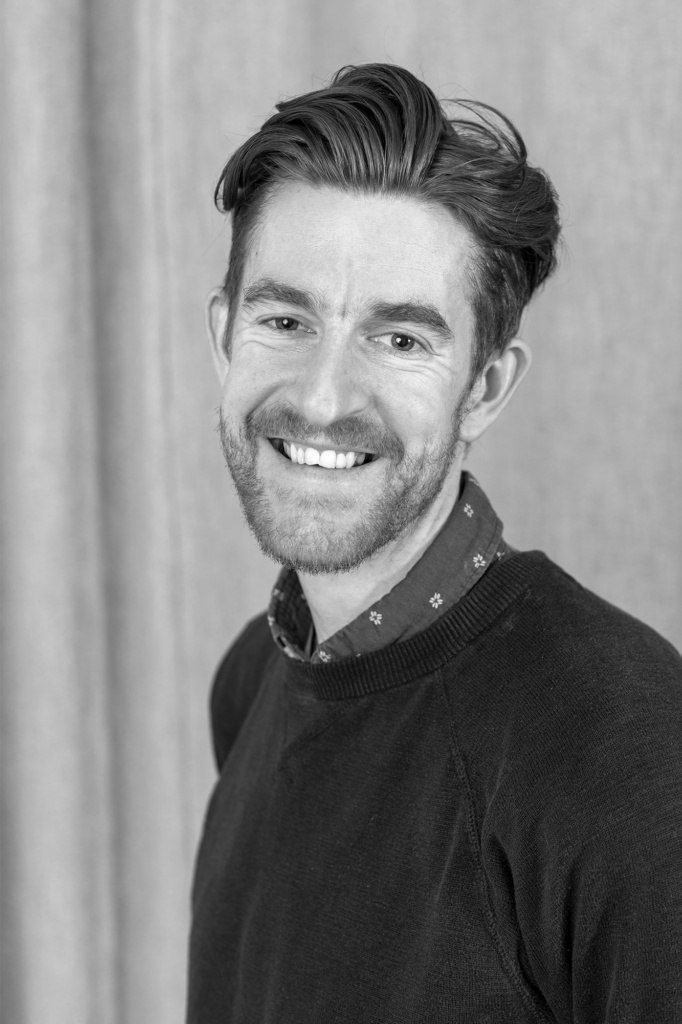
Henry Loveless is a copywriter, teacher and examiner based in Helsinki, Finland. He has been part of the Finnbrit team since 2015. He has worked for many notable clients including Otava, The Finnish Defence Forces and Lindström. He is currently writing the second in a series of textbooks for English learners, Come Along. The first was published in 2025. He is an active runner, orienteer and the organiser of the Finnbrit Gardners’ Meet.
Finnbrit 68/100
Why Oy
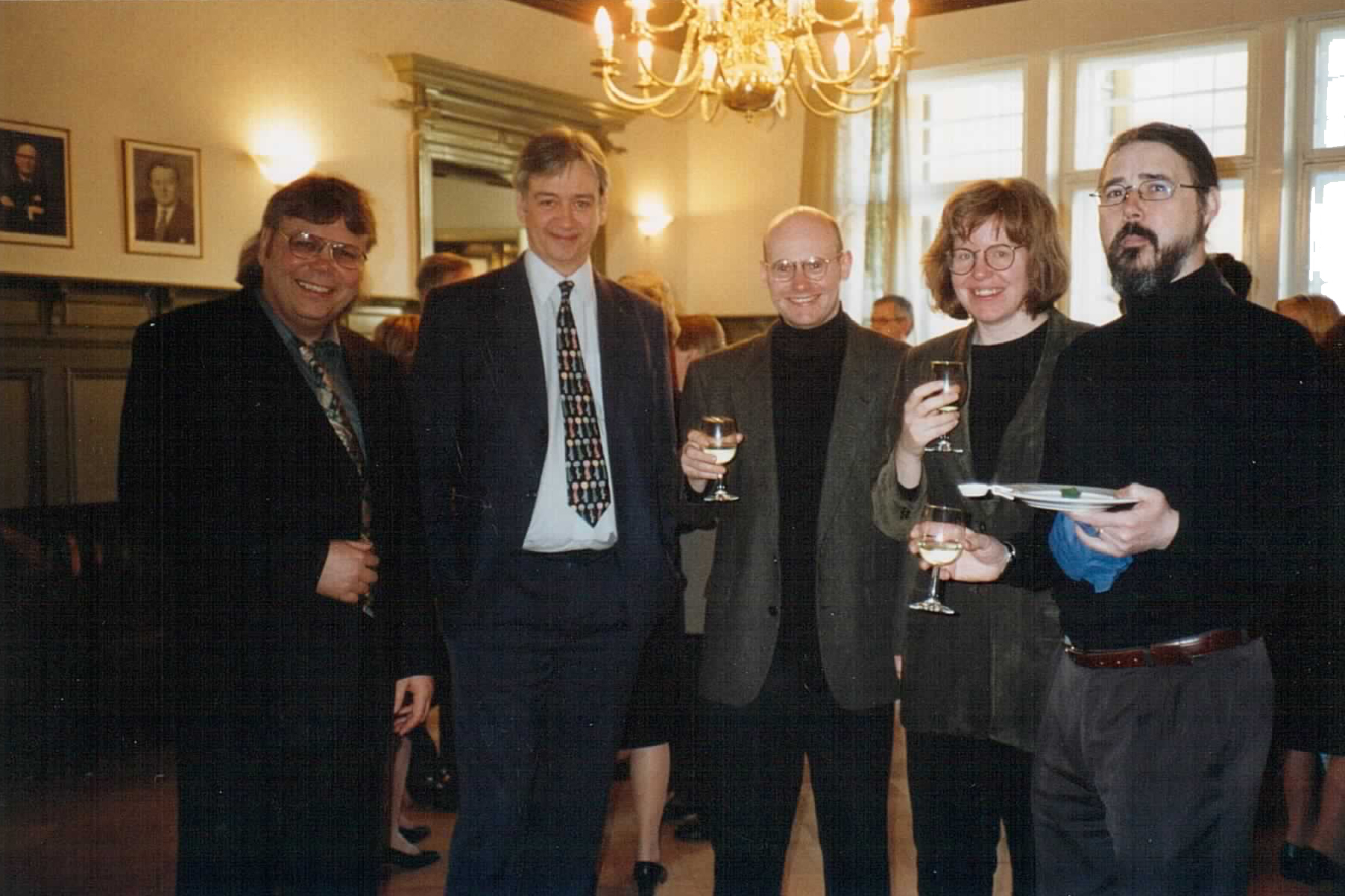
Picture: Former Finnbrit Office Manager Raimo Ahonen (left) with Finnbrit teachers in 1996
This year marks the 100th anniversary of the Finnish British Society, founded in 1926. The Society is a rekisteröity yhdistys – abbreviated to Ry in Finnish – which means it is an association, a not-for-profit organisation, or charity. Its statutes, mission and values are consistent with its legal status. During most of the twentieth century, the Society operated all its activities, including teaching services and Cambridge examinations, as an association.
It was not until April 1996, seventy years after its creation, that the Society established a limited liability company or osakeyhtiö (Oy) with the Finnish Patent and Registration Office. The company, now known as the Finnbrit Language Centre Oy, is owned in full by the Finnish British Society (Ry). The Language Centre pays rent to the Society for the use of the premises on Fredrikinkatu and has its own accounts for which all the bookkeeping is outsourced to a professional accounting firm. The Language Centre is, of course, liable for company tax and value added tax (alv).
The reasons for establishing a limited company were manifold but reflect the shift away from language learning as a social and cultural phenomenon in a country keen to strengthen its ties with the rest of the world in the mid-20th century, towards a structured economic and commercial activity. Towards the end of the 1900s and into the 2000s, language teaching became an increasingly commercial and competitive enterprise in Finland with a plethora of small businesses offering language courses in Helsinki such as International House, Richard Lewis Communications, Berlitz etc, many of which are no longer in existence. Throughout its 100-year history, one of the Finnbrit’s principal activities has been teaching English as a foreign language (EFL) inside companies, public-sector organisations and to individual learners. These activities today continue today with an experienced and qualified team of teachers.
In 2007, the British Council (a UK non-profit organisation with charity status), transferred the organisation of the International English Level Testing System (IELTS) exams to the Society. This enabled the organisation of these high-stakes examinations to be continued in Finland.
IELTS certification is often a pre-requisite for Finnish students and professionals who wish to pursue studies or employment in Finland or abroad. IELTS testing, and the Finnish YKI language tests, are now run by the Finnbrit Language Centre Oy and support the employment of our permanent staff and many part-time examiners and invigilators.
The Finnbrit Language Centre struggled to maintain its activities through the Covid pandemic, often running IELTS examination sessions at a commercial loss but managing to ‘keep the show on the road’ —albeit heavily masked and with the required social distancing and disinfectant— thus providing essential high-stakes language testing to young people applying for university places or visas for working abroad.
During the same period, teaching shifted online and that trend has been maintained with face-to-face, online and hybrid courses now on offer. Financially, this was an extremely challenging period in the Society’s history, but we are really proud of the resilience and reliability of the Society, the Language Centre and all the people who continue to contribute to its on-going success: staff, clients, council, guest speakers, service providers and, last but not least, the Society’s members.
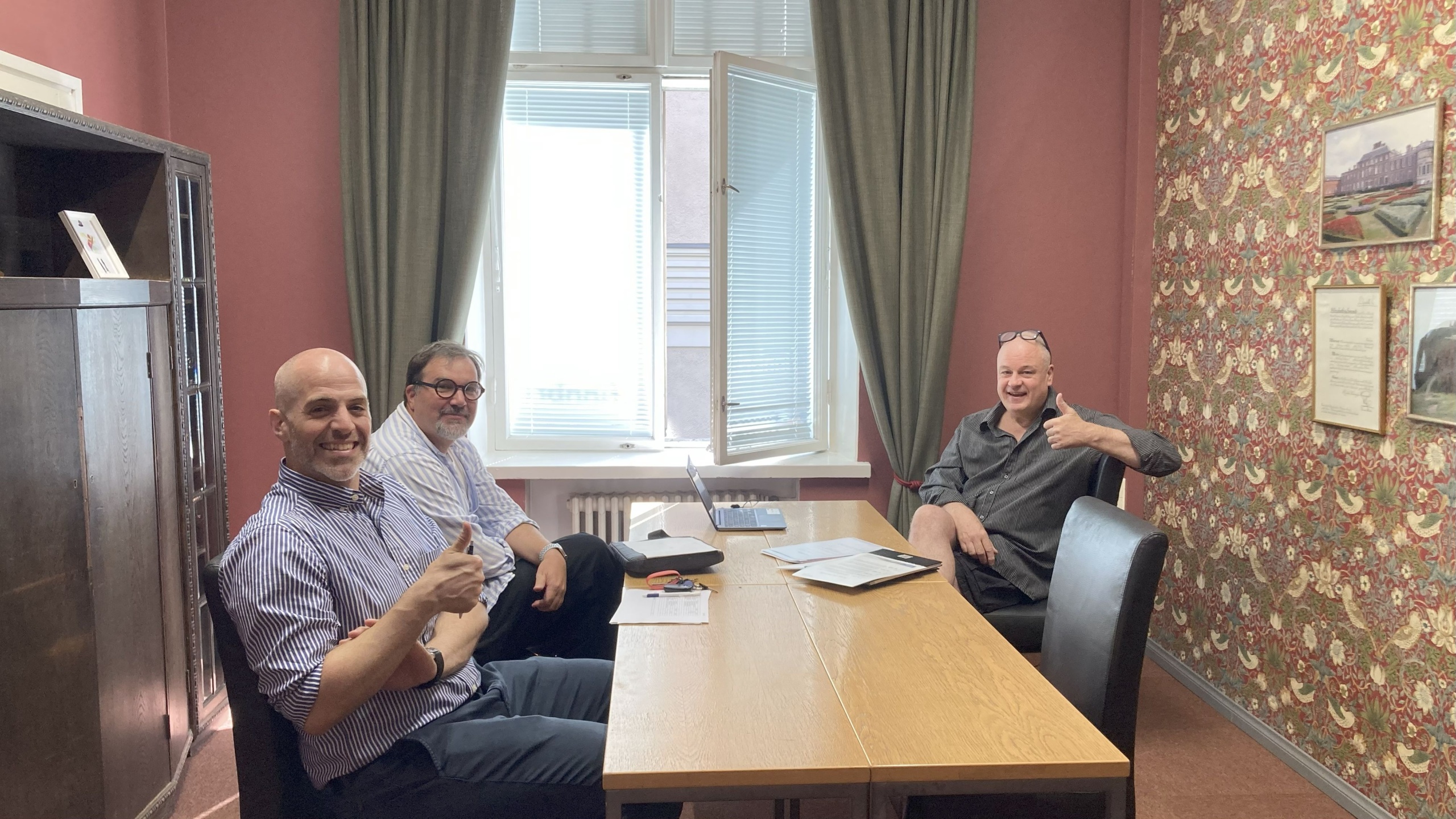
Picture: Finnbrit teachers Panayiotis Doxopoulos, Blake Schumacher, and Ian Marson (2025).
During this anniversary year, we hope to involve all our stakeholders in the Society’s celebrations including the Language Centre’s students, test-takers and company clients. Language teaching and testing are as much an integral part of Finnbrit’s mission and values as they were one hundred years ago.
At the beginning of this new academic year, we invite you to renew your membership or consider joining as a new member. Information about all the Society’s events and the language centre courses and examinations is available on the website. Come to our Open House event in August to find out more!
Text by Penelope Roux – Chair, Finnbrit Ry
Finnbrit 69/100
Teaching for the Finnish-British Society,
Helsinki (September 1970-July 1972)
By John A Stotesbury (Helsinki)
Some months before the end of my final year of English Studies at Edinburgh University (1965-70) the British Council organised an information and recruitment session for novices to teach English in Norway and in Finland. I had already been interviewed and accepted by the University of London Institute of Education to take its one-year PGCE/TEFL postgraduate teaching qualification, although my only previous full-time TEFL teaching experience had been at a Mittelschule in West Berlin in 1967-68, together with one or two evening courses for adults. The Norwegian posts would have been for qualified secondary school language teachers, so Finland and the Finnbrit, with its emphasis on teaching adults, was my obvious choice – thank goodness, I would have been totally incompetent with a younger age group! Given my Scottish MA in English Literature and English Language, my easily postponed teacher training, and my previous EFL teaching experience, I was fortunate to be assigned by the British Council to the Helsinki branch of the Finnish-British Society, and together with some 25-30 similar new recruits I was shipped out near the end of August 1970 aboard the MS Nadezhda Krupskaya (aka the “Missus Lenin”!), operated by the Baltic Steamship Company (just imagine the British Council using Aeroflot at the present time!). The appointment was for nine months from 1st September, which I duly renewed for 1971-72.
I found the Finnbrit, then still in Puistokatu, to be a lively, friendly place to work, with a large office run by two cheerful colleagues, Mirja Attila and Marja Salo, and a couple of dusty, worn classrooms. It was sharing its premises, curiously, with an equally cheerful, small English-medium primary school run quite separately for the children of diplomatic families.
My teaching duties consisted primarily of groups of adults taking either conversation or more structured, textbook-based classes, but also a small number of “pupils” who required a weekly hour of conversation practice. Not all classes or individuals came to the Finnbrit. I especially enjoyed the opportunity to travel around the city (most often by tram, my greatest delight), to institutions, individuals’ homes, and lunchtime restaurants, where the requisite 60 or 90 minutes would be appropriately spent.
Most of the teaching was routine, but a number of incidents have found a permanent place in my memory: a lady at an evening class who giggled almost uncontrollably when I used the word “percolator” – she explained that, in her mind at least, it resembled a taboo Finnish word, so I duly repeated it several times in the course of the evening; a classful of elderly ladies who came weekly to read Iris Murdoch’s The Sandcastle – aloud! – and a vociferous complaint made to the Finnbrit office from one lady who one week had not been asked to read; weekly conversation sessions with an Aleksanterinkatu banker who invariably suggested that we retreat from his office to a nearby restaurant for a gin-and-tonic, or two; a pair of female missionaries, home on leave from Hong Kong, who explained their work in fascinating detail; a few weekly sessions with the Liberal party Minister of Education, Jaakko Itälä, at his office in Rauhankatu – he was delighted when I informed him that someone had inscribed “Itälä on hyvä jätkä!/Itälä’s a good bloke!” on a public opinion whiteboard then located at the end of Aleksanterinkatu; and my surprise, and naïveté, when a Helsinki University psychology lecturer participating in a small conversation group unexpectedly produced a bottle of red wine out of his battered leather briefcase and requested that I fetch glasses for the whole group “so that the conversation would flow better” – only one woman complained to the office and resigned from the group.
What I also enjoyed in my second Finnbrit year was the expansion of my teaching to include 6-8 hours a week teaching students at Otaniemi Technical University – where, along with my wife, I continued full-time for two years after completing my postponed EFL teaching qualifications at London University in 1972-73. And in due course, in 1975, I was appointed Englannin kielen ulkomaalainen lehtori / Lecturer in English as a Foreign Language at the University of Joensuu, in the darkest, remotest eastern region of the country, which was reputed by Finns to be “jumalan selän takana / beyond the back of God” with a university that had a portrait of Lenin on every classroom wall – where I stayed, happily teaching and researching British and Postcolonial Literatures, until retiring and retreating from that Outer Darkness back to Helsinki in 2013. The British Council and that old 1970s version of the Finnbrit undoubtedly helped shape my professional – and personal – life, during the course of which we Finns have inevitably undergone a major change in our awareness of the English language and its varieties and the national and international cultures that it helps to facilitate. Kiitos!
PGCE: Post-Graduate Certificate in Education
TEFL: Teaching English as a Foreign Language
MA: Master of Arts
Finnbrit 70/100
The gentle hand helping
Finland speak English
Finnbrit is a society, and a community, but we’ve also been one of the leading suppliers of English and Finnish training in Finland for over 80 years. We currently run courses at our Fredrikinkatu premises as well as online and at major businesses across Helsinki.
We sat down with five of our current teachers, Pan Doxopoulos, Saga Arola, Blake Schumacher, Ian Marson and Henry Loveless, to find out a little more about who they are and what they do.
Meet our teachers
Where are you from?
Pan: I was born in Leeds in the UK. Because of my name, people ask me, are you Greek? But I’m not really. I’m half Greek, but I’m definitely British. Because I lived in the UK, I didn’t learn Greek as a kid; I learned in my 30s.
Saga: I’m from Kouvola in South-Eastern Finland.
Blake: Orange County, California, which is a part of Los Angeles metropolitan area, USA.
Henry: I’m from Bristol in the UK. I wish I could tell you something more exotic, but the truth is my ancestors have lived in the UK for hundreds of years.
Ian: I’m from a tiny village in Derbyshire, England. My parents were retired farmers.
Can you tell me about your initial work or education?
Pan: I always liked languages. The only easy subjects at school were French and German. I didn’t like French very much to be honest; my teachers didn’t make it much fun. So, I studied 3 languages at university. It was called Modern Languages Studies.
It was a four-year degree because the third year was spent traveling. I had to spend it in a French, a German and a Russian speaking country. And that’s where the biggest improvements came in my spoken languages, because you actually had to use them.
After that, I did the CELTA English teaching qualification because I had learned a lot about English through studying and translating between English and other languages. Finally, I completed a master’s degree in education remotely with the University of Sheffield whilst living and working in Finland.
Saga: I did my Bachelor’s and Master’s degrees in English philology at the University of Helsinki. Philology may be a bit of an obscure term, but it’s basically anything to do with the target language: history, linguistics, literature, social aspects, translation, etc. I enjoyed it immensely.
Blake: It’s a long list. My undergraduate degree was in Communications and Advertising Management at California State University. When I came to Finland, I started teaching English. I enjoyed it and my employers thought I had some promise, so they recommended that I study for a CELTA teaching certificate. I qualified at International House, Barcelona and then a few years after I completed simultaneously an MBA in Communication Management and a vocational pedagogy teaching diploma at Haaga Helia. Now I’m studying for the DELTA teaching diploma which, so far, has been the most difficult of all.
Henry: I studied Journalism and History. I’ve always loved writing, and I’m very curious, so these subjects were a good fit. After University, I took the CELTA English language teaching course. Since then, I’ve collected a few examiner qualifications, but mostly it’s been 20+ years of first-hand experience.
Ian: I had an interesting start to life. I joined the army when I was 16. After completing the basic training, I decided I didn’t want to serve and I was threatened with imprisonment. Fortunately, because I was under 18, I was allowed to leave. Then I travelled to London and lived in squats; it was quite common for young people at that time. I did temporary jobs, like security at Wembley Stadium. I remember I got to see Michael Jackson from the side of the stage! Then I got a job working for a juggling company, and that took me for the first time abroad.

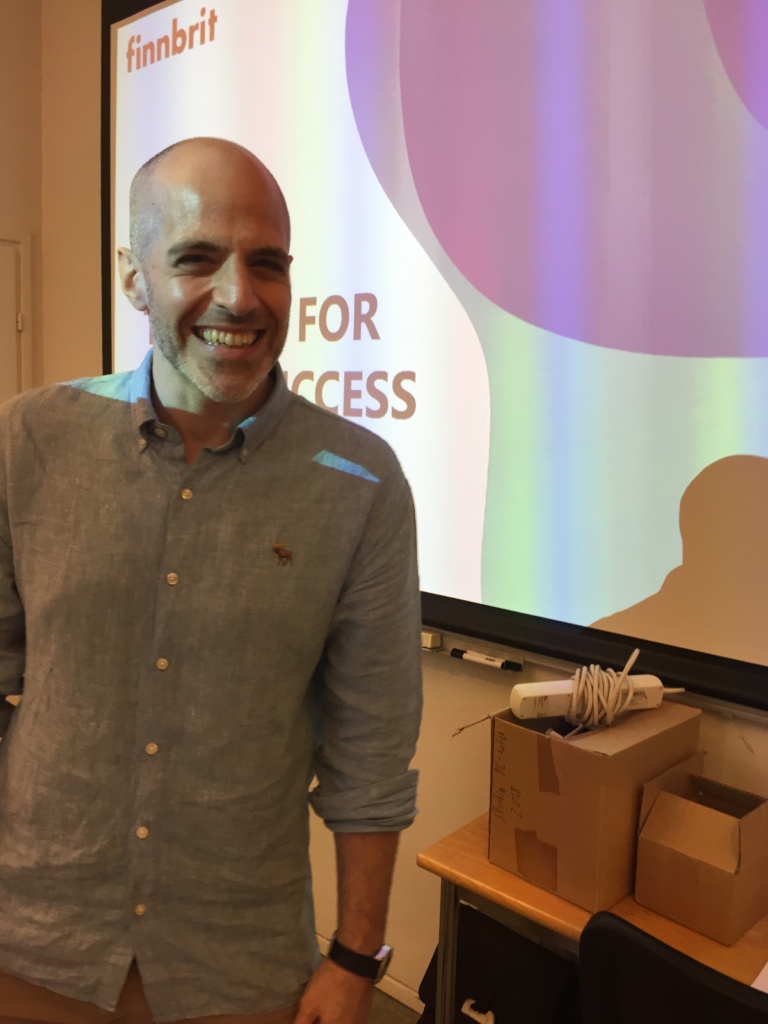
Where did you start working and teaching English?
Pan: In Petrozavodsk, Russia. I’d already studied in Russia for four months, which was a good introduction because, as far as I could tell, I was the only English native speaker in the city. Living in Russia wasn’t for me though, so I moved to the Czech Republic.
I lived and worked there for three years at International House, Prague. It was a nice place. I worked with adults, kids, and teens, taught Business English and Exam English, and there were a lot of training opportunities.
Saga: I started with my first private students during my university years. Then in 2019 I created an Instagram account for Finnish language, and it took off in a way I didn’t expect. It has given me the chance to teach students with diverse language needs, from general Finnish lessons and speaking practice to more specific topics such as preparing for a job interview or an exam.
Blake: I initially worked in Finland in 2001 teaching English for various private language centres. Then, because of the crash in 2008, I moved to Russia for a year to work at International House in Moscow.
When I came back from Russia I started my own teaching business. I did some project work for Helsinki University’s Continuing Education company (HY+) and met a colleague who introduced me to the Finnbrit Society.
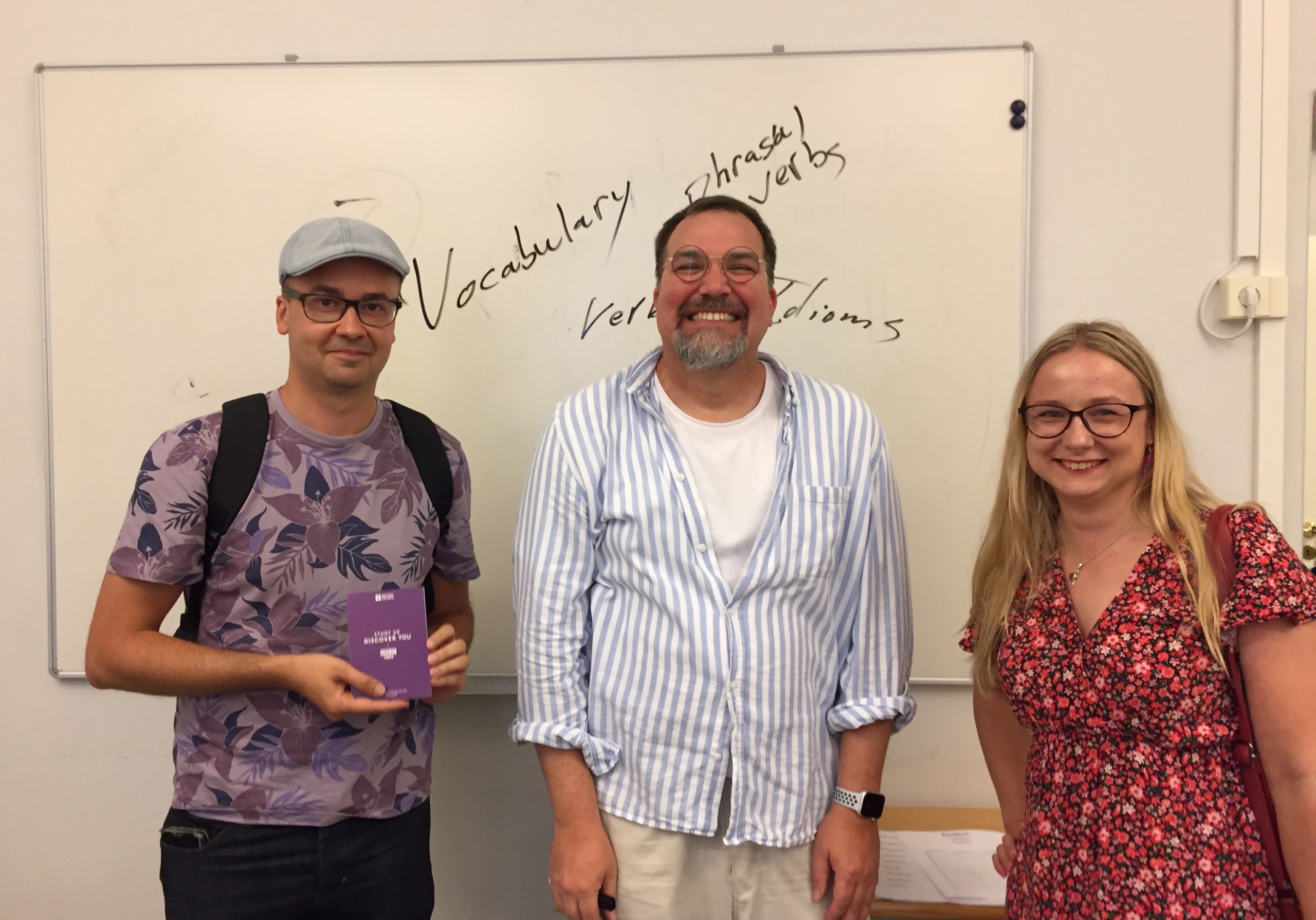
Blake Schumacher( centre)
Henry: My first job was in an international summer school in the UK. Many Finnish people will be familiar with these. Then I worked at a language school in Zaragoza, Spain, for a few months. That was a mixed experience, but I really enjoyed the teaching, so I decided to carry on, in South America.
Ian: I met a Finn in a nightclub in London, who suggested I come to Finland. After visiting in summer, I fell in love with the place and decided to move here and start a juggling import business. This was at the height of the Finnish depression, so it wasn’t a great business idea. However, as a native English speaker, I was asked to help people prepare for some English examinations. I fell in love with teaching and obsessed over the class planning and preparation. I must have done a good job because I was able to get more work.
Then I specialised in business English. I travelled around Finland teaching in many towns and cities. For two years, I worked as the Director of Studies for a school in China, then I came back to Helsinki. Sometimes it feels like I’ve taught in every business in Finland.
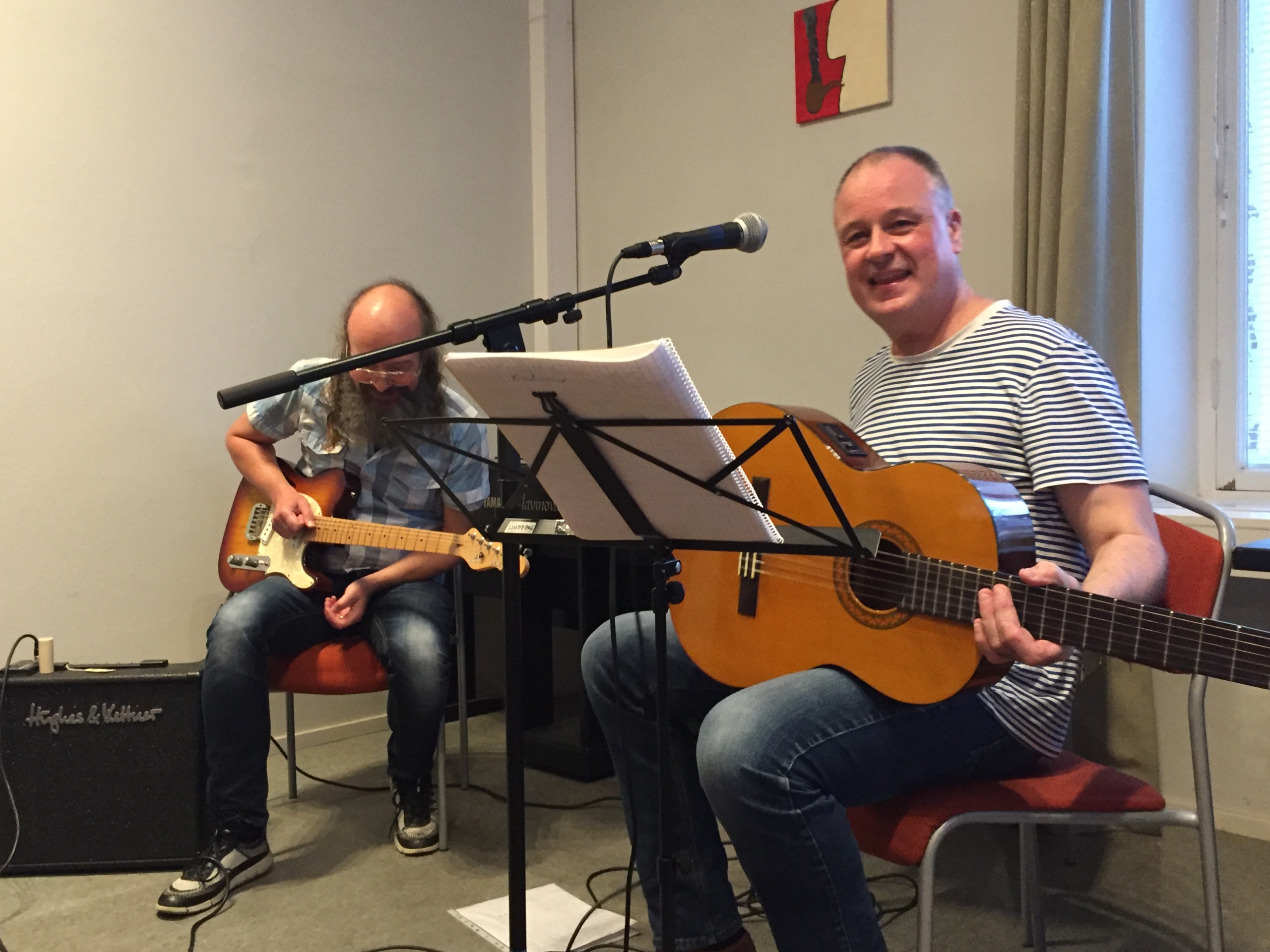
Ian Marson (right)
When did you come to Finland?
Pan: I first came here in 2013. I did some freelance teaching for a bit, then I went to work in English-speaking kindergartens and international schools.
Saga: Well, I was born in Finland. However, I joined Finnbrit in 2019 as one of the group leaders for a children’s group called Nursery Rhyme Time. Since then, I have joined the Social Committee, started a Finnish Language Café, and become a Council member and the resident Finnish teacher. I feel like I have found a home at Finnbrit.
Blake: My first day in this country was December 2nd, 2000. I remember it was a very grey day. I’ve been here ever since apart from a couple of short periods away to work in China and Russia.
Henry: From Spain, I moved to Chile, where I lived for about ten years. Then I came to Finland in about 2015.
Ian: 1992 / 1993. I have lived here through some interesting moments in Finnish history.
What do you do in your free time?
Pan: I’ve been practising Brazilian Jiu-Jitsu for many years, and now I am a trainer and coach. I also support the Mighty Whites of Leeds United FC. And I have two dogs.
Saga: I enjoy theatre both on and off stage. I’m taking psychology courses at the University of Helsinki’s open university. I read as much as I can, both fiction and non-fiction. I dabble in creative writing and singing. And I try to go swimming at least once a week.
Blake: Supporting my son’s artistic interests, fighting with my cat and trying to not drown while outdoor swimming. I also have a blog and I love to write.
Henry: I’m a very active person. I run regularly and I love orienteering. This year I participated in the Jukola relay race for the fourth time. I also love gardening. I run the Finnbrit Gardeners’ meet. I’m a member of the JYRY kayak club and…what else…? I have two adorable kids and a wonderful partner.
Ian: I love music, juggling and literature. In another life I would have had a bookshop. I’m also an excellent mushroom hunter.
Why are you good at teaching? What do you bring to the table?
Pan: Because I’m good at helping students understand what they do and don’t actually need. I’m quite a practical guy. And most of the time students don’t need grammar. I’m going to point them away from that and towards something practical, like vocabulary, basic verbs and nouns that combine in interesting ways to express the things you like. And I’ll focus on speaking about the things you actually want to do, rather than something theoretical.
The other ‘unique´ thing about me, is that I speak many languages. I studied Russian, French and German at university and I’ve picked up 3 more since (Greek, Czech, Finnish). I’d say I’m in the minority of native English speakers as I’ve actually learned other languages to a high level.
Saga: Helping others is my passion, and I think that is reflected in my teaching. I put a lot of effort into creating a safe environment where students feel comfortable asking questions, making mistakes, and trying their best even if they are not yet confident in their language skills. I’ve studied many languages myself, so I know what it’s like to struggle in a new language. It has also helped me understand the differences and similarities between languages, which in turn makes it easier for me to explain and see Finnish from a non-native speaker’s perspective. Additionally, I’m always fascinated by the particularities of each student – what their goals are, how they like to learn, and what they actually need to learn. I think good teaching starts with understanding the student.
Blake: The short answer is because I enjoy it and I think it shows. I’m curious about students first and then focus on the language problems they have a bit later. I’ll often use games which helps the students relax. When you’re relaxed, you’re more focused on production more than accuracy. Once students feel comfortable producing, focusing on their accuracy becomes much easier and productive.
The positive feedback usually mentions that my classes are fun, relaxed, enjoyable, constructive. Those are the main adjectives that I see people using.
Henry: I guess I have a lot of experience, so I can easily identify what the most important issues to resolve are. Then, I have tricks to resolve the problems. I’m also good at communicating. I know what people are trying to say, even if it sounds confusing. In terms of my personality, I’m so curious and I love learning about my students and their work areas.
Ian: I got some lovely feedback from a chap the other day. He said my style was relaxed and supportive. I think I have good people skills. I am good at reading body language, seeing when people are comfortable or if they are struggling. I also appreciate the importance of the job we’re doing. Helping people speak English is a wonderful thing, so I engage fully in the moment. I never wear a watch in the class, for example, because I think it’s important to be 100% present when the student is speaking English.
Finnbrit 71/100
Bush Finns ry – The Legacy of the
Finnish-Language Section of the BBC World Service
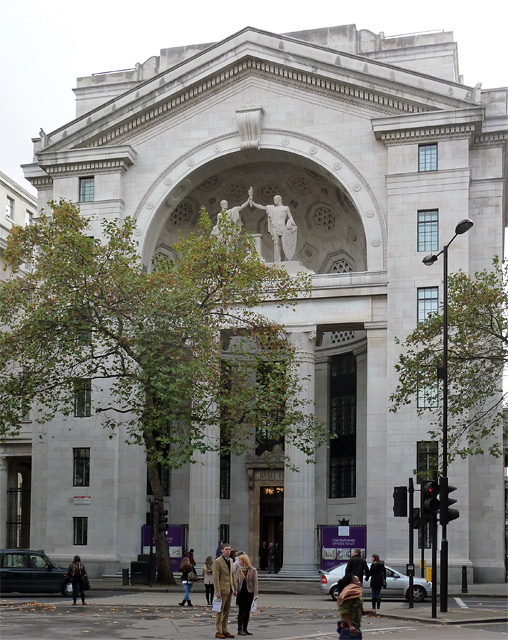
Friday, 9 October 2026
18:00-20:00
Bush Finns ry is the heritage association of the former Finnish-language section of the BBC World Service. Founded in 2019, the association preserves the history and legacy of the Finnish broadcasts that were transmitted from London for 57 years, from 1940 until the service closed in 1997.
This presentation introduces the fascinating story of the BBC Finnish Service and its home in London’s iconic Bush House, the legendary headquarters of the BBC World Service, which was once known as the “most expensive building in the world”.
Finnish-language radio broadcasts from London began just five days after the end of the Winter War. The preparation for the Finnish-language broadcasting operations had started in the second half of 1939. During and after the Winter War, Britain competed for radio supremacy even more with Germany than with the Soviet Union.
We will hear about the role of Finnish-language broadcasting during times of war, political change and international uncertainty, highlighting how the BBC became a trusted source of news and information for generations of Finnish listeners. The presentation also looks at the work of Bush Finns ry in preserving this unique chapter of Finnish broadcasting history.
Finnbrit warmly welcomes Ilpo Salonen and his colleagues to introduce Bush Finns ry and talk about the legacy of the Finnish-language section of the BBC World Service.
At the event, the book about the history of the Finnish Service, ‘Täällä Lontoo – BBC:n suomalaistoimittajat idän ja lännen välisessä informaatiosodassa’ (WSOY 2020), will be available for purchase for 15 euros.
Image: Stephen Richards, Bush House, Aldwych. Licensed under CC BY-SA 2.0. Source: Wikimedia Commons.
Book your place for the event here.
Finnbrit 72/100
Stuff from Staffs
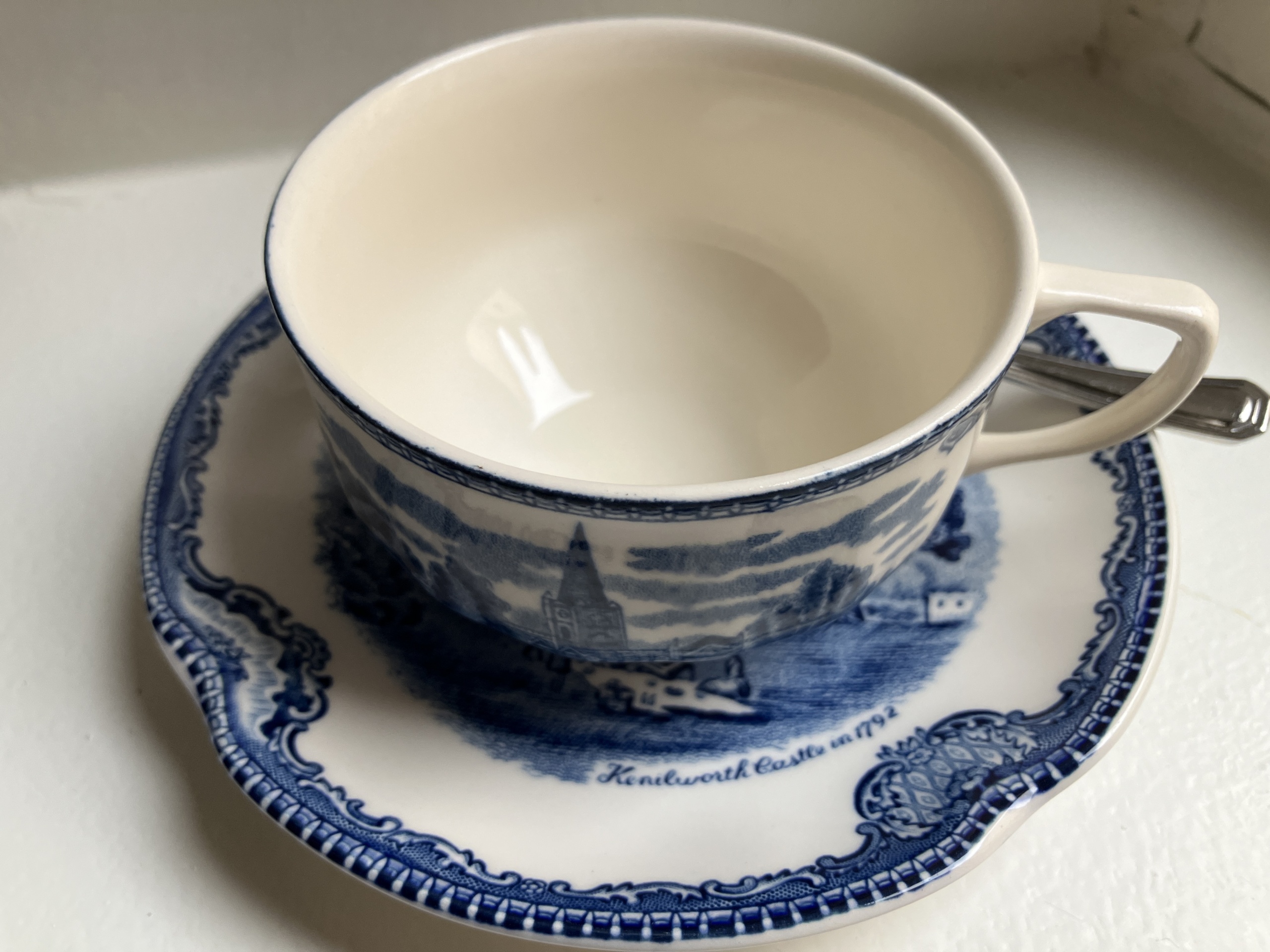
Stoke-on-Trent in Staffordshire is a town many readers won’t have heard much about, unless you are a football fan and, even then, it’s probably more for the succession of managers of their first team than for the club’s success on the pitch.
Stoke-on-Trent is a city in England with more than a reputation for deprivation. It is the area made infamous in the early 2000s with the series of TV shows titled This is England, the first of which was set in1986, telling of a gang of unemployed —and generally unemployable— youths in this working-class area of The English Midlands. Vicky Lee McClure (aka Inspector Fleming from Line of Duty) plays Lorraine ‘Lol’ Jenkins in the series, and Stephen Graham of Adolescence started his acting career as ‘Combo’ in this series.
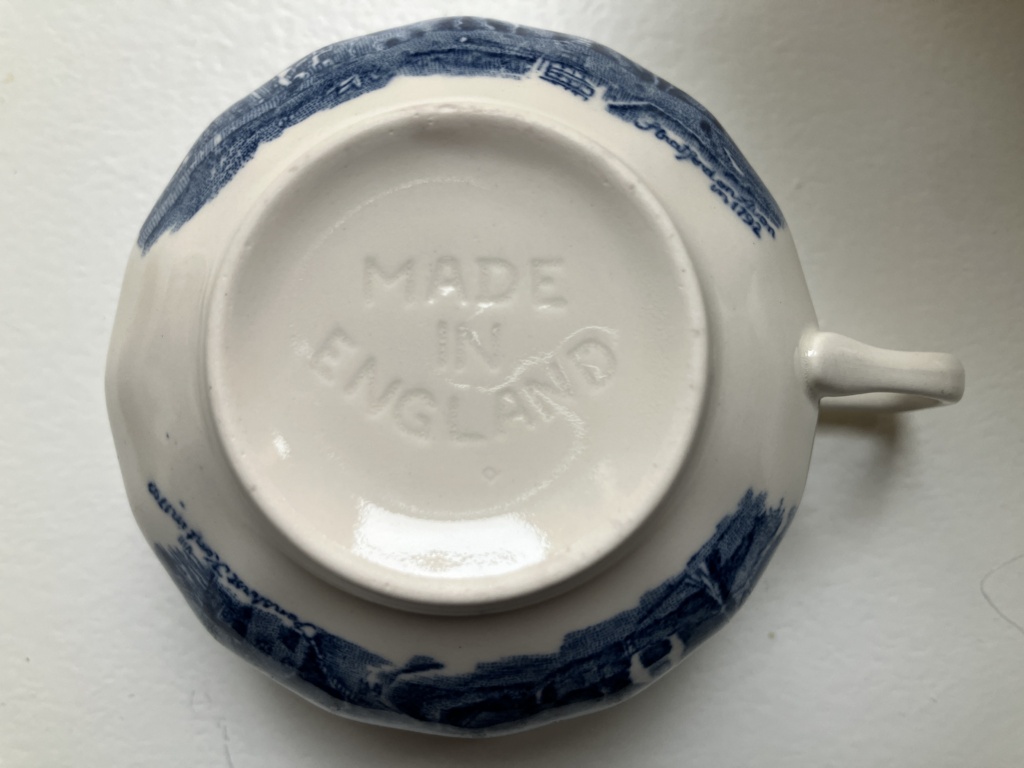
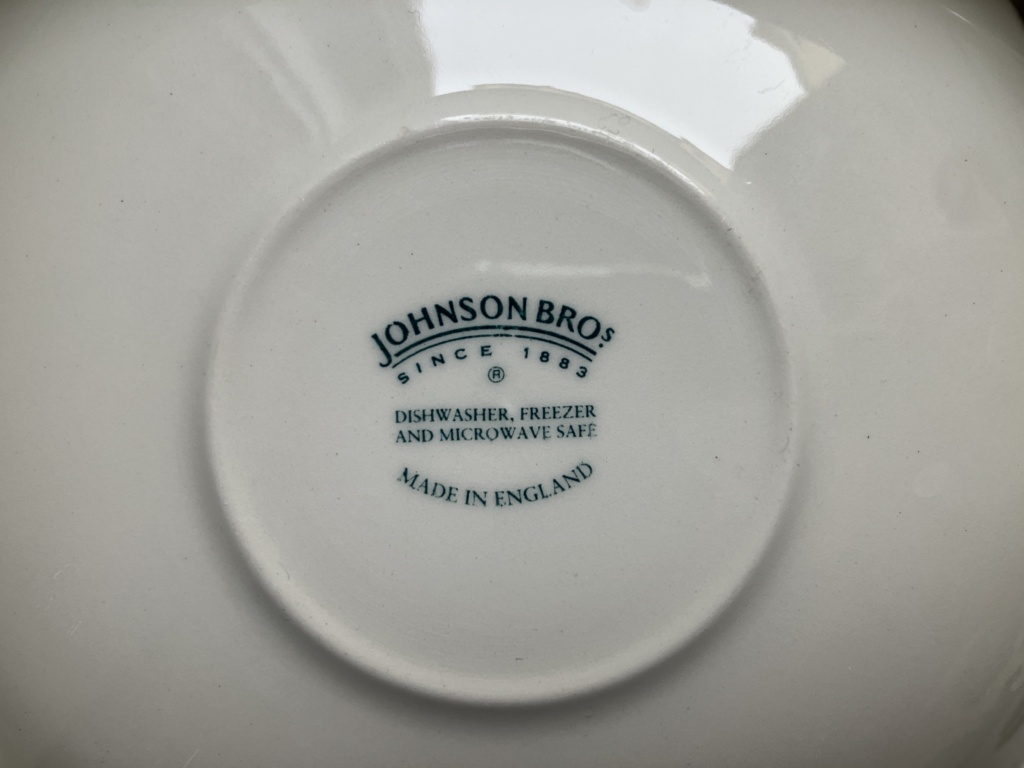
Stoke-on-Trent was not always as socially and economically challenged as it is today. An investigation of the Finnbrit kitchen will reveal it is the origin of a pile of ceramic relics dating from the Finnish-British Society of the 1950s or early 60s. Those were the days of the English Women’s Tea Club, and other more formal occasions held on the premises at Puistokatu 1A. There were no automatic dishwashers back then, which may explain the demise of much of the crockery that has suffered the slings and arrows of clumsy carriers over the years – the writer himself disposed of a handful of cups not so long ago!
The whole set of Staffordshire Tudor Ware pottery probably numbered 20 or more each of dinner plates, soup plates, side plates, cups and saucers. There appear to be two different series among the leftovers from those heydays: Country Inns and English Villages. They show idyllic rural scenes very different from the gaunt terraces of the six small industrial towns that every pupil studying the Industrial Revolution of the early 1800s has learned as The Potteries – Stoke, Hanley, Tunstall, Burslem, Fenton and Longton, now amalgamated as Stoke-on-Trent.
Think of England, especially Staffordshire, this often-forgotten corner of England, its history and its struggle for contemporary survival, as you enjoy your cup of tea in Fredrikinkatu – and no need to worry about where to place your pinky!
Text by Anthony Shaw
Finnbrit 73/100
Christine de Luca and ‘Swansong’
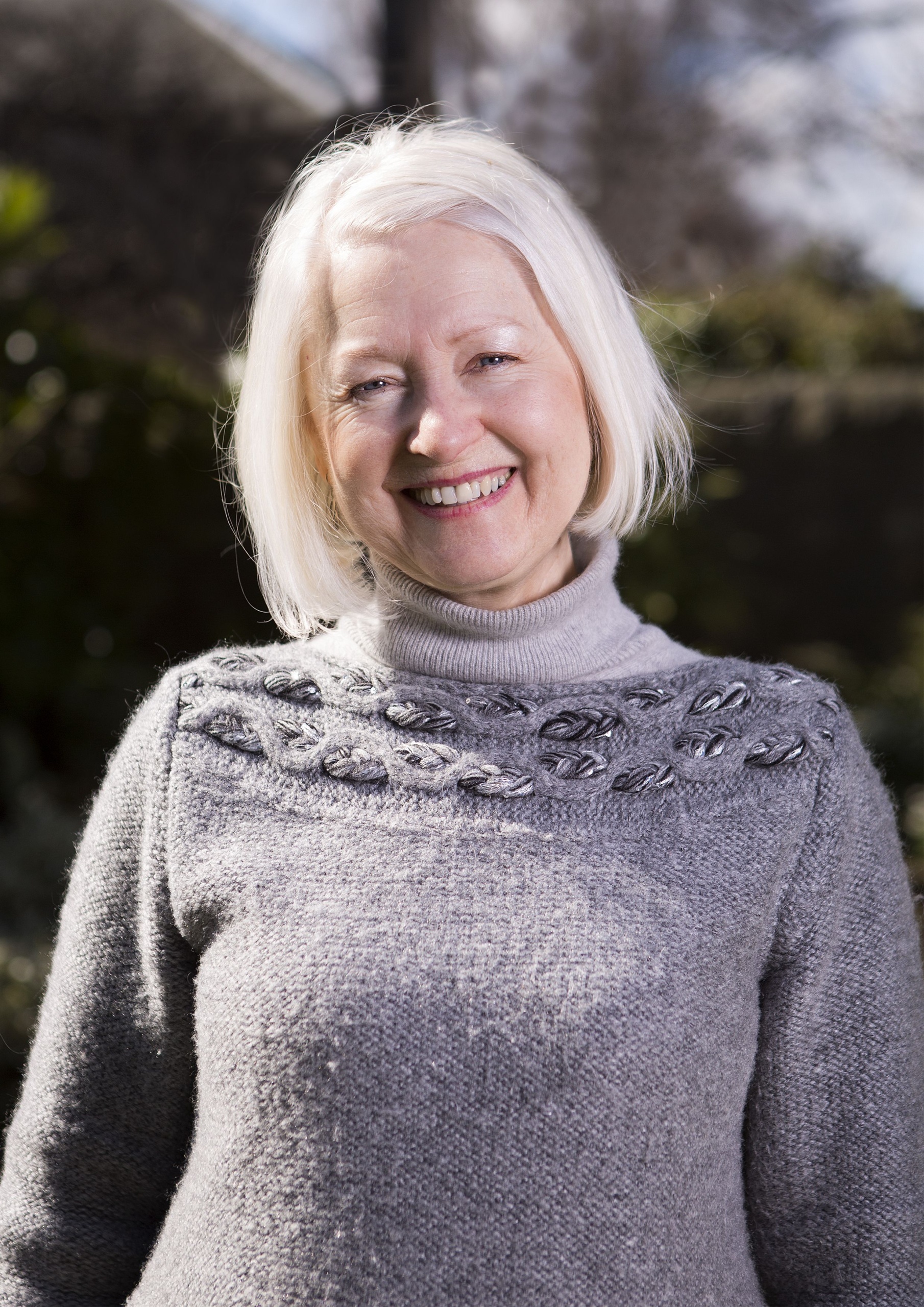
Christine de Luca Portrait by Dawn Marie Jones
Christine was born in Walls on Shetland – locally known as Waas – where her father was headmaster of the school, nearly 800 miles from London. She studied in Edinburgh and taught in secondary school for some years before becoming a full-time poet.
She has had her work published in over ten languages, travelled the world giving readings and continues to write and publish. She visited Finland in 2018 and again in 2022 giving talks and readings around the country as well as at the Finnbrit premises on Fredrikinkatu, where she was accompanied by the Finnish poet Riika Katajavuori.
When approached about a contribution to the 100-year anniversary dinner, Christine offered us a poem which was inspired by Jean Sibelius’s major 5th Symphony, which he composed while watching the swans wheel and fly over his home in Tuusula, near Helsinki. We hope you find her reading of the poem ‘Swansong’ in Shetlandic and in English as moving as Sibelius did the swans.
Click on the play-button to hear the poem.
Swan sang
5th Symphony, Sibelius
… a boannie sang,
afore he whet composin
afore layin doon his pen
… dat simmer, tinkin lang
for swans ta wing it nort
fae winter toons o Ypres,
da shokk o gas.
Dis symphony wid be da forest:
woodwind o mödow;
strings – a mird o shuns
wi mirlin flechs,
a simmermal dance,
a skirl o moarnin birds.
His notts rowl on
plaitit owre an owre, till
da hael splore o nature sklents
da dimriv, filt foo
o licht an soond
ta wylcom da whoopers
dir kloo – kloo.
Da laand is tipperin:
sap risin, a ön a haet,
waarm girse vimmerin
watter barely mövs
aert hadds her braeth
till … i da lift, exultant rhythm:
da galleons o da nort,
sails flaachterin,
flot in, defy
da laws o beauty,
o gravity.
Aathin is on a amp,
da strings is wild,
drums insistin; only da brass
hadds back till da swans
is mapped dir haven
dir haemtoon:
da nest dey’ll bigg again
dir saeson’s uptak…
Pyaagit, dey flummox doon
stumpsed
in swaars o whicht:
whittan a swappin
whittan a laandin
whittan a swan sang;
haem …
dey’r haem …
haem.
Swansong
5th Symphony, Sibelius
… a lovely song,
before he gave up composing
before laying down his pen
… that summer, wearying
for swans to wing it north
from winter fields of Ypres,
the choke of gas.
This symphony would be the forest
woodwind of meadow
strings – a scatter of lakes
with quivering flies,
shimmering light,
shrill morning birds.
His notes roll on
plaited over and over, till
the whole turmoil of nature splits
the sunrise, filled full
of light and sound
to welcome the whoopers
their kloo – kloo.
The land is on tip-toe:
sap rising, humid warmth,
warm grass trembling
water barely moves
earth holds her breath
till … in the heavens, exultant rhythm:
the galleons of the north,
sails fluttering
float in, defy
the laws of beauty,
of gravity.
Everything is agitated,
the strings are wild,
drums insisting; only the brass
holds back till the swans
have mapped their haven
their home patch:
the nest they’ll build again
their season’s work…
Exhausted, they flummox down
bewildered
in swathes of white:
what a beating
what a landing
what a swan song;
home …
they’re home …
home.
Finnbrit 74/100
YLE 100

The 100-year-old Finnish-British Society congratulates the 100-year-old Finnish Broadcasting Company, better known as YLE.
To get a sense of what YLE means to Finland and its people, you can read the greeting from the President of the Republic of Finland here.
Picture credit: YLE.fi
Finnbrit 75/100
The residence of the British Ambassador to Finland in Helsinki
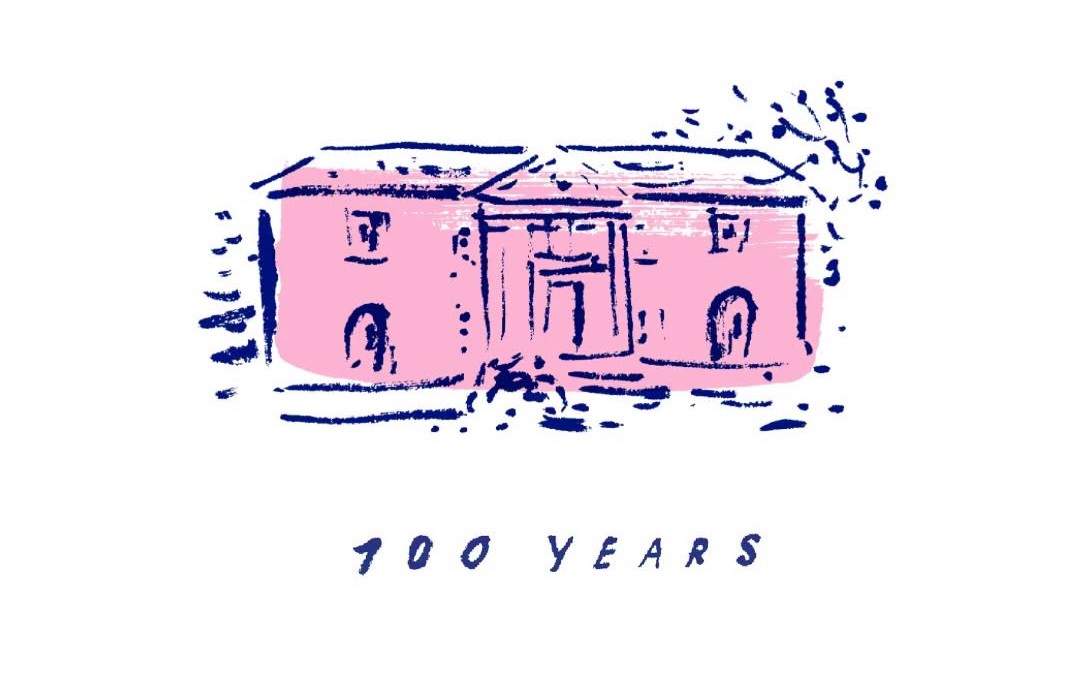
The 100-year-old Finnish-British Society congratulates the 100-year-old residence of the British Ambassador to Finland in Helsinki.
In the linked article, the current Ambassador, Laura Davies, introduces her home and workplace in Helsinki’s Kaivopuisto. The century-old residence hosts hundreds of events and thousands of guests each year, yet retains a wonderfully warm and relaxed atmosphere.
Author: Kari-Otso Nevaluoma. Photographs: Antti Vettenranta. Published on 27 April 2026 by kotona.com. © A-lehdet Oy 1933–2026.
Finnbrit 76/100
Finnbrit Autumn Craft Fair
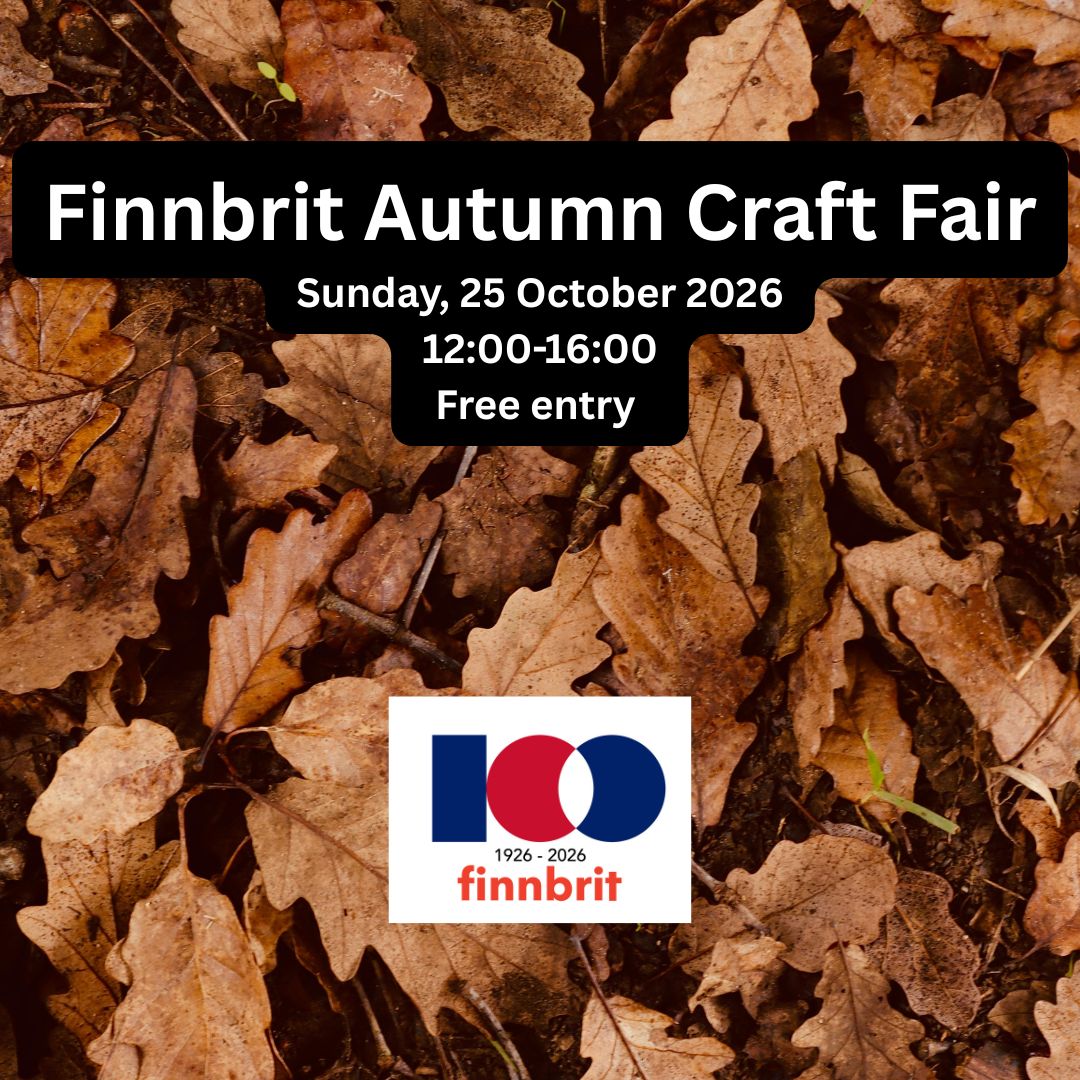
Sunday, 25 October 2026
12:00-16:00
Welcome to the Finnbrit autumn craft fair! You will find handicrafts and artwork on sale, including work by some of our members as well as a range of items from local makers:
rings, necklaces, bracelets, earrings, jewellery, knitted pumpkins, fuzzy-wire flowers and bouquets, mini flowerpots, fairies, keychains, hair accessories, knitted scarves and wraps, pouches, purses, bags, mittens, socks, felted brooches, sculptures, postcards, stickers, calligraphy artworks, fridge magnets, pendants, other decorative objects, honey and much more
This is Finnbrit’s first craft fair and a great opportunity for you to meet the makers, connect with the local handicraft community and maybe find the perfect gift for someone while spending a relaxing and enjoyable Sunday afternoon. Do come in for a look around, a nice cup of tea and a chat!
This event is free for all to attend, no booking required.
Here are some of the makers who will be at the fair.
Kamigraphy
Kamigraphy on social media: Instagram Facebook
Malayang Likha
Malayang Likha on social media: Instagram Facebook TikTok
Nordic Camel
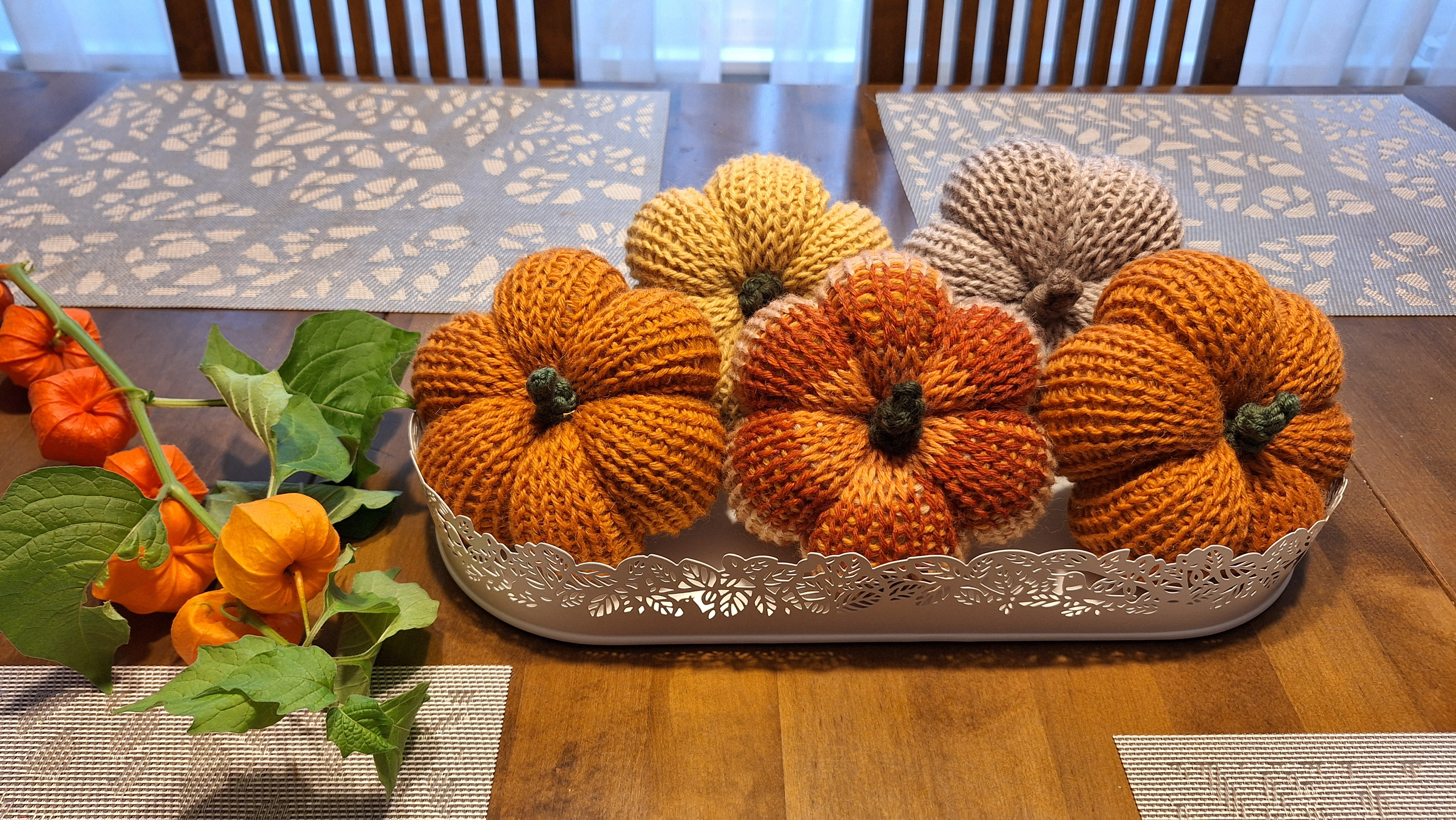
Nordic Camel on social media: Instagram
NatSand
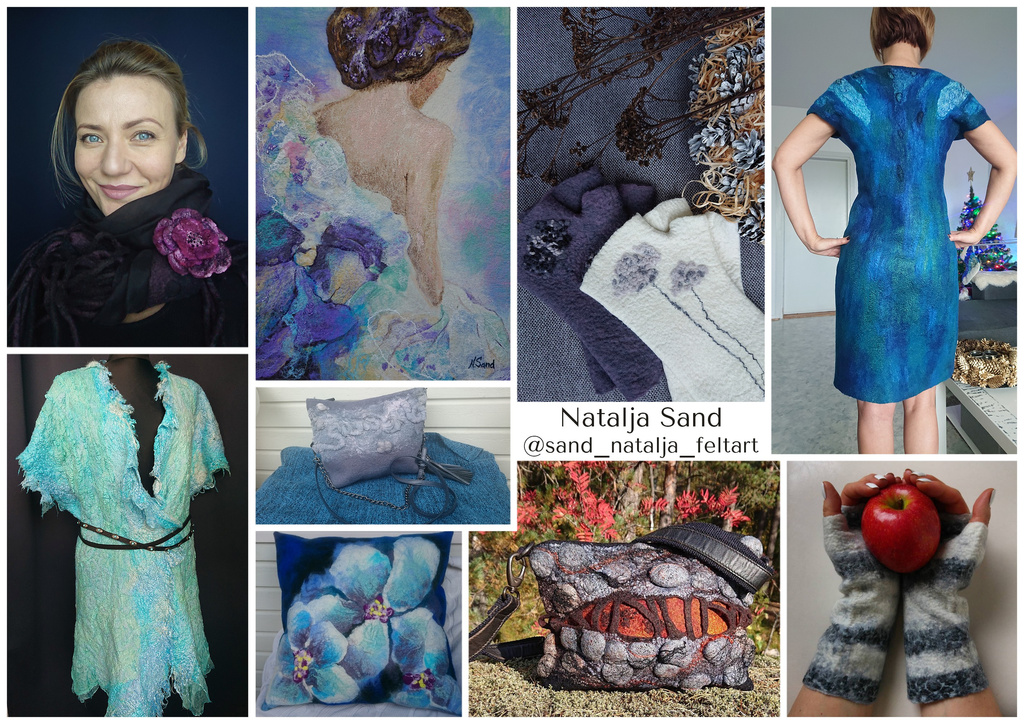
NatSand on social media: Instagram
Artstar Accessories
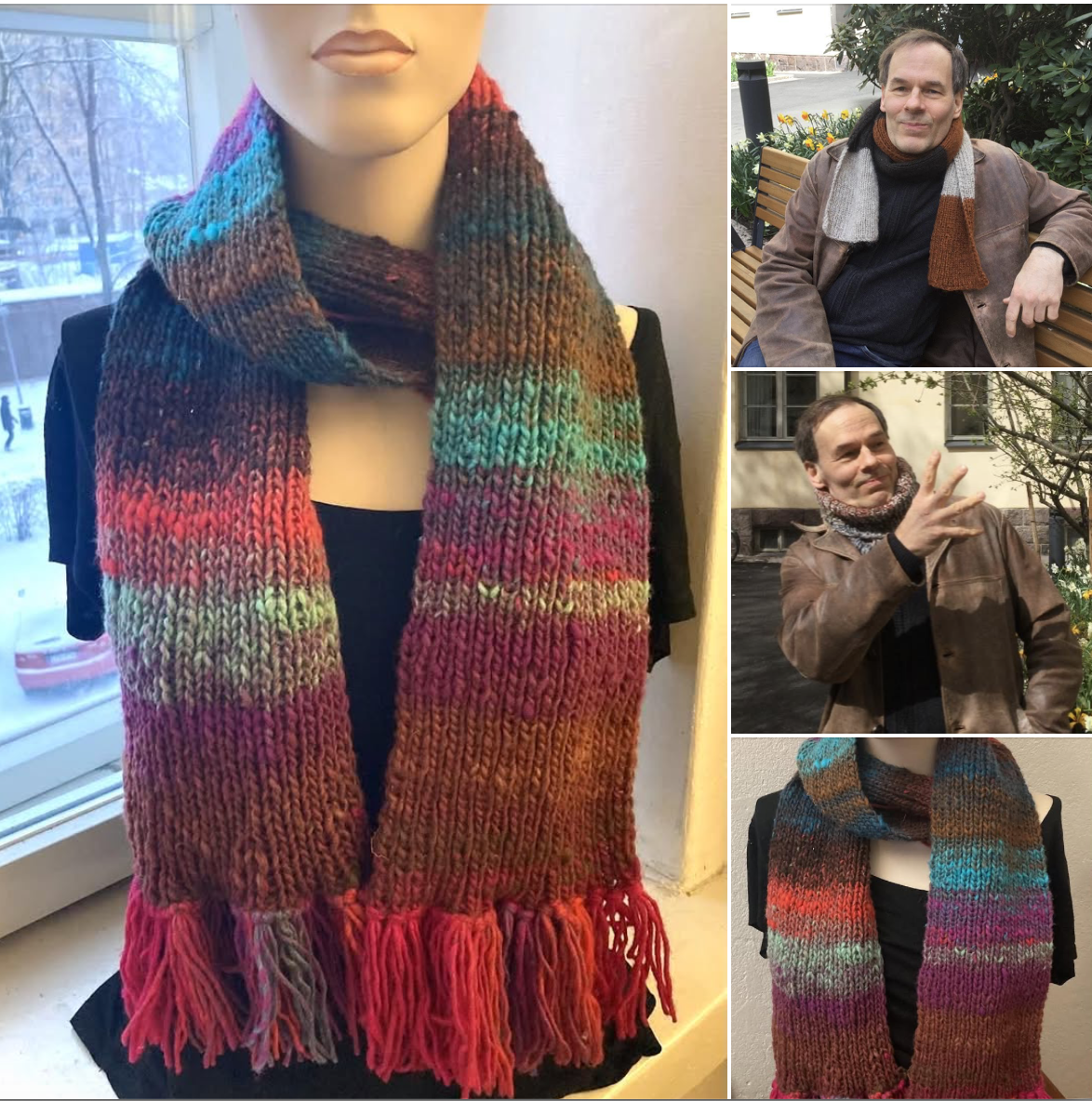

Artstar Accessories on social media: Facebook
Finnbrit 77/100
Two Years in Finland… Thirty-Two Years Later!
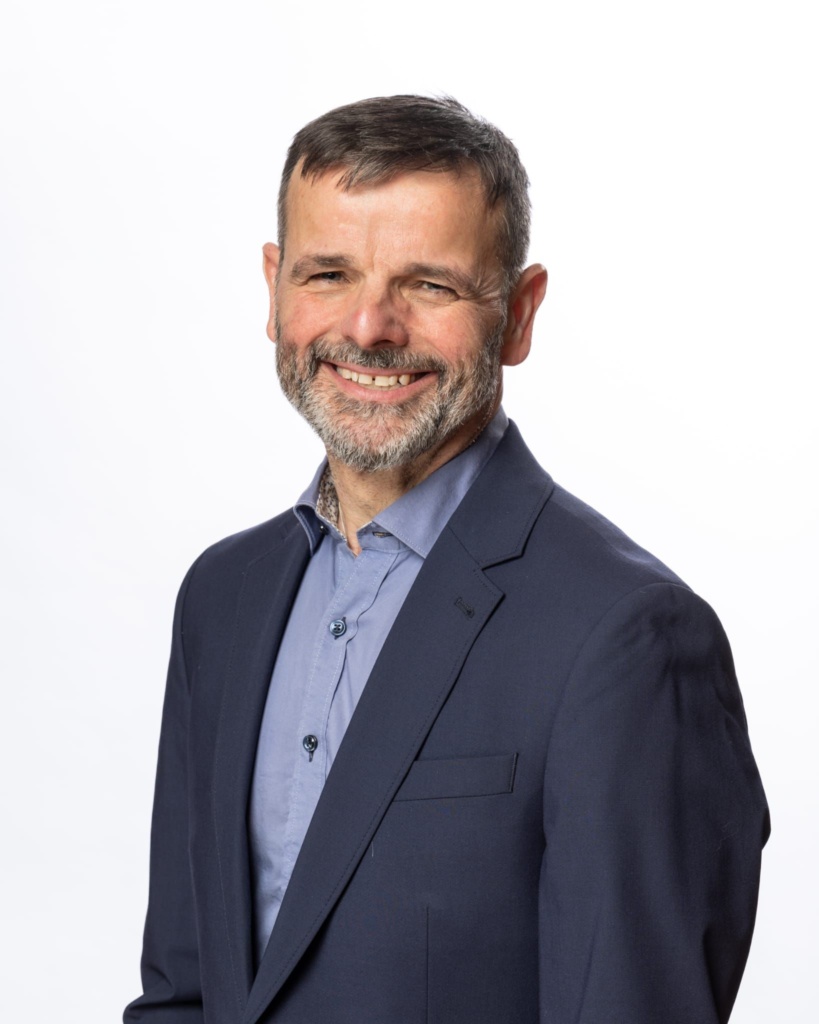
Alasdair Pollock
Memories of the Finnish-British Society, 1994–2026, and a Personal Tribute to Marja Salo
When I arrived in Jakobstad/Pietarsaari on 1 September 1994, my intention was to spend two years in Finland before moving on to what I then regarded as my promised land: Sweden.
Thirty-two years later, I am still here!
As the Finnish-British Society celebrates its centenary in 2026, I find myself reflecting on the circumstances that first brought me to Finland, the people who helped me along the way, and particularly the role played by one remarkable lady: Marja Salo. Without her, I might never have come to Finland at all.
It All Began in Gdańsk
During the academic year 1993–94, I was working as an English teacher in Gdańsk, Poland. One day, during the spring term, I came across an advertisement seeking teachers of English for various locations in Finland.
The Nordic countries had fascinated me for many years. I had always been intrigued by their cultures and the seemingly effortless way in which so many Scandinavians spoke English. Indeed, I can trace something of this fascination back to 1974, when ABBA won the Eurovision Song Contest for Sweden!
Interestingly, I had seen a similar advertisement two years earlier, while teaching English in Milan in 1992. At that stage, however, I hadn’t quite felt confident enough to apply. This time was different. The advertisement seemed almost to jump off the page at me. I wasted no time in sending off the relevant documents to the Finnish-British Society.
An Interview in London
I was subsequently invited by the Society’s recruiting officer, Marja Salo, to attend an interview at the Finnish Embassy in London. As luck would have it, the interview coincided with the Easter holidays.
I remember being warmly received by Marja, who escorted me into an interview room. She asked various questions about my teaching experience and my knowledge of Finland. The conversation was cordial and friendly throughout.
As the interview drew to a close, she asked whether I had any questions. I certainly did!
“If I am offered a post, could I be located in Helsinki?” I asked.
You see, I knew that Swedish was also spoken in Finland, particularly in certain coastal areas, and I was keen to improve my knowledge of the language. My grand plan was to spend two years in Finland before moving on to Sweden!
“I’d like to be in a place where they also speak Swedish,” I explained.
Marja replied, “Well, I’m afraid I’ll have to disappoint you — no one speaks Swedish in Helsinki.” I was crestfallen. Inwardly, at least! Then, almost without hesitation, she continued:
“May I recommend Pietarsaari?”
My heart soared! I had never heard of the town, but somehow that didn’t seem to matter. Marja explained that Pietarsaari was a bilingual town on Finland’s west coast, where both Finnish and Swedish were spoken. Indeed, the town was also known by its Swedish name, Jakobstad, and Swedish was very much part of everyday life there.
This was exactly what I had been hoping for! She then showed me photographs of the town and its surroundings: woodland, lakes, a rocky coastline and seemingly water everywhere.
“This is just like Scotland!” I thought. Well, Scotland without the mountains! The scenery reminded me of family Easter holidays spent in the Scottish Highlands with our paternal grandparents, a much-loved tradition from 1970 until 1991.
And so, my thoughts began to race ahead. Here was a town where I could live and work in Finland while improving my Swedish—the perfect stepping stone towards my eventual goal of moving to Sweden!
Or so I thought…
Little did I know how profoundly Marja’s recommendation would shape the course of my life.
An Offer Too Good to Refuse
Following the Easter holidays, I returned to Gdańsk to resume my teaching duties. Not long afterwards, I received a telephone call informing me that the teaching position in Jakobstad/ Pietarsaari was mine if I wanted it.
I was elated!
I had originally intended to remain in Gdańsk for a second academic year, but this opportunity was simply too wonderful to pass up. I completed the academic year in Poland and then embarked on a rather extraordinary summer of travelling.
In July 1994, I visited Australia and New Zealand. In August, I was in New York — literally the week before flying to Finland!
After all that globetrotting, my next destination was a small coastal town in western Finland which, only a few months earlier, I had never even heard of.
My First Finnish Adventure—The Shuttle Bus!
I flew from Manchester to Helsinki and then took a connecting flight to Kronoby, the airport serving Jakobstad/Pietarsaari and Kokkola/Karleby. Even before boarding the domestic flight, I found myself somewhat bewildered by the various place names associated with the destination.
Were we flying to Jakobstad? Pietarsaari? Kokkola? Karleby? Kronoby?
I remember asking a flight attendant for clarification and discovering that the different Finnish and Swedish names referred to the towns served by the same airport. My first practical introduction to bilingual Finland!
On arrival at Kronoby, nobody was there to meet me, but I had received instructions by telephone from the Chairman of the English Club in Jakobstad about how to reach the town. Unfortunately, despite the airport being rather small and decidedly local in character, I somehow managed to miss the shuttle bus! I approached the information desk and enquired about taking a taxi.
“Oh, there’s a shuttle bus,” I was informed.
“But it’s already left.” Oh well, I thought. A taxi it would have to be. But before I had even finished thinking this, the member of staff continued:
“Never mind. We’ll ask the bus driver to come back!” I could hardly believe my ears!
Feeling thoroughly embarrassed, I made my way outside to where the bus had returned. I apologised profusely to the driver, who seemed perfectly happy to load my luggage into the boot.
But I still had another ordeal to face: the other passengers!
I braced myself before stepping aboard, imagining their irritation or bewilderment at having been delayed on account of one rather hapless Englishman. Determined to attract as little attention as possible, I made my way to the empty seats at the very back of the bus.
As we set off on our second journey from the airport, I began to relax and admire the peaceful rural landscape. Everything seemed to be sweetness and light. Then somebody near the front appeared to say something to the driver, who responded by gesturing towards the back of the bus.
Towards me!
Suddenly, or so it seemed, all eyes were upon me, if only momentarily. So much for keeping a low profile!
“Oh well,” I thought. “Nothing to lose now!”
Perhaps this was the moment to put my extremely limited Swedish into practice, courtesy of a little language book entitled Swedish in Three Months. I turned to a lady sitting in the row immediately in front of me and tentatively struck up a conversation. I explained where I came from, that this was my first visit to Finland, and how lovely I thought the country was.
To my delight, she understood me!
Indeed, I gained the impression that she was a native Swedish speaker. She was wonderfully patient and accommodating, and I resolved to keep the conversation going for as long as possible.
By the time we reached my destination, a local hotel and nightclub in Jakobstad—now an insurance company office—my spirits had risen considerably. I am sure I thanked her for her conversation and company. She had done me an enormous favour.
And there is a rather extraordinary postscript to this little episode.
Over the years, our paths have crossed from time to time. During my first year in Jakobstad, I even taught English to her husband in a group course at a local company! And now, in October 2026, as I was recalling this very bus journey and putting these memories together, a Facebook friend request suddenly appeared on my screen.
From none other than that very lady! Thirty-two years later. What extraordinary timing!
Marja Salo—The Person Who Made It Possible
But I must return to Marja Salo, whose contribution to my arrival in Finland deserves particular recognition.
Marja was the recruiting officer for the Finnish-British Society, based in Helsinki, and it was she who had recommended bilingual Pietarsaari/Jakobstad during our interview in London.
Following that interview, she contacted the English Club of Jakobstad/Pietarsaari to inform them that she had found an ideal candidate for their position of English Teacher and Social Secretary for the forthcoming academic year.
That candidate, of course, was me!
Marja’s work went well beyond recruiting teachers. She also played an important role in bringing together teachers from the various English Clubs and Societies across Finland.
I would have the pleasure of meeting her again the following month.
The Finnbrit Autumn Seminar—Jyväskylä, October 1994
In October 1994, I attended my first Finnish-British Society autumn seminar, held in Jyväskylä.
At that time, there were twelve affiliated English clubs and societies employing teachers in different parts of Finland. The seminar brought us together for a weekend of professional development, discussion and social contact.
If my memory serves me correctly, the event ran from Friday to Sunday. The programme included talks, lectures and discussions covering various aspects of language teaching. I recall five guest speakers, each bringing their own experience, background and perspective. For someone who had only recently arrived in Finland, it was an enriching and stimulating occasion.
The entire weekend had been coordinated by Marja Salo. I was delighted to see her again, although with so many participants in attendance, we had only a brief opportunity to talk.
I cannot resist mentioning a little incident from the following year’s seminar, which I believe took place in Tampere. By then, I had begun learning some Finnish alongside my Swedish, and I was determined to surprise Marja by putting my newly acquired Finnish into practice.
She seemed pleasantly surprised!
“No one speaks Finnish at the headquarters down in Helsinki!” I think she remarked.
Whether those were her exact words, I cannot be entirely certain, but I remember her reaction with considerable affection.
More Than Just Teaching English
My position in Jakobstad was not simply that of an English teacher. My official title was English Teacher and Social Secretary. The social side of the job was an important part of the work of the English Clubs and Societies.
As teachers, we were expected to help organise events promoting British culture and traditions within our local communities. During my first autumn in Jakobstad, I helped organise two particularly British occasions: Bonfire Night on 5 November and a traditional Carol Service in early December. These activities provided opportunities for people to experience something of British culture beyond the language classroom.
Looking back, I appreciate how the two aspects of our work complemented one another. Learning a language was not simply about grammar, vocabulary and pronunciation. It was also about discovering the customs, traditions and everyday life of another country.
And through these events, we were able to bring a little piece of Britain to Jakobstad.
Changing Times, Enduring Connections
Over the past thirty-two years, the role of the Finnish-British Society’s affiliated English clubs and societies has changed considerably.
When I arrived in Finland in 1994, English-language teaching was a central part of their activities. Today, with English so widely available through schools, international travel, television, digital media and everyday communication, the need for traditional language instruction through the clubs has diminished.
Many of the clubs and societies now function primarily as social and cultural meeting places, bringing together people who share an interest in Britain, its language, traditions and culture. In some respects, the emphasis has shifted from learning English to enjoying the connections that English makes possible.
Yet the underlying purpose remains familiar: encouraging friendship, cultural understanding and personal connections between Finland and Britain.
Thirty-Two Years Later
On 25 September 2026, I attended the annual Finnbrit seminar at the British Embassy in Helsinki.
As I reflect on that occasion, and on the Society’s centenary, my thoughts return to the autumn seminar in Jyväskylä in October 1994. It seems particularly fitting that I should be putting these recollections together in October 2026, almost exactly thirty-two years after that first gathering.
There was another important milestone along the way.
In 2017, the year in which Finland celebrated the centenary of its independence, I became a Finnish citizen, while also retaining my native British citizenship. The timing could hardly have been more appropriate!
What had begun in 1994 as a planned two-year adventure had, by then, become a permanent part of my life. Finland was no longer simply the country in which I happened to live and work. It was also my country.
And so, as I reflect on the Finnish-British Society’s centenary in 2026, I do so with a particular sense of belonging to both nations.
British by birth, Finnish by choice and grateful for the friendships and opportunities that have connected the two throughout my life.
Above all, my thoughts return to Marja Salo.
She was the person who first suggested Pietarsaari, who recommended me to the local English Club, and who helped bring together teachers from across Finland through the Society’s annual seminars.
When I walked into the Finnish Embassy in London during Easter 1994, I imagined that Finland would be a stepping stone towards a future life in Sweden. Instead, thanks in no small part to Marja, I discovered a town that would become my home. What was intended to be a two-year adventure has turned into thirty-two years — and counting!
As the Finnish-British Society celebrates its hundredth anniversary, I offer these memories with gratitude for the opportunities, friendships and experiences that began with that advertisement in Gdańsk all those years ago.
And, most especially, with warm appreciation for Marja Salo, whose recommendation changed the course of my life.
Happy Centenary, Finnbrit!
Alasdair Pollock
Jakobstad/Pietarsaari, October 2026
Finnbrit 78/100
A letter of congratulations from the British Council
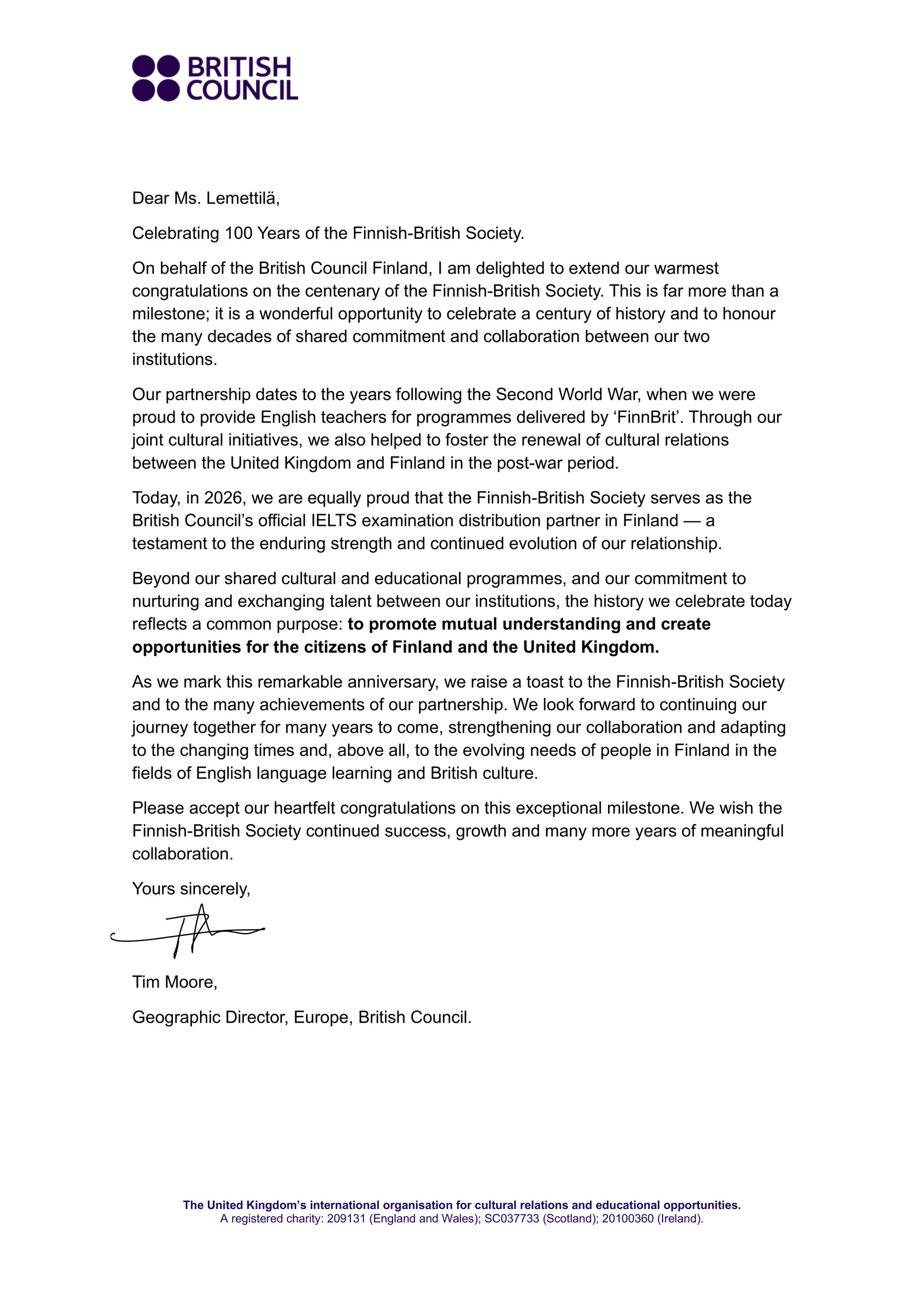
Finnbrit 79/100
Spoken Words: talk by author, translator Kasper Salonen
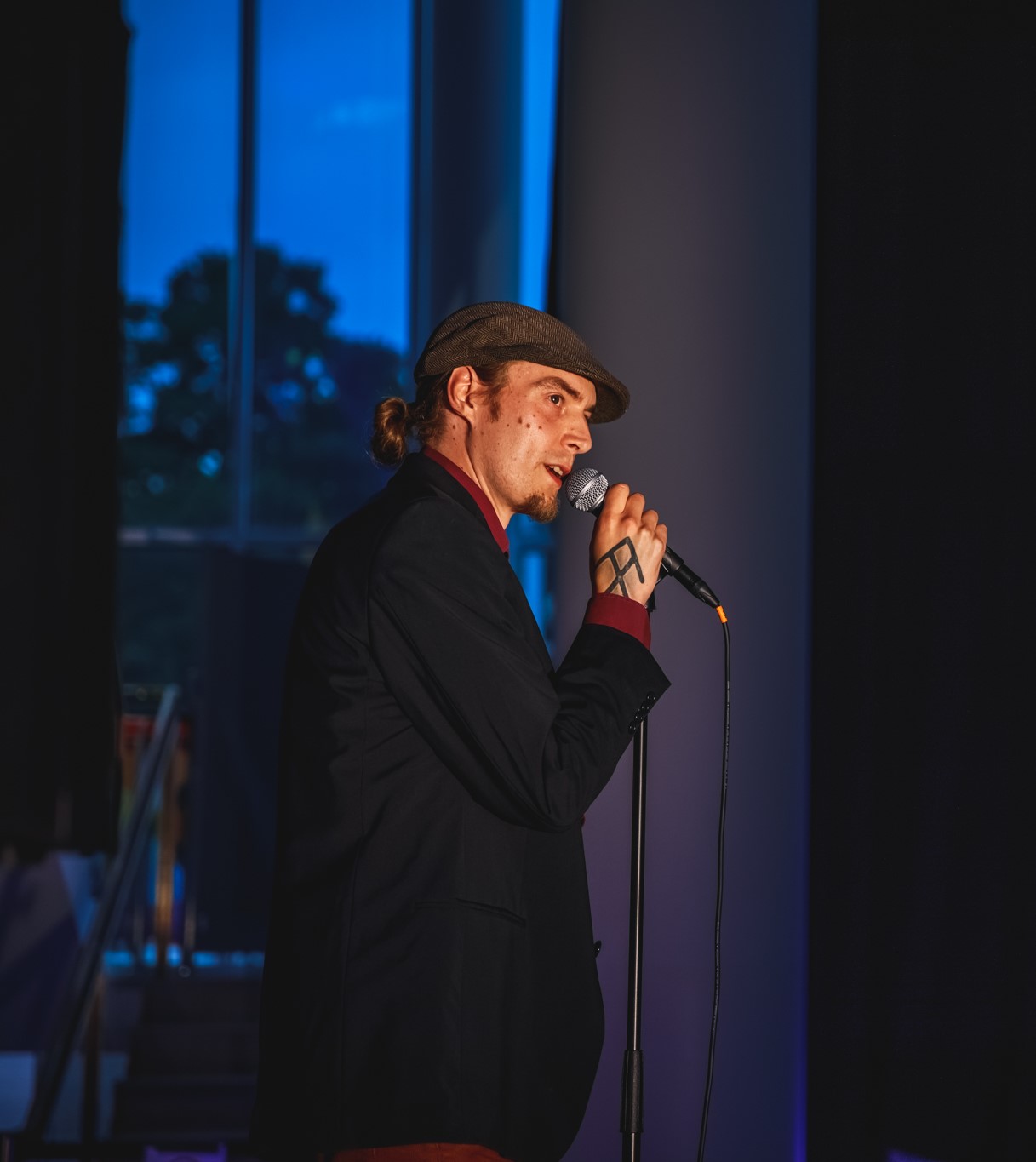
“Roots and early childhood in London, education and freelance career in Finland.” Finnbrit 80/100 celebrates a century of Finno-British relations with a very special guest and a friend of the Society:
Spoken Words: talk by author, translator Kasper Salonen
Friday, 13 November 2026
18:00-20:00
You are warmly invited to attend a talk given by Kasper Salonen. He is an author, translator, educator, poet, and cultural activist living in Espoo.
Over more than fifteen years, Kasper has been involved in diverse cultural and linguistic work that spans multiple industries. His talk will provide an overview into his roots and early childhood in London, his education and freelance career in Finland, and his catalogue of published books, articles, and other creative media.
Among Kasper’s most recent publications is a world-first in poetry translation. His talk will include an introduction to his book Unspoken Words: Selected Poems of Arto Melleri (Enostone, 2025) as well as a performance of his translations and original spoken word poetry.
Kasper believes in the sacredness of nature and consciousness, and in the power of art, language, and literature to both access the comprehension of human emotions and to overthrow systems of oppression, supremacy, and war.
Picture of Kasper by Kadi Raudvassar
Book your place here.
Finnbrit 80/100
Main picture: The Fourparty at the Finnbrit Folk Club taken by Esko Rahikainen,1965.