

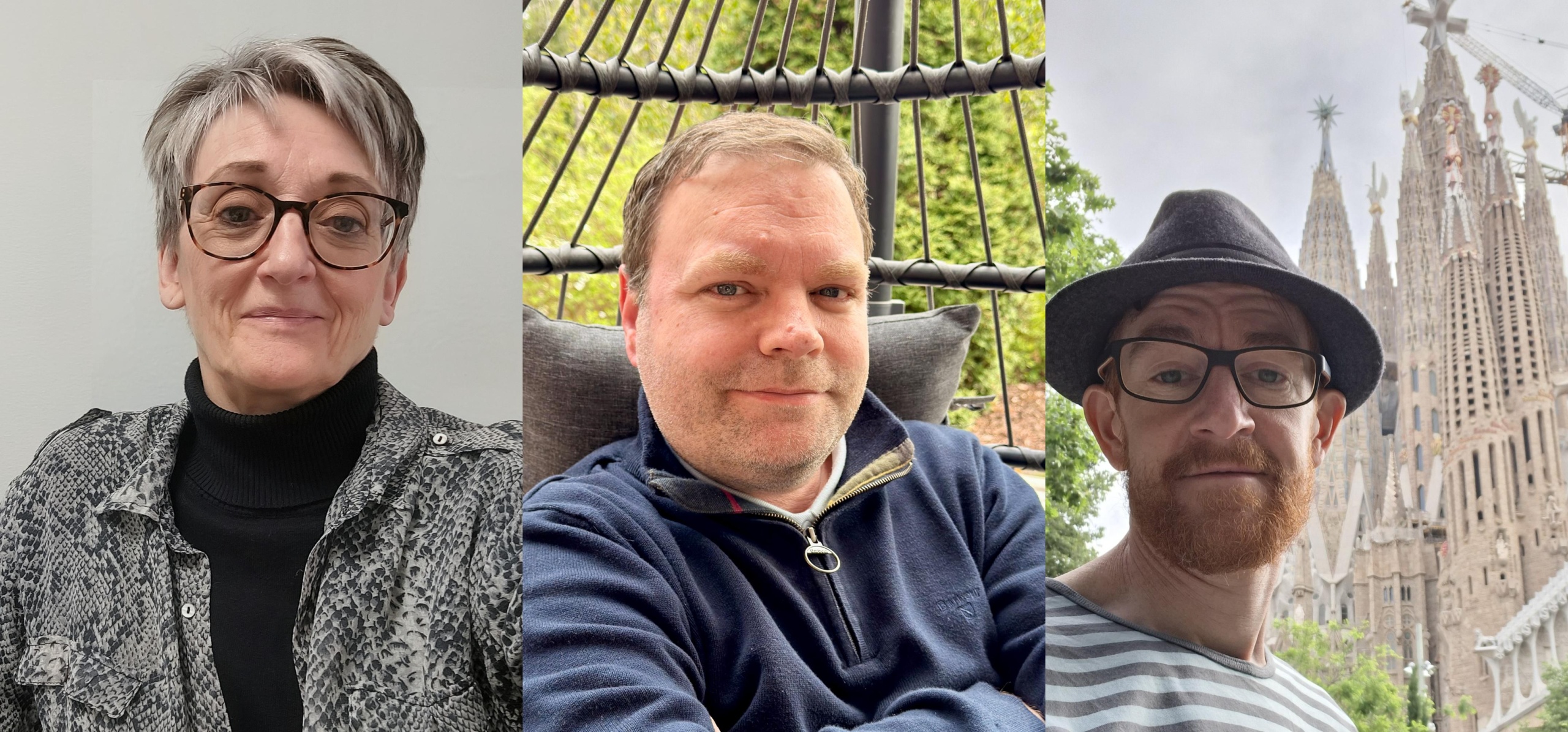
Pictured (left to right): Penelope Roux, Christian Evans & Henry Loveless
We’re a small community at Finnbrit, but good things come in small packages.
Among our number are some truly remarkable people, with amazing knowledge and experience and our teachers are no exception.
We must be doing something right because there are currently at least ten English coursebooks written by Finnbrit teachers available in bookshops, and at least three more on the way.
We asked three of our teacher-authors about the secrets to writing a good English book for adults.
Henry Loveless: English teacher, copywriter, gardener, orienteer, father of two. From Bristol, UK, now living in Helsinki, Finland. Co-author of the Come Along series.
Christian Evans: English teacher for 30-odd years, football dad, Westie servant, half Welsh – half Finnish. Living in Kirkkonummi, Finland. Co-author of Around the World -Matkailuenglantia (Travel English)
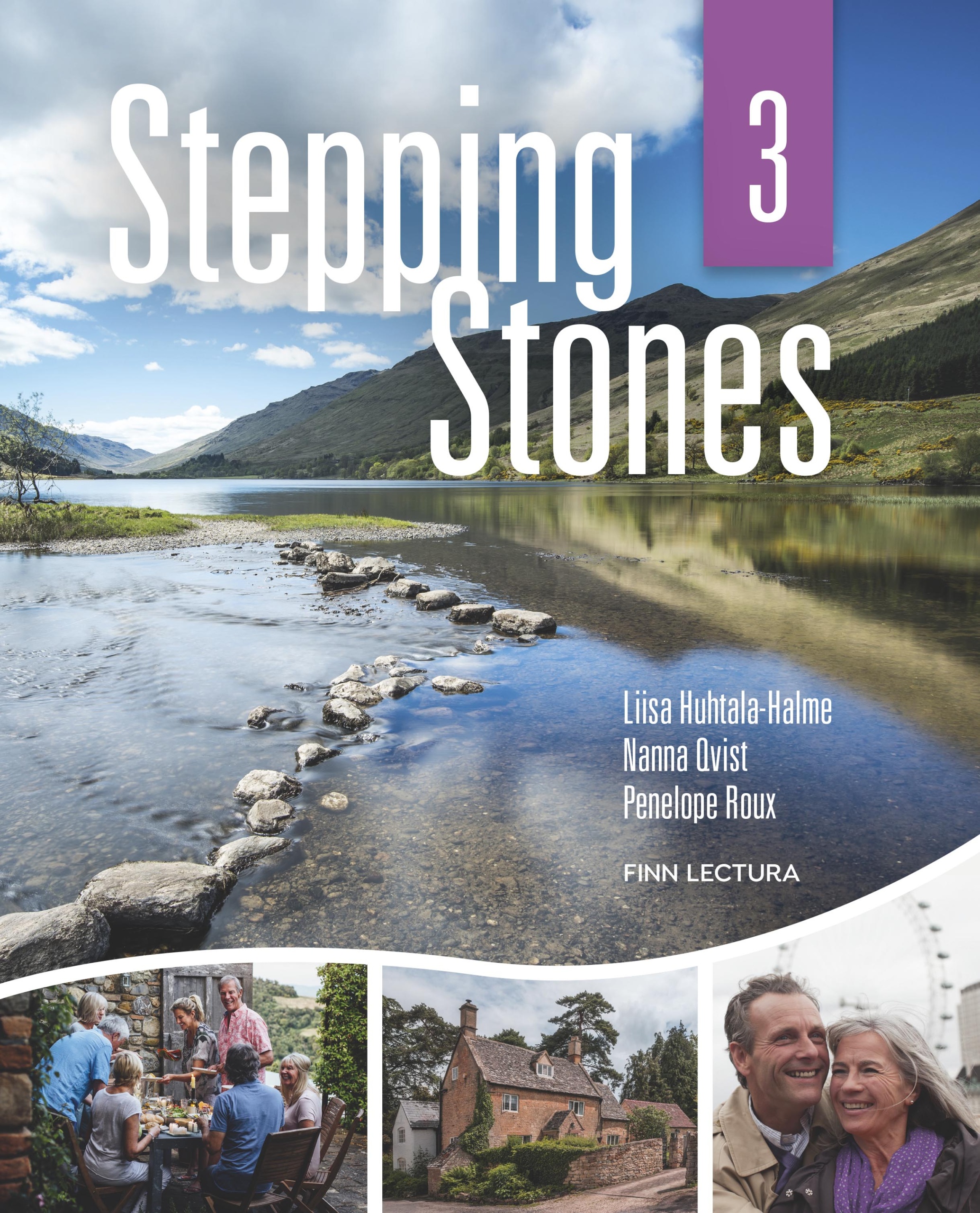
Penelope Roux: Semi-retired after more than 20 years working in education and 20 years in business and finance. Beekeeper, gardener and active Finnbriter living in Espoo and Raasepori. Co-author of Stepping Stones and Voices and Echoes.
How do you start writing an English textbook?
HENRY
Otava / Finn Lectura came to us individually with the idea. They had a clear idea about the market that needed a textbook. Then as a writing group, we started to plan the structure, the content (topics, grammar, vocabulary, etc.) and we talked about the things we would like to do. Once we had a plan we started to divide the work. Like any new job, there were so many pieces to organise at the beginning, and it was very confusing, but soon it all made sense. By the time we had written the first half of the book, we had a pretty good working system, we also had thought of a name: Come Along.
PENNY
I could write a whole book about how to write a textbook! First, you need to build your writing team: ideally authors who share your vision, to avoid wasting too much time arguing over the process or content. There is a lot of preparation to do before the writing starts. For example, I think it’s helpful to agree on a framework (such as ‘can-do’ statements from the European Common Framework of Reference -ECFR) and the profile of the learners who will be using the book, so the writing team has a coherent approach to producing materials that are appropriate, relevant, and also sufficiently supportive and challenging.
Personally, I prefer to work in a team, meeting regularly to review each other’s work, next steps and new ideas. This may slow down the process but, in my opinion, collaboration reaps huge rewards for the writers, the teachers and the learners alike.
CHRIS
For a book I co-authored with Anni Holopainen and Mari Laakso-Suutari, Around the World -Matkailuenglantia (Travel English), I was fortunate to be contacted by the publisher Otava/Finn Lectura, who offered me the project. Having written a book with the same publisher earlier, I like to think ‘I was in their good books’. The process involved many tasks, including meetings, planning, research, and the most demanding part: editing, editing, and editing.

What makes an English textbook good for Finnish people?
CHRIS
I think a good textbook should be fun and practical. For Finnish learners I think it’s also good to have vocabulary lists both in Finnish and the target language. If you are looking for a good textbook, you could ask a language teacher, browse the library, or check out a publisher’s website. For instance, Finn Lectura has so many great language textbooks and helpful information.
HENRY
Every learner is unique, but there are often issues that learners from the same country share. All of the authors in our group had extensive experience with Finnish learners. Between myself, Anja Odell, Susanna Ylihärsilä and Elina Vienamo, we had been teaching English to adults for almost 100 years! We knew what worked, what didn’t, and what was useful or interesting, etc.
It’s also important to have a local publisher that has a long history of preparing textbooks for language learners in Finland.
PENNY
When Liisa Huhtala-Halme, Nanna Qvist and I wrote Stepping Stones, published by Finn Lectura (now part of Otava), we were very aware that the book needed to work for the multicultural classroom. However, we did focus on grammar that is challenging for native Finnish speakers such as the use of prepositions, the syntax of passive sentences, future structures and pronunciation.
More importantly, the materials need to motivate learners to produce language spontaneously, so it is really important to include lots of group activities that support this and help the students become more confident.
What should we look for in a book for adult learners?
PENNY
Adult learners are a diverse group: they can be anywhere between 20 and 80 years old! They also have different professional backgrounds and a huge range of goals and aspirations. Some will be learning English to boost their careers, others for taking holidays abroad, and many study for the benefits that language learning can bring to cognitive function —yes, it really can slow down ageing in the brain!
Additionally, I think a coursebook for adults should not shy away from difficult topics such as discussions on politics, social issues, money or religion. Many international publishers actively avoid these sensitive topics in order to make their books accessible to a global market.
HENRY
Adults are motivated in different ways. They have no obligation to learn, like at school. This means it’s very important for the book to be interesting and relevant. If not, students can get bored and give up.
CHRIS
For adult learners, it’s especially important to have content that is relevant and practical, focusing on things they can use. For example, travel English is a practical topic, and learners can use what they study in real-life situations.

What makes an English textbook good for beginners?
CHRIS
For beginners, it’s important that a textbook gives enough content to help progress, but not so much that it feels overwhelming. Striking this balance keeps learners motivated. It’s also good to have plenty of exercises that reinforce learning through repetition.
HENRY
Personally, I think it’s important to build up. Don’t presume that the learner knows something or remembers something. Start at the beginning and take clear steps towards the objective.
PENNY
From my own experience as a beginner learning Finnish and Swedish, the best classes were where the teacher did not use a book all the time. A good textbook can incorporate many group activities, but a good teacher will know when it’s time to put the textbook down and just play a game, sing along to some music, or let the group take over the direction of a lesson.
I have noticed that a lot of textbooks for beginners don’t provide enough quality audio materials, or the students are unable to access them outside the classroom. We were very lucky that the Stepping Stones publishers gave us the opportunity to record dozens of audio tracks using a range of voice actors with different accents.
What was the most surprising thing about writing a book for English learners?
PENNY
When I started working with Rebecca von Bonsdorff on Voices and Echoes (Schildts and Söderströms), we faced the steep learning curve of creating materials that would work on a digital platform.
Overall, what probably surprised me most about writing EFL materials was how much I enjoyed the whole collaboration process whether it was finding ideas, writing dialogues, recording the audio tracks, assisting with the layouts and design or just proofreading and editing the final drafts.
HENRY
The amount of content that goes into a book is impressive: texts, exercises, vocabulary lists, pronunciation guides, listening activities, and more. A textbook is packed like a packet of coffee.
I also learned a lot from the team about Finnish learners, the things they struggle with and the activities they like and don’t like. I also learned about teachers’ preferences for different types of learning material.
CHRIS
For a book I wrote called ‘101 English Mistakes Finns Do – A Dictionary of Mistakes’, I was surprised by the number of comments I received about the title. The deliberate mistake in the title ‘do mistakes’ was meant to be witty. However, my credibility was questioned because people thought I really had made a mistake!
We all need a little help with our English sometimes. At Finnbrit, our experts will make you feel confident when speaking and participating. Call or email today. We speak English and Finnish, and we’re always happy to hear from you.
About the Author
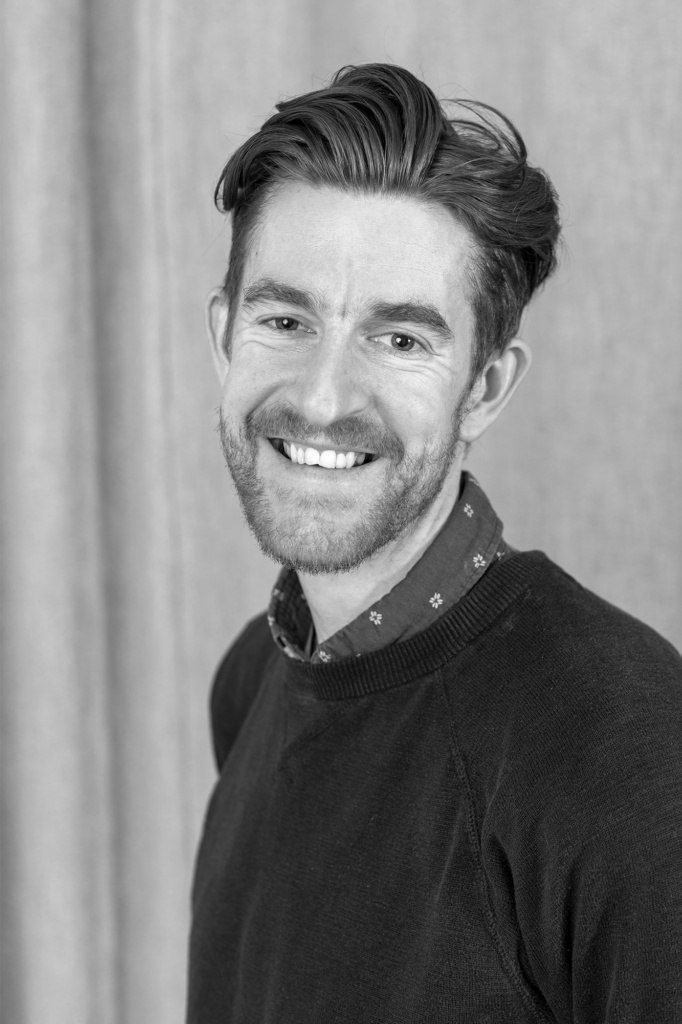
Henry Loveless is a copywriter, teacher and examiner based in Helsinki, Finland. He has been part of the Finnbrit team since 2015. He has worked for many notable clients including Otava, The Finnish Defence Forces and Lindström. He is currently writing the second in a series of textbooks for English learners, Come Along. The first was published in 2025. He is an active runner, orienteer and the organiser of the Finnbrit Gardners’ Meet.